Mahli Beardman: Australia’s Next Fast Bowling Sensation
Australia has always had a soft spot for fast bowlers who look like they’re bowling on instinct and adrenaline. Shaun Tait. Then Lance Morris. Now, the next name being whispered around dressing rooms and selection meetings is Mahli Beardman — and the “wild thing” tag might be on the move again.
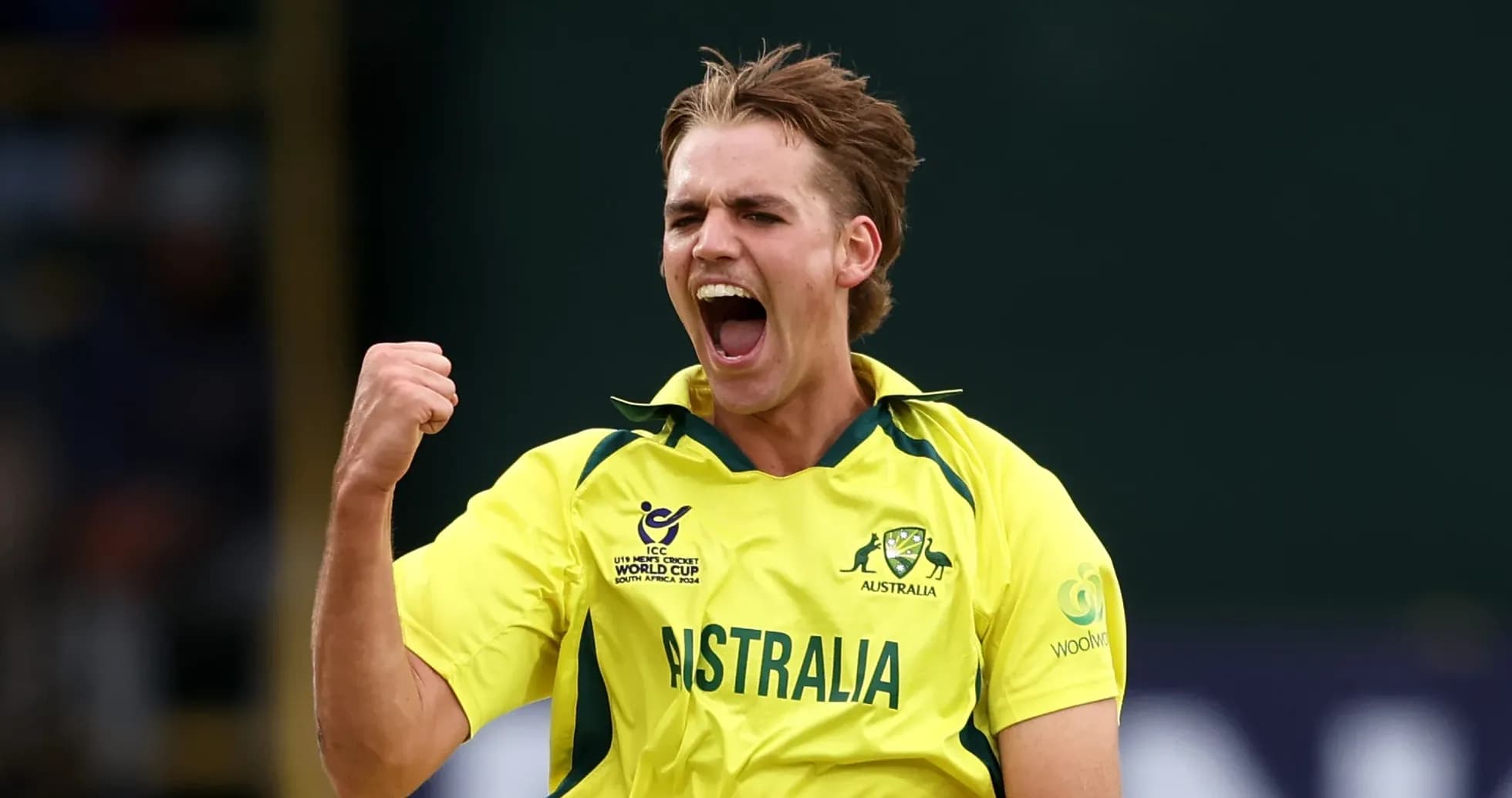
On Friday in Perth, the 21-year-old could walk out at Optus Stadium and bowl his first ODI over for Australia, on his home deck, in front of a crowd that already knows what’s coming: pace, hostility, and a bit of theatre.
He fits the type.
Beardman is quick, genuinely quick, the sort of quick that makes batters hop and shuffle and second-guess their footwork. He loves it. He hunts that reaction. And yet, once he walks off the field, he could almost be from another time.
He’s a throwback: spear fishing, surfing, camping, disappearing off the grid whenever cricket allows. Raised around Margaret River, time in the Pilbara, happiest on a boat or in a wetsuit, nowhere near a city skyline.
“He’s a bubbly character. He’s a free spirit,” West Australian bowling coach Tim MacDonald told foxsports.com.au. “He’s up-and-about all the time. He lifts the group when he’s there… He loves nature. He loves the water. He loves his spear fishing. He’s diving, he’s fishing, he’s surfing. He loves country, loves the land and any chance he gets, he’s either out on a boat, in a wetsuit diving and surfing or he’s out camping. We don’t see a lot of the younger kids these days doing that.”
On the field, he’s different again.
Built for Pace, Managed for the Long Haul
Beardman has been on the radar for years. He was part of Australia’s Under 19 World Cup triumph in 2024, has already debuted in T20 internationals in Pakistan, and owns a Big Bash title with the Perth Scorchers. For a player yet to bowl a ball in the Sheffield Shield, his résumé is oddly top-heavy.
That’s no accident. It’s strategy.
As Pat Cummins, Mitchell Starc, Josh Hazlewood and Scott Boland edge towards the twilight of their careers, Beardman has been carefully ushered into the fringes of the national set-up.
“They’ve had eyes on Mahli for a while, knowing that he’s probably going to be a pretty good prospect,” MacDonald said. “He’s been running the drinks and been in-and-around training, chewing the fat with Pat Cummins, Mitchell Starc and Josh Hazlewood. It’s been a key feature of the last couple of years. Those guys are pretty keen to pass on their knowledge to the next generation coming through.”
He has sought out that knowledge with intent.
Like Cummins before him, Beardman has tapped into the wisdom of Dennis Lillee. Mitchell Johnson wrote recently that Beardman contacted him to organise a coffee and talk fast bowling. Adam Gilchrist has also spent time with him.
“I’ve had a few chats with him,” Gilchrist told foxsports.com.au. “He’s an impressive young fella. A lovely young man.”
Behind the scenes, the conversations have been dominated by one topic: his body. How to keep it on the park. How to bowl fast without breaking.
Cummins is the template. Bursting onto the Test scene as a teenager in Johannesburg, then disappearing from the longest format for six years as his body caught up with his talent. Those years of white-ball cricket, limited overs, carefully managed loads — they’re now being echoed in Beardman’s path.
He’s not alone in the treatment room either. Lance Morris and fellow Under 19 quick Callum Vidler have also spent long stretches sidelined with stress-related issues. MacDonald calls the spate of back problems among young quicks “probably close to an epidemic with that age group at the moment.”
So Beardman is being handled with extreme care.
“Mahli, from the age of 14 was bowling fast and was very wiry,” MacDonald explained. “Bone mineral density and general strength in the areas that he needed to be strong in wasn’t quite up to where his bowling skill was up to. Every time he went out and played, or trained, he was trying to bowl 140 plus K’s an hour with a frame and a body that just wasn’t ready for that. And to a certain extent, an action that probably made it even more high risk.”
The result? Lumbar stress injuries. Back issues. Pelvis and groin problems. A body trying to cope with a speed it wasn’t yet built to handle.
“He’s had a big 12 months to try rectify that. He’s not the finished product, in any regard, but he’s in a much better place to handle the demands of professional cricket.”
Rewiring the Action, Keeping the DNA
Watch Cummins’ early footage and you see a whirlwind of limbs. Compare that to the tighter, more economical action that carried him to the captaincy and a place among Australia’s greats. Beardman is now walking that same path.
He’s in the middle of a remodel. Subtle, not radical. Enough to reduce risk, not blunt his edge.
“He’s pretty good all the way up to bowling mid-130s,” MacDonald said of Beardman’s new action. “Then when he wants to push the envelope and really find that extra speed, where he has to cross over a bit more and rotate a bit more. He’s very aware of that and he’s working really hard on that without losing the DNA he’s got.”
That “DNA” — the raw pace, the willingness to bend his back, the love of the contest — is why good judges in Australian cricket believe it will not take many Shield appearances before Beardman is seriously considered for a baggy green.
But first, he has to get through this white-ball block.
Last summer he put together an impressive Big Bash campaign, playing 10 or 11 games in a condensed schedule for the Scorchers. Short spells, but frequent, with heavy travel layered on top.
“He had a massive Big Bash campaign… it’s a really condensed format,” MacDonald said. “He’s not bowling a lot of balls, but he’s bowling them often. He then went away to Pakistan, played one game and his back got injured.”
The timing stung.
“I feel like I was feeling quite nice at the back of the Big Bash,” Beardman told reporters in Perth last week. “It was just one of those things. I think it's understanding my body as I'm growing and developing. It was extremely frustrating, but I'm super fortunate to be able to come back. Spent a good four or five months in the gym and built my body up.”
For now, every outing is a checkpoint. No grand Shield debut date circled in red. No promises.
“It's a tough one to plan [Shield cricket]. It's just a game-by-game thing at the moment,” he said. “It's just to prove after each game that I'm getting through okay, that I'm not reporting any symptoms or soreness.”
MacDonald likened sending him into the Australian camp this week to “sending your kids off to school”. If all goes well, there will be a lot more of that.
“He’s definitely going to be a weapon in red ball cricket, Shield cricket, Test cricket, going forward,” MacDonald said. “It’s just as a 21-year-old guy how do we get that safely?”
Test Talk and Selectors’ Vision
Inside the Australian set-up, ODI cricket has long doubled as a proving ground for future Test players. The selectors have used the format to blood quicks, test their temperament, and see who can handle the stage. Beardman fits that mould perfectly.
Ashton Agar, his West Australian teammate, is convinced the ceiling is high. “I think as his body gets even stronger, his pace can probably still go up, which is exciting for someone that can bowl in the 140s already,” Agar told foxsports.com.au. “I just hope his body stays strong and he can string plenty of games together because he's a great asset for Australian cricket in the future. Yeah, definitely (a Test prospect)… I think because he's got control. That's the one thing you really need in Test cricket: good pace, great control, so he'll be able to execute for a long time exactly what the captain needs and wants. And he moves the ball. They're really good attributes. I'd love to see him have a Test future for Australia.”
Gilchrist sees the same thing. “It’s velocity. Pace on the ball, which makes him so exciting,” he said.
Mark Waugh likes what he’s seen as well. “He’s quick. He’s 140-145 and that’s getting up there. You’ll threaten a few good players at that pace,” Waugh told foxsports.com.au. “You need things other than pace, obviously. You’ve got to have accuracy, game smarts. But if you’ve got pace, you’ll trouble good batsmen. If he can combine his pace with those things, he could be anything.”
Even England have taken note. “He bowls fast, raw,” England coach Brendon McCullum said when asked about Beardman earlier this month. “Probably similar to some of our guys actually - you've got to keep trying to bring that next wave of fast bowlers through. Australia have gone down that route. There's something always exciting about fast, raw pace.”
Home Cauldron, Rising Noise
Optus Stadium is no mystery to Beardman. He’s felt the bounce, heard the roar, worn the Scorchers orange under the lights. If he gets his ODI cap there, in front of family, friends and the fans who have already watched him crank it up in the Big Bash, the atmosphere will only sharpen his edge.
A fast bowler charging in, the ball fizzing through, the crowd collectively turning to the big screen to check the speed gun — that’s the spectacle. That’s the lure.
And Beardman, for all his time spent in the ocean and out bush, thrives on that stage.
“It tends to lift him. It’s a special trait to have,” MacDonald said of Beardman in front of big crowds. “Cooper Connolly, Mahli Beardman, these guys that are young and coming through, and they just thrive on atmosphere, big crowds and big moments.”
Australia has seen this story before: a raw, fast, slightly untamed quick, carefully managed, gradually refined, pointed towards Test cricket. The difference now is the urgency. Cummins, Starc, Hazlewood, Boland — the great quartet is closer to the end than the beginning.
Beardman doesn’t need to replace them yet. He just needs to show, ball in hand at Optus, that the future of Australian fast bowling still comes with a snarl, a blur, and a number on the speed gun that makes everyone sit up a little straighter.
As MacDonald put it, “There’s a pretty exciting couple of years ahead for Mahli.” The real question is how quickly those years turn into a career that defines Australia’s next era of pace.