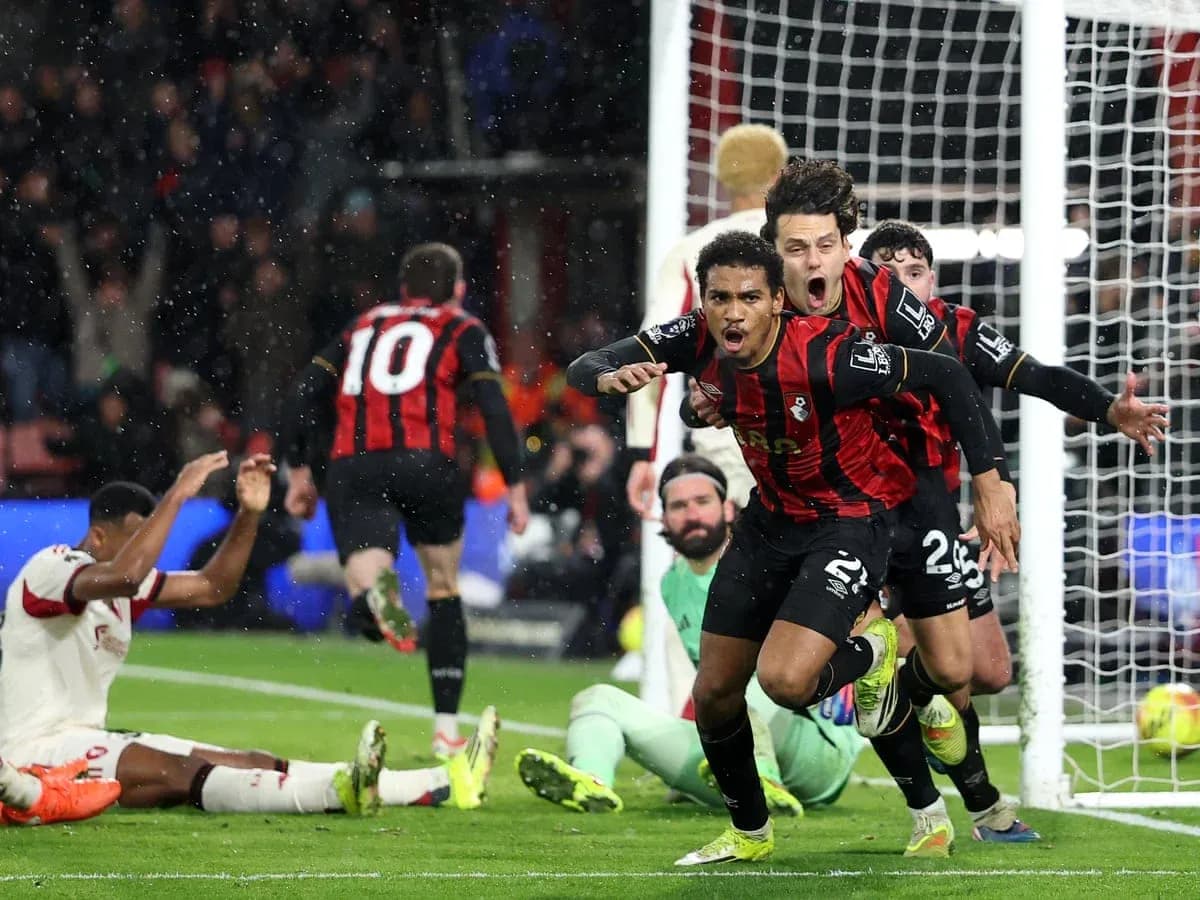
Manchester City vs Aston Villa: Tactical Breakdown of the 4-2-2-2 and 4-2-3-1
Manchester City’s 4-2-2-2 against Aston Villa’s 4-2-3-1 produced a game defined less by volume of possession and more by what each side did in transition and around the box. At the Etihad Stadium, City controlled marginally more of the ball (52% to 48%) and generated more total shots (16 to 12), but Villa’s structure and vertical threat turned a relatively even territorial battle into a 1-2 away win.
City’s shape on paper was aggressive: a back four of R. Lewis, J. Stones, R. Dias and N. Ake behind a double pivot of Nico and B. Silva, with A. Semenyo and Savinho as the advanced midfield line and P. Foden plus T. Reijnders as a front two. In practice, City created a wide 3-2 base in build-up, with Lewis stepping inside and Ake often tucking in, aiming to overload Villa’s first line. They converted that control into 458 passes (405 accurate, 88%), but the tempo was more probing than penetrative, reflected in 10 shots inside the box but only 3 on target.
A. Semenyo’s Goal
A. Semenyo’s 23rd-minute goal encapsulated City’s best phase. With Villa’s double pivot of Douglas Luiz and L. Bogarde pinned, City found Semenyo between the lines from the left half-space. The 4-2-2-2 allowed him to arrive as a third runner beyond Foden and Reijnders, and Villa’s back four—A. Garcia, V. Lindelof, T. Mings, I. Maatsen—were slow to track the extra body. That sequence underlined how City’s box-midfield could overload Villa’s central block when circulation was quick and vertical.
However, after half-time Unai Emery’s adjustments flipped the dynamic. The introduction of M. Cash (IN) for A. Garcia (OUT) at 46' immediately gave Villa more thrust down the right and a more natural outlet in transition. Within a minute, O. Watkins struck at 47', capitalising on City’s rest-defence. With both full-backs high and the pivots stretched, Villa’s 4-2-3-1 morphed into a 4-2-4 on the break, with L. Bailey and E. Buendia narrowing inside to support Watkins. City’s centre-backs were exposed to direct runs, and the equaliser reflected Villa’s willingness to attack quickly rather than recycle.
Pep Guardiola’s Response
Pep Guardiola’s response on 58' and 59' was telling. R. Cherki (IN) came on for A. Semenyo (OUT) and M. Kovacic (IN) for B. Silva (OUT), effectively refreshing the advanced midfield and one pivot. Cherki offered more ball-to-feet creativity than Semenyo’s vertical running, while Kovacic is a more progressive carrier than Silva in deeper zones. The intent was to regain central dominance and unlock Villa’s now-deepening block, but it also slightly reduced City’s counter-pressing intensity, which Villa exploited.
Decisive Phase
The decisive phase arrived around the hour. At 61', Watkins scored again, this time assisted by R. Barkley, who had been influential as the central “10” in Villa’s 4-2-3-1. The move illustrated Villa’s attacking pattern: Douglas Luiz and Bogarde forming a stable double pivot, Bailey and Buendia tucking in to create central overloads, and Barkley arriving late between City’s lines. Watkins’ movement across the front of Dias and Stones repeatedly unsettled City’s back line. VAR at 63' confirmed the goal rather than interrupting Villa’s momentum, cementing the 1-2 scoreline.
From there, Emery shifted fully into game-management mode. On 73', a triple substitution reshaped Villa’s spine: Y. Tielemans (IN) for Douglas Luiz (OUT), P. Torres (IN) for V. Lindelof (OUT), and A. Onana (IN) for L. Bogarde (OUT). Tielemans’ entrance added composure in possession and better ball retention under pressure, while Torres’ left-footed distribution helped Villa play out of City’s press. Onana provided fresh legs in midfield to contest second balls. Later, J. McGinn (IN) for R. Barkley (OUT) at 86' further solidified the block, turning Villa into a compact, hard-running 4-5-1 without the ball.
City's Late Push
City, chasing the game, went to the bench aggressively between 77' and 78'. J. Doku (IN) for T. Reijnders (OUT) added direct 1v1 threat from wide areas, R. Ait-Nouri (IN) for N. Ake (OUT) refreshed the left flank, and J. Gvardiol (IN) for J. Stones (OUT) maintained left-footed build-up from the back. The structure tilted towards a 3-2-4-1 in possession, with Lewis pushing high and wide, Doku and Savinho stretching the pitch, and Cherki and Foden operating between the lines. The result was territorial dominance and a flurry of efforts—City finished with 16 shots and 9 corners—but Villa’s box defending held firm.
Defensive Discipline
Defensively, Aston Villa were impressively clean and disciplined: only 4 fouls and no cards, despite spending long spells under pressure. Their back four protected the central lane, forcing City into wide crosses and blocked efforts; Villa finished with only 2 blocked shots against them, a sign of how effectively they limited clear shooting lanes. In contrast, City committed 8 fouls and collected the game’s only booking: at 82', Rico Lewis (Manchester City) — Foul. That card reflected City’s increasing desperation to disrupt Villa’s counters as spaces opened up behind their advanced full-backs.
In goal, J. Trafford (Manchester City) made 3 saves, while M. Bizot (Aston Villa) registered 2. Those numbers align with the shot profile: Villa’s 5 shots on goal were more efficient and better located, while City’s 3 on target from 16 total attempts underline their difficulty in converting possession into truly dangerous chances. The xG data reinforces this: City’s xG of 1.25 versus Villa’s 1.58 shows that, despite having more shots and slightly more of the ball, City conceded the better quality opportunities, particularly in transitional phases around Watkins.
The late drama at 90+2', when a potential goal by Phil Foden was disallowed by VAR, underlined the fine margins but did not disguise the broader tactical story. City’s 4-2-2-2 gave them control and volume but left their rest-defence vulnerable to Villa’s verticality and intelligent use of the “10” and wide playmakers. Villa’s 4-2-3-1, carefully adjusted through targeted substitutions, maximised efficiency: fewer passes (436, with 394 accurate at 90%) but sharper attacking patterns and superior chance quality. In a match where both sides were technically secure, it was Villa’s structure in transition and Emery’s in-game management that turned near-parity in possession into a decisive away win.