Nottingham Forest vs Bournemouth: Tactical Analysis of 1-1 Draw
Nottingham Forest and Bournemouth closed their Premier League campaigns at City Ground with a 1-1 draw that neatly reflected the underlying tactical balance. Forest, in a 4-4-2 under Vitor Pereira, created the better chances and carried the higher xG (1.87 to 1), but Andoni Iraola’s 4-2-3-1 Bournemouth controlled more of the ball (55% possession) and grew into the game after the interval. Each side had a spell of clear ascendancy: Forest in a high-tempo first half built around direct forward play and wide pressure, Bournemouth in a more measured, possession-heavy second half that eventually produced the equaliser.
The game’s rhythm was shaped by how each team chose to use their structure with and without the ball, and by the way the coaches tweaked those structures through a dense run of second-half substitutions.
Forest’s 4-4-2 was very classical on paper but aggressive in execution. With Chris Wood and Igor Jesus up front, Pereira used early passes into the front line as a trigger to push the wide midfielders high. O. Hutchinson on the right and M. Gibbs-White from the left line (nominally a midfielder but operating almost as a free 10 drifting inside) formed the main creative hub. The numbers underline Forest’s intent: 15 total shots, 10 from inside the box, and 6 corners generated from sustained pressure rather than sterile possession.
Central to that pattern was the double pivot of I. Sangare and E. Anderson. Sangare anchored, screening the back four and contesting second balls, while Anderson stepped higher to connect with Gibbs-White between the lines. This staggered pairing allowed Forest to compress the pitch vertically: when the ball went into Wood or Igor Jesus, Anderson and Gibbs-White were close enough to collect knockdowns, and Hutchinson could drive at A. Truffert one-versus-one. The opening goal at 34' – M. Gibbs-White finishing from an O. Hutchinson assist – was a natural product of this structure: wide overload, quick combination, and a midfield runner arriving in a dangerous pocket.
Without the ball, Forest’s 4-4-2 block was relatively narrow, inviting Bournemouth to circulate across the back four but aggressively jumping once the ball entered central midfield. That approach limited Bournemouth to 6 shots inside the box despite their higher volume of total attempts (17) and superior possession. Forest’s back four – N. Williams, Morato, N. Milenkovic, and Cunha – were protected by that compactness, and the five blocked shots recorded by Forest underline how often they were able to get bodies in front of efforts at the edge of the area.
Bournemouth’s 4-2-3-1, by contrast, was designed to control tempo and territory. The double pivot of T. Adams and A. Toth offered a stable platform, with Adams more active in advancing into half-spaces and Toth initially holding. Ahead of them, the trio of M. Tavernier, E. J. Kroupi and Rayan (with Rayan starting centrally and Kroupi from the right) were tasked with finding pockets between Forest’s lines and combining with Evanilson. Early on, this structure looked too flat: Forest’s two forwards could press the centre-backs while one of the Forest central midfielders jumped onto Adams, forcing Bournemouth wide and slowing progression.
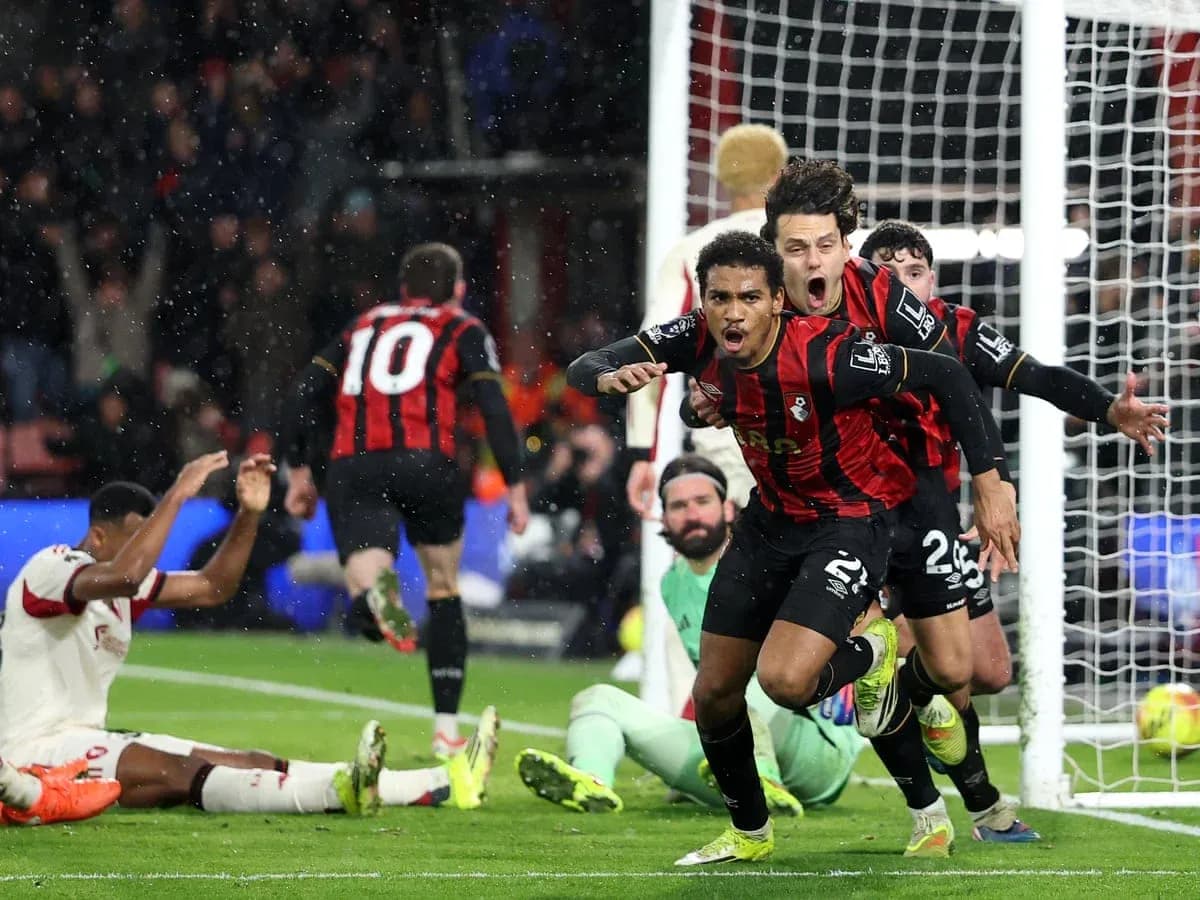
The turning point in Bournemouth’s attacking effectiveness came with their increased willingness to use the full-backs, especially Truffert on the left. His overlapping and underlapping runs began to drag Forest’s wide midfielders deeper, and he eventually provided the assist for M. Tavernier’s 54' equaliser. That goal encapsulated Bournemouth’s best attacking sequences: patient circulation, full-back advanced high, and a late-arriving midfielder exploiting space as Forest’s block shifted.
Both coaches used substitutions to adjust the tactical picture. Iraola’s first change at 57' saw B. Gannon-Doak (IN) come on for A. Toth (OUT), a clear move to inject more verticality and attacking thrust from deeper zones. Later, at 73', a triple change reshaped the front line: J. Kluivert (IN) came on for E. J. Kroupi (OUT), E. Unal (IN) replaced Evanilson (OUT), and A. Adli (IN) entered for Rayan (OUT). This effectively turned Bournemouth into a more transition-oriented 4-2-3-1, with fresh legs across the attacking band to press Forest’s build-up and attack space behind their full-backs.
Pereira’s response was equally decisive. At 62', T. Awoniyi (IN) came on for C. Wood (OUT), adding more depth-running and physicality against Bournemouth’s centre-backs. Within minutes, Forest reshaped their left flank and midfield: at 63', L. Netz (IN) came on for Cunha (OUT), offering a more naturally attacking left-back profile, and at 65' both R. Yates (IN) for E. Anderson (OUT) and N. Dominguez (IN) for I. Sangare (OUT) changed the nature of the central pairing. Yates brought energy and late runs, while Dominguez provided a calmer passing presence. Finally, at 78', J. McAtee (IN) replaced O. Hutchinson (OUT), keeping the creative profile on the right but with fresher legs and more inside drifting.
These changes subtly shifted Forest’s shape toward a more fluid 4-2-3-1/4-2-4 hybrid in the final phase, with Awoniyi and Igor Jesus able to occupy both centre-backs and McAtee and Gibbs-White operating between lines. However, Bournemouth’s defensive structure held, aided by disciplined work from the double pivot and the late introduction of L. Cook (IN) for A. Smith (OUT) at 90', which helped secure the right flank as Forest chased a winner.
Discipline played a minor but telling role in the match’s tactical tone. Bournemouth’s James Hill received a yellow card at 33' — Foul — a reflection of Forest’s early pressure and his need to step out aggressively. Later, at 67', Taiwo Awoniyi (Nottingham Forest) was booked — Foul — as the game became more stretched and duels intensified, particularly with Forest trying to regain momentum after Bournemouth’s equaliser.
Statistically, the draw looks fair but nuanced. Forest’s 45% possession and 396 total passes, with 307 accurate (78%), show a side comfortable without monopolising the ball, using it more vertically to create higher-quality chances. Their 5 shots on goal from 15 total, plus 10 attempts inside the box, align with an xG of 1.87, suggesting they fashioned enough to win. Bournemouth’s 483 passes, 405 accurate (84%), and 55% possession reflect control, but their shot profile – 17 total shots, only 6 inside the box and 4 on goal – matches a more speculative approach, consistent with an xG of 1.
Both goalkeepers, M. Sels (Nottingham Forest) and D. Petrovic (Bournemouth), made 3 saves each, with the goals prevented metrics at -0.5 for both teams hinting that each conceded from situations that were marginally less dangerous on paper than the final outcomes. Overall, Forest’s more incisive chance creation was balanced by Bournemouth’s territorial control and effective in-game adjustments, producing a tactically rich 1-1 that felt appropriate to the underlying numbers.