Manchester City vs Aston Villa: Tactical Insights from the Premier League Clash
Under the grey Manchester sky, the Premier League season closed with a jolt at the Etihad Stadium. Manchester City, already confirmed as runners-up and heading into this game with 78 points and a formidable overall goal difference of 42 (77 scored, 35 conceded), fell 2-1 at home to an Aston Villa side that finished fourth on 65 points, with an overall goal difference of 7 (56 scored, 49 conceded).
The script was meant to be familiar: City at home, where across the season they had turned the Etihad into a scoring machine, averaging 2.4 goals at home while conceding just 0.7. Aston Villa arrived as dangerous travellers but more fragile, averaging 1.3 goals on their travels and conceding 1.4. Yet across 90 minutes, Unai Emery’s 4-2-3-1 outmanoeuvred Pep Guardiola’s rare 4-2-2-2, flipping the expected narrative and exposing the risk in City’s final-day experimentation.
Tactical Voids and Structural Choices
The absences list told its own pre-match story, and it was almost entirely claret and blue. Aston Villa were without Alysson (muscle injury), B. Kamara (knee injury) and E. Martinez (finger injury). The loss of Kamara, in particular, stripped Villa of a natural screening midfielder, forcing Emery to lean heavily on Douglas Luiz and L. Bogarde as a double pivot. Without Martinez, M. Bizot stepped in between the posts, an understudy asked to survive the most potent home attack in the division.
Guardiola’s void was of a different kind: it was chosen. He rolled out a 4-2-2-2 that City had used only twice in the league all season, diverging from the more familiar 4-1-4-1 and 4-3-3 that had underpinned their consistency. J. Trafford started in goal, shielded by a back four of R. Lewis, J. Stones, R. Dias and N. Ake. Ahead of them, Nico and Bernardo Silva formed a double pivot, with A. Semenyo and Savinho as narrow attacking midfielders behind a front two of P. Foden and T. Reijnders.
The structure promised verticality and central overloads but sacrificed some of the usual control City enjoy with a single pivot and an extra midfielder between the lines. It was a gamble against a Villa side that, across the season, had been drilled in their 4-2-3-1 (34 league games in that shape), comfortable in defending zones and springing forward.
Emery’s XI, even without Kamara and Martinez, was reassuringly orthodox: M. Bizot in goal; a back four of A. Garcia, V. Lindelof, T. Mings and I. Maatsen; Douglas Luiz and L. Bogarde sitting as the double pivot; L. Bailey, R. Barkley and E. Buendia as the creative band behind O. Watkins. It was a classic Emery away blueprint: compact mid-block, quick wide transitions, and a lone striker capable of stretching the pitch.
Disciplinary trends framed the likely rhythm. Heading into this game, City’s yellow-card distribution showed a late-game edge of aggression, with 20.90% of their cautions arriving between 76-90 minutes and another 16.42% in added time (91-105). Villa, by contrast, tended to boil just after the restart: 29.31% of their yellows came between 46-60 minutes, with a notable spike again in late and added time (17.24% between 91-105). It set the expectation of a match that would grow increasingly fractious as legs tired and spaces opened.
Key Matchups – Hunter vs Shield, Engine Room vs Enforcer
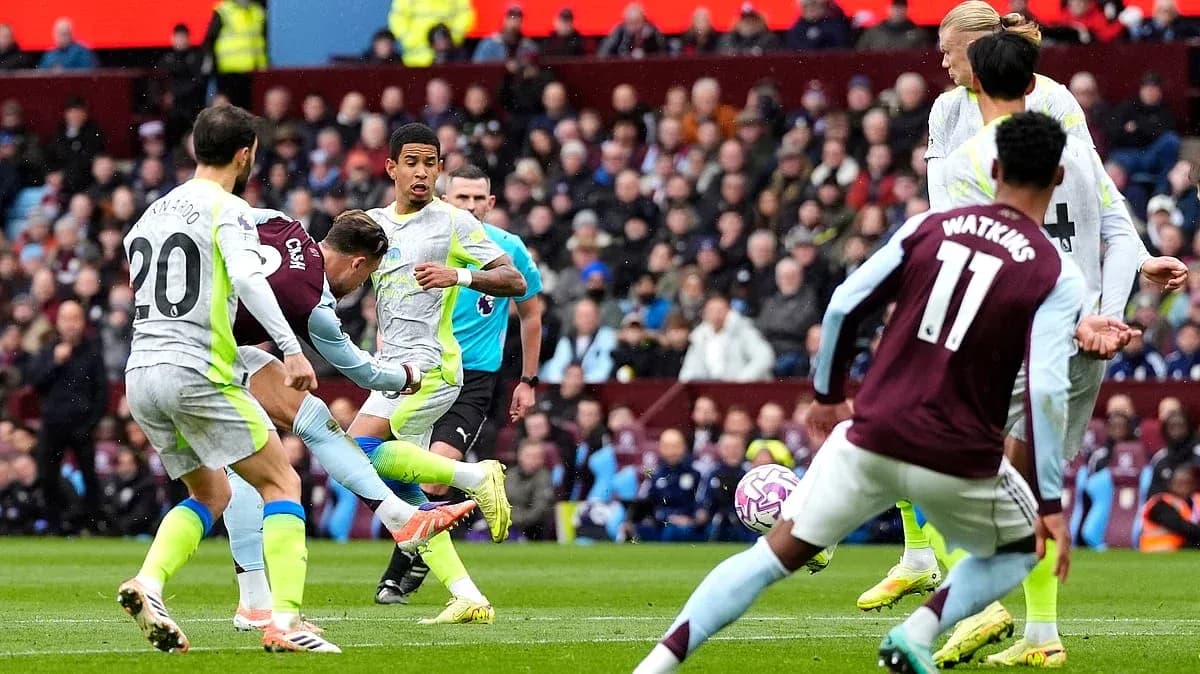
The most intriguing battle was always going to be “Hunter vs Shield”: O. Watkins against a City defence that, at home, had conceded only 14 goals across 19 matches. Overall, City’s defensive record was elite, allowing just 0.9 goals per game, with that figure dropping to 0.7 at home. Watkins, however, arrived as one of the league’s premier forwards: 16 goals and 3 assists in 37 appearances, backed by 60 shots and 38 on target. He is not just a finisher but a worker — 283 duels contested, 22 tackles, 2 blocked shots — a forward who can both stretch and harass a back line.
Against R. Dias and J. Stones, Watkins’ movement into the channels and his willingness to press Trafford were pivotal. City’s two-striker shape left less natural cover in front of the centre-backs, asking Nico and Bernardo Silva to do heavy defensive lifting while also progressing the ball. Any delay or misstep in their build-up gave Watkins and the Villa three behind him an invitation to pounce.
In the “Engine Room” duel, Douglas Luiz and L. Bogarde faced Bernardo Silva and Nico. City’s pivot had to dictate tempo and protect the half-spaces, but Bernardo arrived as a player stretched across responsibilities all season. He had contributed 2 goals and 4 assists, but his defensive load was immense: 53 tackles, 6 blocked shots and 22 interceptions, plus 10 yellow cards — a profile of a midfielder constantly at the coalface.
Villa’s midfield, meanwhile, leaned on Douglas Luiz’s blend of passing and bite, with Bogarde adding legs and coverage. Ahead of them, R. Barkley and E. Buendia floated between City’s lines, testing whether Guardiola’s double pivot could both press and screen. On the flanks, L. Bailey’s pace against N. Ake and R. Lewis was a key release valve, especially when Villa looked to escape City’s pressure with direct switches.
From City’s perspective, the creative threat was meant to come from the hybrid front four. P. Foden, with 7 goals and 5 assists in the league, has been one of the division’s most incisive final-third players, his 56 key passes and 25 successful dribbles underscoring his dual role as creator and carrier. Savinho and A. Semenyo, starting as narrow attacking midfielders, were tasked with dragging Villa’s full-backs inside, opening corridors for Lewis and Ake to advance.
On the bench, R. Cherki loomed as a potential game-breaking substitute. With 4 goals and 12 assists, plus 61 key passes and 105 dribble attempts, he embodies City’s capacity to change the texture of a match from the bench. But deploying him would also have meant further tilting the balance towards attack, a risk against Villa’s counter-punching.
Statistical Prognosis and Tactical Verdict
Heading into this game, every number pointed towards a City win. At home they were ruthless: 14 wins from 19, 45 goals scored and only 14 conceded, with 9 clean sheets and just 1 match at the Etihad where they failed to score. Villa’s away profile was solid but not spectacular: 7 wins, 6 draws and 6 defeats from 19, scoring 24 and conceding 27. Their defensive average on their travels — 1.4 goals conceded — suggested City would find chances.
From an Expected Goals perspective, the underlying trends favoured City’s volume and territorial dominance. Their attacking structure, especially in more familiar shapes, typically generates sustained xG through repeated box entries and cut-backs. Villa, by contrast, tend to live on sharper, more selective chances, often through Watkins’ movement and the creative supply of players like Morgan Rogers over the season (10 goals, 6 assists, 47 key passes, though he did not feature in this particular XI).
Yet the final 1-2 scoreline underlined how tactical context can bend the probabilities. Guardiola’s 4-2-2-2 reduced his usual midfield control, exposing his back line to more direct transitions. Emery’s 4-2-3-1, drilled all season, exploited those spaces with clarity and discipline.
Following this result, the statistical verdict is clear: the raw numbers still paint City as the more dominant side across the campaign, but on this day Villa’s defensive organisation and clinical edge outperformed the xG expectations. The late-season data on both teams’ card timings and structural tendencies foreshadowed a tense, increasingly stretched contest — and in that chaos, it was Emery’s side, not Guardiola’s, who found the clearer path to goal.