Manchester City Dominates Burnley in Premier League Clash
Burnley’s 5-4-1 at Turf Moor was designed to survive rather than trade punches, but Manchester City’s 4-2-3-1 imposed territorial and technical control from the first whistle. The match finished 0–1 in the Premier League Regular Season - 34, with Erling Haaland’s early strike the only goal, yet the underlying dynamics were of near-total City domination: 65% possession, a 28–9 shot count and a stark xG split of 3.36 to 0.63. Burnley’s structure and Martin Dúbravka’s goalkeeping kept the scoreline narrow, but City’s pressing, rotations between the lines and wing occupation ensured the game’s tactical story was one-sided even if the margin was not.
First Half
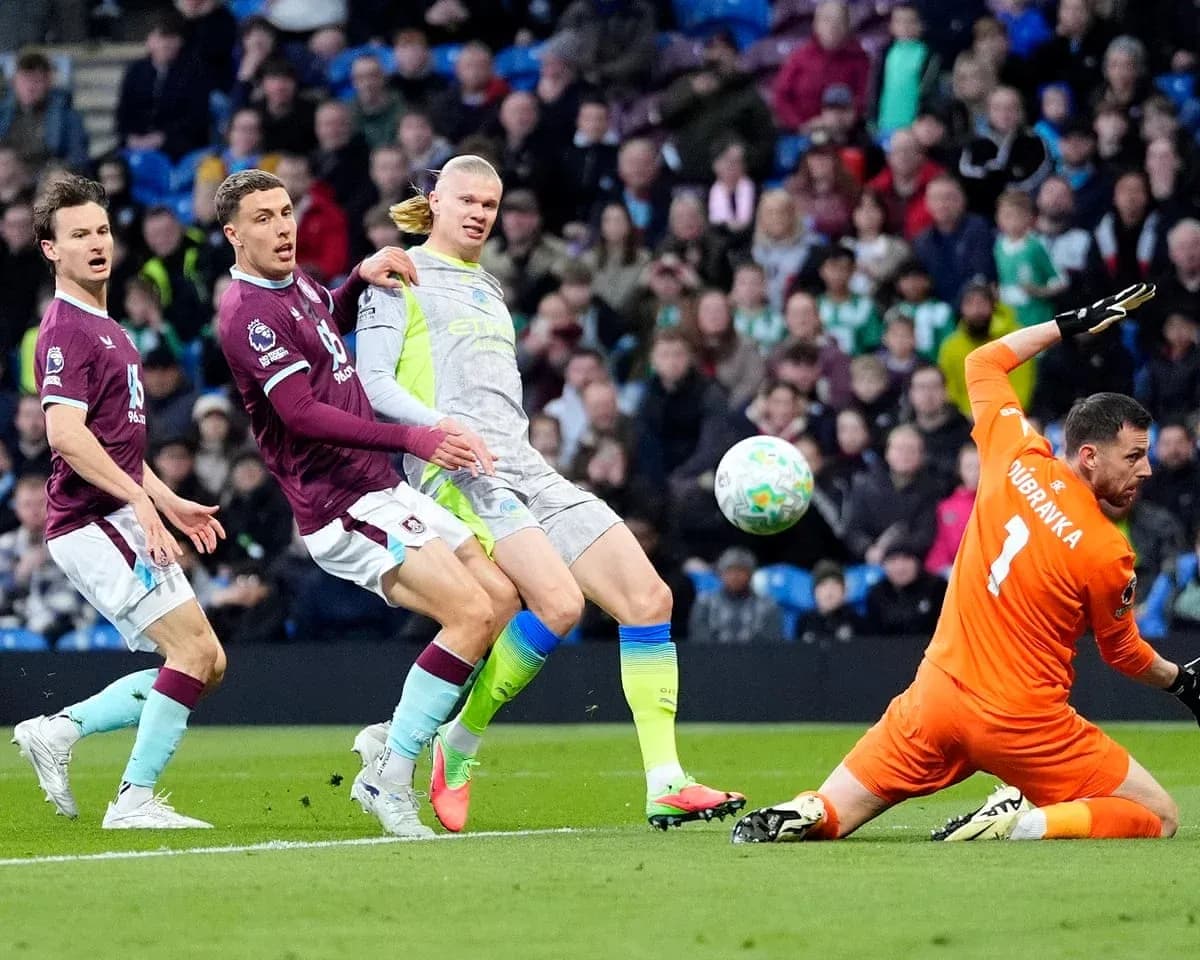
Haaland’s goal on 5 minutes set the tone and framed the rest of the contest. Jérémy Doku, starting from the left in City’s attacking 4-2-3-1 shape, isolated his man and drove at the Burnley back line. His early involvement underlined City’s intention to attack the outside shoulder of Burnley’s wing-backs. The move ended with Doku supplying Haaland, whose finish gave City a 0–1 lead that they would never relinquish. With no further goals and no cards recorded in the event log, the scoreboard remained unchanged through half-time (0–1) and full-time (0–1), the contest decided by that single, cleanly executed attacking pattern.
Substitutions
The substitutions followed the flow of control rather than crisis management. At 65', Antoine Semenyo (OUT) made way for Savinho (IN), a like-for-like change in the attacking midfield line that refreshed City’s pressing and wide threat. Simultaneously, Rayan Aït-Nouri (OUT) was replaced by Nico González (IN), with City maintaining their back-four structure but gaining fresher legs for ball progression and counter-pressing on the left side.
Burnley’s changes came later and were more reactive. At 72', Loum Tchaouna (OUT) was replaced by Lyle Foster (IN), signalling a shift from a conservative 5-4-1 towards a more forward-oriented approach, looking for direct outlets to relieve pressure. On 82', Bashir Humphreys (OUT) went off for Florentino Luís (IN) and Zian Flemming (OUT) for Armando Broja (IN). This double change rebalanced the side: Florentino added a screening presence in midfield to protect a back line that had been under constant siege, while Broja provided a fresh focal point to attack space behind City’s high defensive line. At 87', Jaidon Anthony (OUT) was replaced by Mike Trésor (IN) and Josh Laurent (OUT) by Marcus Edwards (IN), late attacking substitutions aimed at injecting dribbling and creativity between the lines. Despite this wave of offensive intent, Burnley could not turn their structural tweaks into clear chances, and there were no bookings or dismissals to alter the tempo or risk profile of either team’s approach.
Burnley’s Structure
Structurally, Burnley’s 5-4-1 was compact but passive. The back five of Kyle Walker, Bashir Humphreys, Hjalmar Ekdal, Maxime Estève and Quilindschy Hartman stayed narrow, conceding space to City’s fullbacks and wide midfielders but trying to deny central access. In front, Loum Tchaouna, James Ward-Prowse, Josh Laurent and Jaidon Anthony formed a flat four that slid laterally, more concerned with blocking passing lanes than pressing high. Zian Flemming, alone up front, had limited support on transitions.
This low-to-mid block produced volume defending rather than high-quality resistance. Burnley allowed 28 shots, 19 of them inside the box, which speaks to City’s ability to work the ball into prime areas despite the numerical density. Dúbravka’s 8 saves were critical: he was repeatedly exposed to shots from close range and cut-backs, and his shot-stopping, rather than collective defensive control, kept the xG-against of 3.36 from turning into a heavier defeat. The defensive index, inferred from shots conceded and territory, was poor despite the respectable scoreline.
Burnley’s Possession
In possession, Burnley were limited. Their 35% of the ball and 356 total passes (79% accuracy) underline a game plan built on survival and sporadic counters. With only 1 shot on target from 9 attempts and an xG of 0.63, they rarely progressed through City’s pressure in a structured way. Long balls toward Flemming, and later Broja and Foster, were the main release valves, but City’s centre-backs Marc Guéhi and Abdukodir Khusanov generally controlled the aerial and second-ball zones.
Manchester City’s Performance
City’s 4-2-3-1 functioned as a high-possession, high-territory system. Gianluigi Donnarumma had to make only 1 save, reflecting how effectively City’s rest defence and counter-press suffocated Burnley’s attacks. The back four of Matheus Nunes, Khusanov, Guéhi and Aït-Nouri (then Nico González) held a high line, with the fullbacks stepping into midfield when City had stable possession. Bernardo Silva and Nico O’Reilly as the double pivot orchestrated circulation, repeatedly switching play to stretch Burnley’s five-man defence.
Ahead of them, Antoine Semenyo, Rayan Cherki and Doku operated in a fluid three behind Haaland. Cherki drifted between the lines, drawing out Ward-Prowse or Laurent and creating pockets for Doku and Semenyo to attack. Doku’s early assist encapsulated City’s plan: isolate wide, win the one-v-one, then find Haaland’s runs across or between centre-backs. Haaland’s movement pinned Ekdal and Humphreys, preventing Burnley from stepping out to pressure the ball.
City’s Pressing Structure
City’s pressing structure was equally decisive. With 689 passes at 90% accuracy, they sustained long possession phases, but the key was how quickly they recovered the ball after loss. The front four led an aggressive counter-press, supported by Bernardo stepping high, which limited Burnley to 10 fouls and very few controlled counters. City’s overall form index in this match was strong: they created high xG, dominated territory and limited transitions against.
Statistical Verdict
Statistically, the verdict is clear. City’s 3.36 xG to Burnley’s 0.63, coupled with a 9–1 shots-on-target margin and 65–35 possession split, reflect a game where the away side’s performance far exceeded the narrow 0–1 scoreline. Burnley’s defensive index is flattered by the result but exposed by the volume and quality of chances conceded. Dúbravka’s 8 saves stand out as the primary reason Burnley remained competitive on the scoreboard, while Donnarumma’s 1 save highlights how little City’s defensive structure was tested.
Disciplinary Control
Disciplinary control was total: no yellow or red cards for either side, despite 10 Burnley fouls and 12 from City. This absence of cards meant no enforced tactical compromises; both managers could maintain their initial risk profiles throughout. In synthesis, City delivered a high-control, high-chance performance consistent with a top-level overall form, while Burnley’s low-possession, deep-block approach produced a respectable scoreline but a fragile defensive index and limited attacking threat.