Bournemouth and Leeds Share Points in Tactical 2–2 Draw
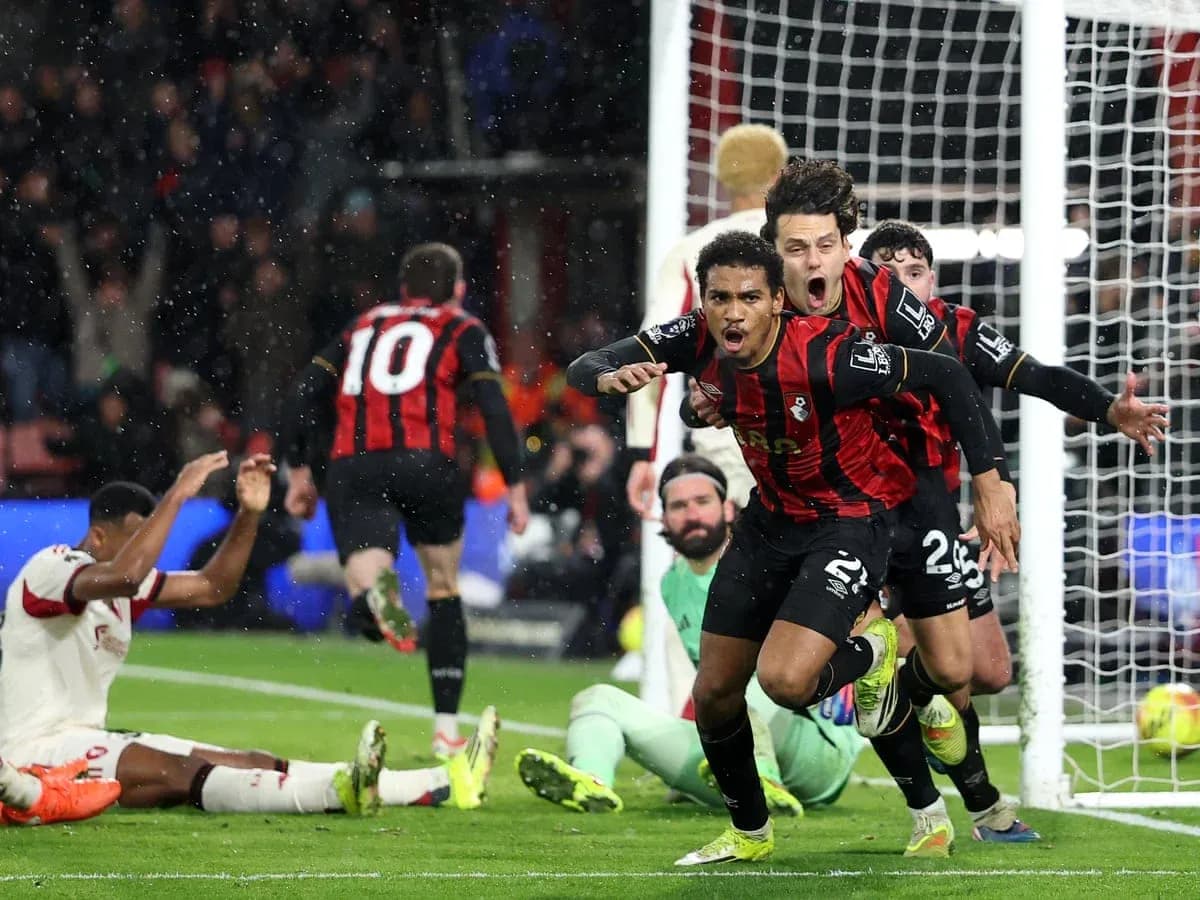
Bournemouth and Leeds produced a tactically rich 2–2 draw at Vitality Stadium in Premier League Round 34, a match where structure and in-game adjustments mattered as much as the late drama. Bournemouth’s 4-2-3-1 used territorial dominance and wide overloads to control long stretches, reflected in 60% possession, 17 total shots and 12 corners. Leeds, in a 3-4-2-1, leaned into verticality and transition, living off efficient attacks (10 shots, all from inside the box) and late bench impact. Despite Bournemouth generating the higher expected goals (1.65 vs 0.81) and leading twice, Leeds’ resilience and a stoppage-time equaliser turned a controlled home performance into two points dropped.
The disciplinary and scoring narrative unfolded within Bournemouth’s control of territory but persistent Leeds threat. The first card arrived on 25', when Eli Junior Kroupi was booked for a foul, a signal of Bournemouth’s aggressive counter-press from the attacking midfield line. On 41', right-back Álex Jiménez also saw yellow for a foul, underlining the risk in Bournemouth’s high full-back positioning when Leeds broke into space.
Leeds’ first structural shift came at 46', when Joe Rodon (IN) came on for Jayden Bogle (OUT), turning the visitors into a more secure back line, with Rodon reinforcing the defensive unit and giving Leeds clearer distribution from deep. Bournemouth’s pressure finally converted on 60', Kroupi finishing a move assisted by Marcos Senesi to make it 1–0, the centre-back stepping into midfield and threading the decisive pass.
Leeds reacted aggressively on 64' with a double change: Wilfried Gnonto (IN) came on for Noah Okafor (OUT), and Lukas Nmecha (IN) replaced Jaka Bijol (OUT), trading a centre-back for an extra forward and effectively loosening the original 3-4-2-1 into a more attacking shape. Bournemouth then altered their own attacking band at 67', when Rayan (IN) came on for David Brooks (OUT), adding fresh depth to the right side.
The match flipped briefly on 68', when James Hill turned into his own net for an own goal, levelling at 1–1 and punishing Bournemouth’s otherwise solid defensive line. On 73', Andoni Iraola (implicitly, given Bournemouth) refreshed central and wide creativity: Amine Adli (IN) replaced Ryan Christie (OUT), and Tyler Adams (IN) came on for Kroupi (OUT), moving Bournemouth towards a more balanced double pivot with Adams and Alex Scott and a new dynamic between the lines.
Leeds made another midfield adjustment at 84', Sean Longstaff (IN) replacing Brenden Aaronson (OUT), adding late running and shooting threat from deeper zones. Bournemouth immediately reasserted control: on 85', Rayan finished a move assisted by Tyler Adams, making it 2–1 and validating the American’s introduction as a stabilising yet progressive six. At 89', Joël Piroe (IN) replaced Ao Tanaka (OUT), Leeds sacrificing a central midfielder for a pure striker and committing to a final attacking push.
Stoppage time was chaotic. On 90+2', VAR cancelled a Bournemouth goal by Evanilson, a critical intervention that prevented the hosts from going 3–1 up and directly preserved Leeds’ hope. On 90+5', Evanilson was booked for a foul, Bournemouth’s third yellow of the night, reflecting the strain of defending a narrow lead. Leeds’ pressure finally told on 90+7', when Sean Longstaff scored unassisted to make it 2–2, a payoff for the late attacking reshuffle. The final substitution came in regulation time: at 90', Alex Tóth (IN) replaced Marcus Tavernier (OUT), a late attempt to add legs and ball security on the flank.
Tactical Overview
Tactically, Bournemouth’s 4-2-3-1 was built on structured possession and wide progression. With Đorđe Petrović behind a back four of Álex Jiménez, James Hill, Marcos Senesi and Adrien Truffert, they sought to create a high base camp around the Leeds half. The double pivot of Alex Scott and Ryan Christie (before Christie’s withdrawal) was key: Scott orchestrated from deeper zones, while Christie’s higher positioning enabled quick pressure after turnovers. The attacking three of David Brooks, Kroupi and Marcus Tavernier supported Evanilson, constantly rotating between lines to drag Leeds’ back three into uncomfortable spaces.
Bournemouth’s 12 corners and 17 shots, 12 from inside the box, show how effectively they pinned Leeds back. Their 473 passes at 80% accuracy, compared to Leeds’ 315 at 75%, underline a clear possession strategy: circulate, shift Leeds’ 3-4-2-1 horizontally, then attack through the half-spaces or via overlaps from Truffert and Jiménez. The first goal encapsulated this: Senesi stepping into midfield, exploiting the gap between Leeds’ lines, and finding Kroupi in an advanced pocket.
Defensively, Bournemouth’s overall form was proactive but carried risk. With only 6 fouls but 3 yellow cards (Kroupi 25', Jiménez 41', Evanilson 90+5'), their Defensive Index here was about intensity more than volume: they defended high, accepted one-vs-one duels in wide channels, and were vulnerable to isolated errors, as seen in Hill’s own goal. Petrović faced only 3 shots on target (given Leeds’ 3 shots on goal) and made 1–2 key interventions; the raw stat shows 2 goalkeeper saves for Bournemouth, indicating that while the back line limited volume, the few chances conceded were relatively clear.
Leeds Tactical Shape
Leeds’ 3-4-2-1, with Karl Darlow behind James Justin, Jaka Bijol and Pascal Struijk, was initially conservative. Wing-backs Jayden Bogle and Gabriel Gudmundsson were tasked with stretching the pitch, while Ethan Ampadu and Ao Tanaka formed a central screen. Ahead, Brenden Aaronson and Noah Okafor supported Dominic Calvert-Lewin. In possession, Leeds were more direct: 10 total shots, all from inside the box, and only 1 corner highlight a plan built around quick entries and high-quality final actions rather than sustained pressure.
Darlow was far busier than Petrović, registering 5 saves and effectively outperforming his defence’s workload. With Bournemouth’s xG at 1.65 and Leeds’ at 0.81, the Statistical Verdict is clear: Bournemouth created more and better chances, and Leeds finished above the quality of their opportunities, particularly via Longstaff’s late strike. Both keepers’ goals prevented metric stands at zero, implying that finishing roughly matched the underlying chance quality, but Bournemouth’s inability to convert territorial and statistical superiority into a decisive lead—combined with the VAR-cancelled Evanilson goal—defines this as a missed opportunity.
Disciplinary totals were starkly asymmetric: Bournemouth 3 yellow cards, Leeds none, despite Leeds committing more fouls (10 to 6). That asymmetry reinforces the tactical story: Bournemouth’s high, aggressive structure invited more last-ditch, card-worthy interventions, while Leeds’ more compact, reactive block spread their fouls across phases without tipping into bookings. Overall, the numbers and events align: Bournemouth’s overall form was that of a dominant home side; Leeds’ Defensive Index and late-game risk-taking earned them a point that the underlying metrics suggest they were slightly fortunate to secure.