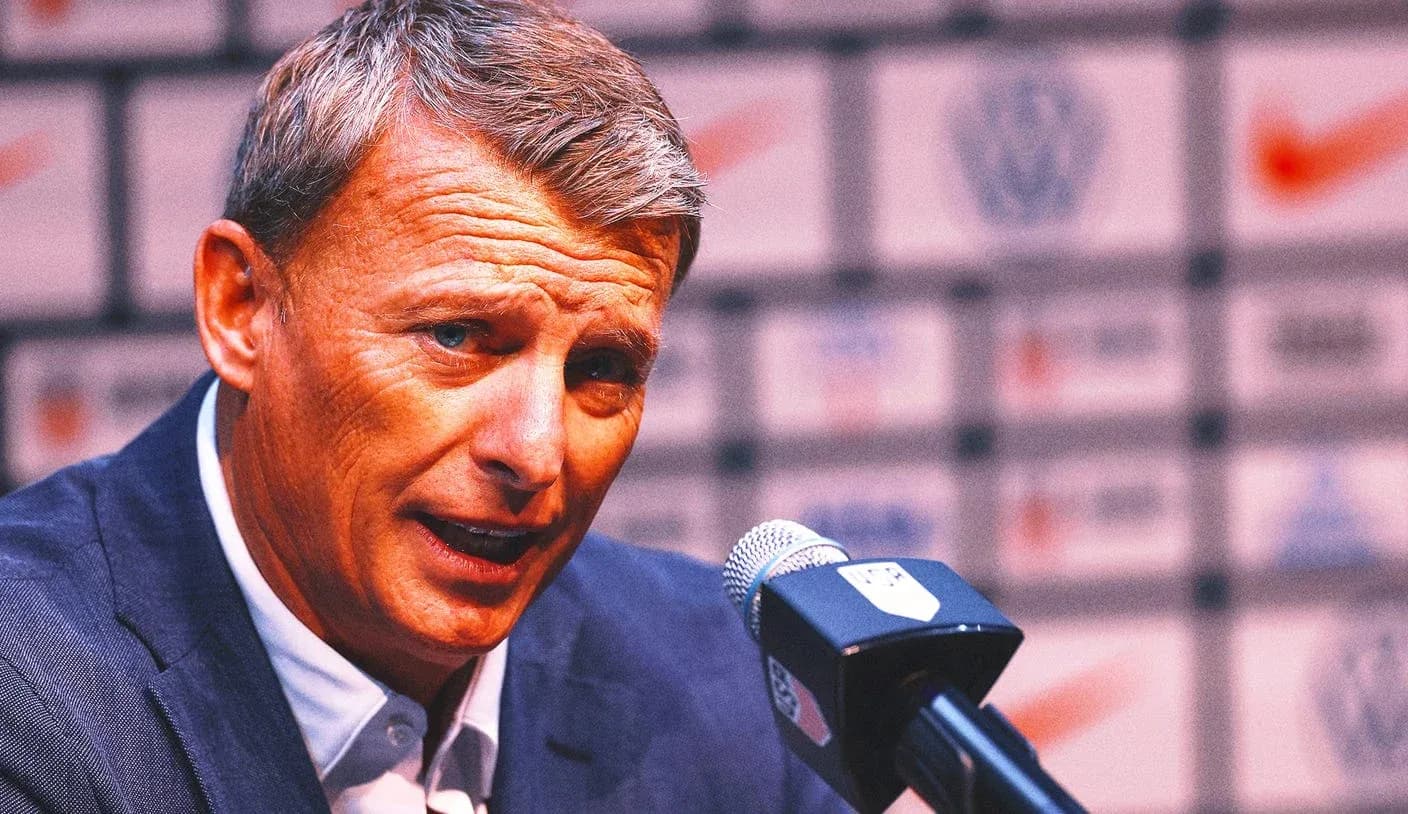
Matt Crocker Leaves U.S. Soccer for Saudi Arabia Ahead of World Cup
Matt Crocker is walking away from U.S. Soccer just weeks before the country stages the biggest tournament in its history — and straight into the arms of Saudi Arabia.
The federation’s sporting director is leaving his post with immediate effect to take a similar role with the Saudis, multiple sources confirmed on Monday. It’s a seismic change at the top of U.S. Soccer’s technical structure, arriving less than two months before the U.S. men open their 2026 FIFA World Cup campaign against Paraguay in Los Angeles on June 12.
Inside Soccer House, the response has been swift. Assistant sporting director Oguchi Onyewu, head of women’s development Tracey Kevins and COO Dan Helfrich will share Crocker’s responsibilities through the tournament co-hosted by the United States, Canada and Mexico.
Helfrich insists the World Cup plan will not buckle.
“I anticipate zero impact on World Cup preparation as a result of Matt's decision,” he said Monday. “Mauricio and his staff have full control of the preparations for this summer's tournament, and we have full confidence in them. This transition in no way impacts those plans, which have been long-established.”
The message is clear: the train is already moving, and Mauricio Pochettino is driving it.
Crocker’s whirlwind tenure
Crocker arrived from Southampton in 2023 with a mandate to modernize and sharpen U.S. Soccer’s sporting vision. He didn’t waste time.
The federation was reeling on both fronts. The women had just crashed out of the 2023 FIFA Women’s World Cup earlier than expected. The men were without a permanent coach, Gregg Berhalter frozen in place amid the ugly, very public saga involving the parents of Gio Reyna.
Crocker’s answer was bold hiring.
He brought in Emma Hayes in the autumn of 2023, prising one of the game’s most respected managers away from Chelsea to take over the U.S. women’s national team. She needed only 10 matches to deliver a statement: Olympic gold in Paris, the Americans’ fifth, sealed with a win over Brazil in the final and a rapid restoration of their status atop the women’s game.
On the men’s side, Crocker first rehired Berhalter, then showed he was willing to reverse course. After the United States became the first Copa América host ever to fail to escape the group stage in 2024, Berhalter was dismissed that July.
Crocker then landed Pochettino in September 2024, a coup by any measure. The Argentine, with heavyweight spells at Paris Saint-Germain and Chelsea on his résumé, arrived as one of the most coveted managers in the world. He now commands a squad under intense scrutiny heading into a home World Cup, with group-stage games and high-stakes knockout scenarios already mapped out down to the last detail.
A federation in transition, again
Crocker himself had been the product of a previous reset. U.S. Soccer hired him in April 2023 after Earnie Stewart, a three-time World Cup veteran and National Soccer Hall of Famer, left to take over at PSV Eindhoven.
The Welshman from Cardiff quickly embedded himself in the federation’s long-term projects. He played a central role in the planning and design of the Arthur M. Blank U.S. Soccer National Training Center near Atlanta, a $228 million facility that opens next month. The complex will serve as the U.S. men’s base for their final two World Cup tuneups, against Senegal on May 31 and four-time champion Germany on June 6.
That combination of elite coaching hires, crisis management and infrastructure work made Crocker an attractive figure to ambitious federations around the globe. Saudi Arabia, flush with resources and preparing to host the men’s World Cup for the first time in 2034, has now moved to secure his experience.
Moroccan administrator Nasser Larguet, Saudi Arabia’s technical director since 2002, is expected to leave his post this month, according to multiple reports. Crocker will step into a project that mirrors, on a different scale, the one he just left: build a national program capable of peaking on home soil.
Helfrich, though, framed the departure as a sign of progress rather than instability.
“If you're going to compete at the highest levels in the sporting world, you expect that team members will have other opportunities,” he said. “Soccer in our country and the federation overall are in a better place than several years ago when Matt joined, and we're grateful to him for those contributions.”
He also confirmed that the search for Crocker’s replacement has already begun.
U.S. Soccer, he said, has launched “a thoughtful and comprehensive search for a successor,” with candidates to be considered “both domestically and globally.” Onyewu, who played at the 2006 and 2010 World Cups and was a finalist for the job three years ago before Crocker was hired, will again be a name to watch.
World Cup on the horizon — and a possible Saudi showdown
For now, all roads point to June 12 and the opener against Paraguay at a home World Cup that will define this generation of U.S. players.
The intrigue doesn’t end there. Crocker’s new employers could cross paths with his old federation on the biggest stage of all.
Several routes exist for a USA–Saudi Arabia clash this summer. If Pochettino’s team wins Group D and reaches the round of 16, the Saudis could be waiting in Seattle on July 6. If both nations finish second in their groups and then win in the new round of 32, they would meet on July 7 in Atlanta. If they both advance as third-place teams and then win their first knockout game, the matchup would land on July 4 in Philadelphia.
There’s an even loftier scenario: if both win their groups, they’d be set on a collision course for a quarterfinal in Los Angeles on July 10. In theory, the 16th-ranked United States and No. 61 Saudi Arabia could even meet in a semifinal or in the final itself on July 19 in East Rutherford, New Jersey.
Saudi Arabia has only once reached the knockout rounds in six previous World Cups — back in 1994, the last time the United States hosted. The Green Falcons are now building toward 2034. The U.S. is staring down 2026.
Crocker has chosen his next project. The question is whether the one he leaves behind can hit its peak without him when the world arrives on American soil.