Mexico Dominates Ecuador 2–0 in World Cup Round of 32
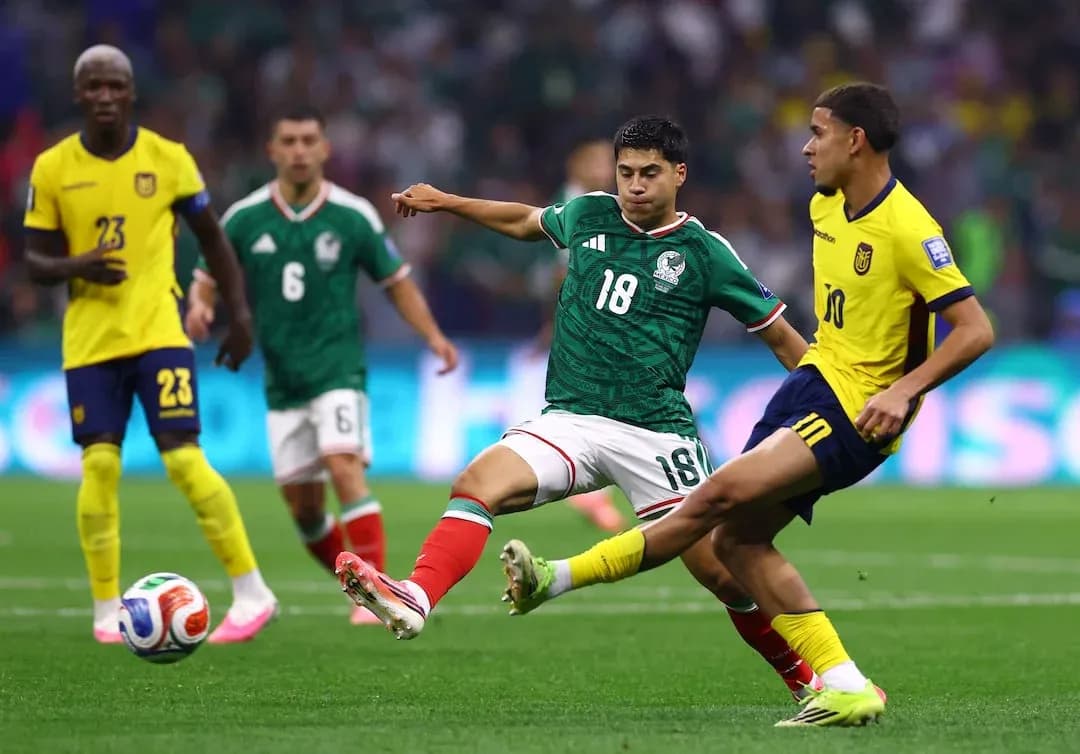
Under the lights of Estadio Banorte in Mexico City, Mexico’s 2–0 victory over Ecuador in the World Cup Round of 32 felt less like a single match and more like the logical extension of two very different tournament journeys. One side arrived with a perfect record and a defensive wall untouched in group play; the other came in scarred by away struggles and an attack still searching for rhythm. Over 90 minutes, those narratives crystallised.
I. The Big Picture – Mexico’s control vs Ecuador’s constraint
Heading into this game, Mexico were the form team of the tournament. They topped Group A with 9 points from 3 matches, a total goal difference of 6 built from 6 goals scored and none conceded. Across the campaign overall, they had played 4 fixtures, winning all 4, with 8 goals for and 0 against. At home in this World Cup, they had played 3 times, winning all 3, scoring 5 and conceding 0; on their travels, they had added 1 win, 3 goals for and 0 against. It is a profile of ruthless efficiency: an average of 2.0 goals scored per match overall, with 1.7 at home and 3.0 away, and not a single goal allowed in any venue.
Ecuador’s path was far more fragile. They emerged from Group E with 4 points, 2 goals scored and 2 conceded, a total goal difference of 0 and a mixed form line of one win, one draw and one defeat. Overall in this World Cup, they had played 4 fixtures, winning 1, drawing 1 and losing 2. At home they had been competitive – 2 matches, 1 win, 1 draw, 2 goals scored and only 1 conceded – but away they were exposed: 2 games, 0 wins, 0 draws, 2 defeats, 0 goals scored and 3 conceded. Their overall scoring rate sat at 0.5 goals per match, with 1.0 at home and 0.0 away, while they allowed 1.0 goal per match overall, 0.5 at home and 1.5 away.
Into that context stepped a Mexico side set up in a 4‑3‑3 by Javier Aguirre, and an Ecuador team arranged in a 4‑4‑2 by Sebastian Beccacece. The scoreboard told the story at half-time already: Mexico 2–0 Ecuador, a lead they protected to full-time without the need for extra time or penalties.
II. Tactical Voids – Discipline, edge and what was missing
The absence list offered no explicit injuries or suspensions, but the disciplinary histories of these squads shaped the tone. Mexico’s campaign had been remarkably controlled: across the tournament, their yellow cards were concentrated in two windows, with 50.00% shown between minutes 16–30 and 50.00% between 61–75, and just a single red card overall, arriving deep into added time between 91–105 minutes. It is a pattern of occasional spikes rather than sustained chaos.
Ecuador, by contrast, lived closer to the edge. Their yellow cards were spread across the heart of matches: 25.00% between 31–45, another 25.00% between 46–60, plus 12.50% from 61–75 and 12.50% from 76–90, before another 25.00% in the 91–105 window. They also carried a red card in that 91–105 band. Two of their defenders, Alan Franco and Piero Hincapié, were among the tournament’s most carded players. Franco had collected 2 yellow cards and committed 7 fouls, while Hincapié had 1 yellow and 1 red, with 5 fouls committed. Those numbers underscored a back line that often had to tackle on the brink.
In a knockout tie where Mexico already owned the ball and the scoreboard early, Ecuador’s propensity to pick up cards in the middle phases of matches limited their ability to press high or rotate the back four aggressively once they fell behind. The need to avoid another dismissal muted their aggression just when they needed it most.
III. Key Matchups – Hunter vs Shield, and the engine rooms
The headline duel was always going to be Mexico’s attacking trident against Ecuador’s central defence, and within that, the “Hunter vs Shield” storyline focused on Julián Andrés Quiñones and the Ecuadorian back line. Quiñones came into this match as one of the World Cup’s most effective attackers: 3 goals and 1 assist in total, from 4 appearances and 333 minutes, with 9 shots (5 on target), 7 key passes and 6 successful dribbles from 8 attempts. He is officially listed as a midfielder, but in Aguirre’s 4‑3‑3 he started high on the left of the front line, constantly attacking the channels between full-back and centre-back.
Against him stood Hincapié and Jhoanner Ordóñez, supported by Franco at right-back. On paper, this was a robust unit: Hincapié had won 24 of 47 duels, made 12 tackles, 2 blocks and 4 interceptions; Franco had 8 tackles, 1 block and 4 interceptions, with 96% passing accuracy. But Ecuador’s broader defensive record – 4 goals conceded overall, 3 of them away, and an away average of 1.5 goals allowed per match – suggested that under sustained pressure, the line could be prised open. Mexico’s two first-half goals were the embodiment of that statistical warning.
In the “Engine Room” matchup, Mexico’s midfield trio of G. Mora, E. Lira and L. Romo had the task of controlling Moisés Caicedo, Pedro Vite and the Ecuadorian central unit. Mexico’s tournament identity had been built on a compact block in front of an immaculate defence: 4 clean sheets in 4 matches, with R. Rangel protected by a back four led by C. Montes and J. Vásquez, plus the full-backs J. Sánchez and J. Gallardo. Montes, despite carrying a red card earlier in the competition, had been one of the standout centre-backs, with 1 blocked shot, 2 tackles and 1 interception, and 89% passing accuracy.
Ecuador’s attack, meanwhile, had been heavily dependent on moments from Enner Valencia and Gonzalo Plata, but the numbers were stark: they had failed to score in 3 of their 4 matches overall, and on their travels they had yet to find the net. Mexico’s total defensive record of 0.0 goals conceded per match, both at home and away, clashed directly with Ecuador’s away scoring average of 0.0 – and the result followed the logic: Ecuador never broke through.
IV. Statistical Prognosis – Why 2–0 felt inevitable
Following this result, the shape of the tie mirrored the season-long data. Mexico extended their perfect run to 5 wins from 5, with 10 goals scored and still none conceded across the tournament, reinforcing an identity built on structural discipline and a clinical front line. Their most frequent formation, 4‑3‑3, again delivered control between the lines, with wide forwards like Quiñones and R. Alvarado – the competition’s leading creator with 3 assists and 10 key passes – stretching Ecuador horizontally and vertically.
Ecuador, meanwhile, saw their core weaknesses amplified. Their total of 2 goals scored across the entire campaign remained unchanged by this match, while their goals against column ticked upward. The away pattern – 0 goals scored, 3 conceded before this tie, and now more damage on their travels – underlined a side that could not translate home solidity into neutral or hostile environments.
Even without explicit xG values, the structural indicators are clear. Mexico’s combination of a 2.0 goals-per-match scoring rate overall with a flawless defensive record made them heavy favourites to progress, especially against a team averaging 0.5 goals per match and conceding 1.0. Ecuador’s disciplinary profile, with frequent yellow cards in the 31–60 minute band and a history of late red cards, further reduced their margin for error once they trailed.
In narrative terms, this Round of 32 tie was less an upset or a twist than a confirmation. Mexico’s squad, anchored by a commanding back line and lit up by Quiñones and Alvarado in the final third, played to their statistical strengths. Ecuador, brave but blunt, ran into a wall that their numbers had long suggested they were unlikely to breach.