Morocco Dominates Canada in World Cup Round of 16
Canada’s 4-4-2 against Morocco’s 4-2-3-1 at NRG Stadium produced a match where structure and control belonged to Morocco, even if Canada generated a comparable shot volume. Morocco’s 3-0 win in this World Cup Round of 16 tie was built on superior spacing between the lines, cleaner progression through midfield, and ruthless exploitation of transition moments, while Canada’s more direct, wing-oriented approach never translated its territory and set-piece volume into clear chances.
Jesse Marsch’s Canada set up with a flat back four of Richie Laryea, Luc De Fougerolles, Moise Bombito and Alistair Johnston, a midfield line of Ali Ahmed, Stephen Eustaquio, Niko Sigur and Tajon Buchanan, and a front two of Jonathan David and Tani Oluwaseyi. The idea was clear: use the wide midfielders and full-backs to create 2v1s on the flanks, then attack the box with the front pair and late midfield runs. Canada’s 11 total shots, 7 inside the box and 11 corner kicks underline how often they reached advanced wide zones and forced restarts.
However, Morocco’s 4-2-3-1 under Mohamed Ouahbi controlled the game’s rhythm. With Noussair Mazraoui and Achraf Hakimi as full-backs, Issa Diop and Redouane Halhal centrally, and a double pivot of Ayyoub Bouaddi and Neil El Aynaoui, Morocco built a secure base. Ahead of them, Bilal El Khannouss, Azzedine Ounahi and Brahim Díaz operated behind Ismael Saibari, giving Morocco a fluid, technically strong line of three that constantly found pockets between Canada’s midfield and defence.
The possession split – 55% for Morocco to 45% for Canada – reflects how often Morocco could circulate and reset. Their 472 total passes, 389 accurate at 82%, contrasted with Canada’s 357 passes, 272 accurate at 76%. Morocco’s higher pass volume and accuracy allowed them to progress in a more controlled, vertical-possession style, drawing Canada’s midfield out and then playing through or around it. Canada, by contrast, often bypassed central combination play, going earlier into the channels or looking for crosses and second balls, which helped explain their 11 shots but relatively modest xG of 0.86.
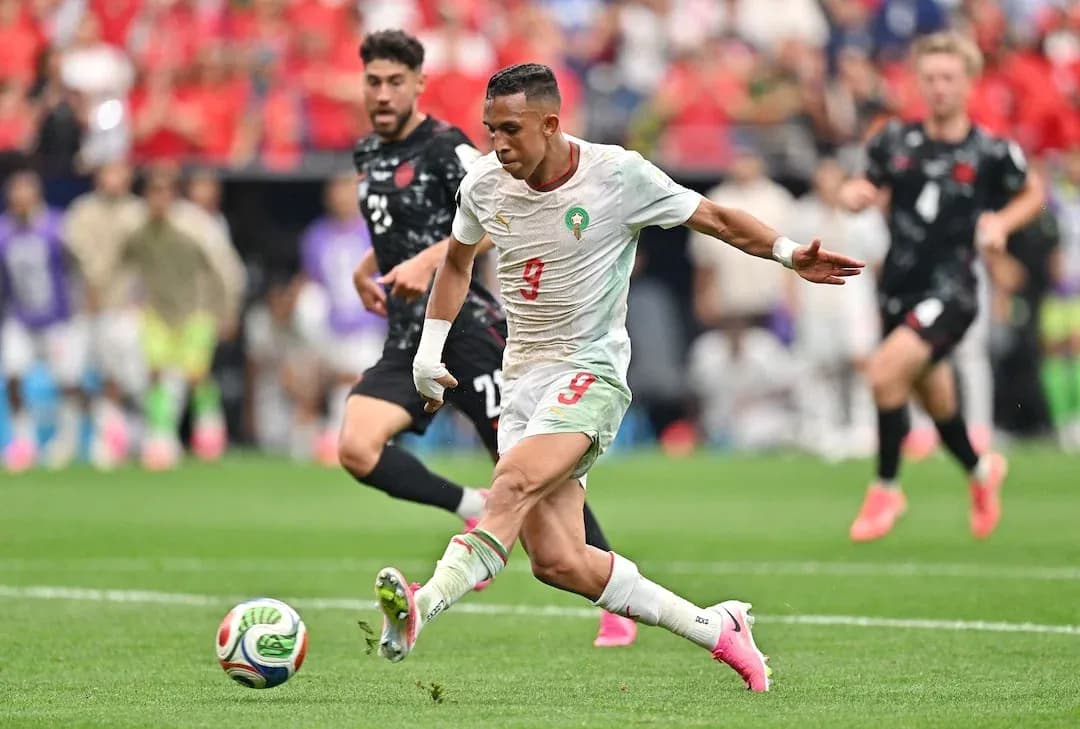
Key to Morocco’s control was the way Hakimi and Mazraoui managed width. Out of possession, they stayed compact to deny direct balls into David and Oluwaseyi. In possession, they pushed high selectively, especially on the right, where Hakimi’s overlapping and underlapping runs created the platform for the opener. At 50', Hakimi advanced and combined before delivering the assist for Azzedine Ounahi’s first goal, a sequence that typified Morocco’s pattern: double pivot secure, full-back advanced, attacking midfielders occupying half-spaces to pin Canada’s back four.
Canada’s defensive structure suffered once Morocco started to find those interior pockets. The Canadian midfield four, naturally stretched by Morocco’s width, struggled to maintain vertical compactness with the back line. That gap allowed Ounahi and El Khannouss to receive facing goal. Fouls became Canada’s main emergency tool: they committed 24 fouls to Morocco’s 14, and their four yellow cards – to Richie Laryea, Jonathan David, Luc De Fougerolles and Cyle Larin – reflected a reactive, scrambling defensive phase rather than a controlled press.
Morocco’s second and third goals highlighted how Ouahbi’s side punished Canada once the game state tilted. At 82', Ounahi struck again, this time assisted by Brahim Díaz. With Canada chasing, their lines stretched further, and Díaz’s positioning between Canada’s midfield and defence created the angle to slip Ounahi into space. By then, substitutions had refreshed Morocco’s attacking line, with Chemsdine Talbi and Soufiane Rahimi adding direct running against a tiring Canadian back four.
The 90+8' goal from Rahimi, again assisted by Brahim Díaz, underlined Morocco’s superiority in late-game management. Canada had thrown on Jacob Shaffelburg, Promise David, Jayden Nelson and Jonathan Osorio in place of Richie Laryea, Ali Ahmed, Tajon Buchanan and Niko Sigur, trying to inject pace and fresh legs. But the structure remained similar: high full-backs, aggressive numbers forward, and a back line increasingly exposed to counter-attacks. Morocco, with fresher legs in attack and a still-compact base, exploited the open spaces to close out the 3-0.
In goal, Maxime Crépeau (Canada) was statistically underused despite the scoreline, credited with 1 save and 0.66 goals prevented. That figure, combined with Morocco’s xG of 0.78 from only 5 total shots (4 on target), suggests Morocco’s finishing was extremely clinical rather than volume-based, and that the goals came from high-quality, well-constructed situations rather than speculative attempts. Yassine Bounou (Morocco), by contrast, made 3 saves and matched Crépeau’s 0.66 goals prevented, anchoring a defence that allowed 11 Canadian shots but limited their danger profile.
Morocco’s defensive discipline in open play was impressive: 0 blocked shots conceded, yet only 3 shots on target faced from 11 attempts. They consistently forced Canada into suboptimal shooting positions or rushed efforts, especially from wide angles or crowded central zones. Canada’s 3 blocked shots at the other end show a back line frequently forced into last-ditch interventions as Morocco broke through the first line of pressure.
Statistically, the match paints a picture of strategic maturity from Morocco. With fewer total shots (5 to 11) but a similar xG (0.78 to Canada’s 0.86), they generated chances of comparable quality from far fewer attempts, reflecting superior shot selection and chance creation mechanics. Their ability to convert those chances into three goals, while keeping a clean sheet, turned that efficiency into a decisive edge.
Discipline was broadly balanced – 4 yellow cards each – but context matters. Morocco’s bookings to Redouane Halhal, Achraf Hakimi, Bilal El Khannouss and Azzedine Ounahi came largely from individual duels within a stable collective structure. Canada’s cautions were more systemic, a symptom of being outplayed in key zones and repeatedly forced into recovery fouls. The 14-24 foul count in Morocco’s favour further underlines how often Canada were second to the ball or late into challenges.
Overall, Morocco’s 3-0 win was not about overwhelming attacking volume but about tactical control, clean build-up, and ruthless exploitation of space as Canada opened up. Canada’s aggressive, wide-focused 4-4-2 produced territory, corners and a respectable xG, but Morocco’s superior spacing, passing security and game management ensured that the decisive moments all went one way.