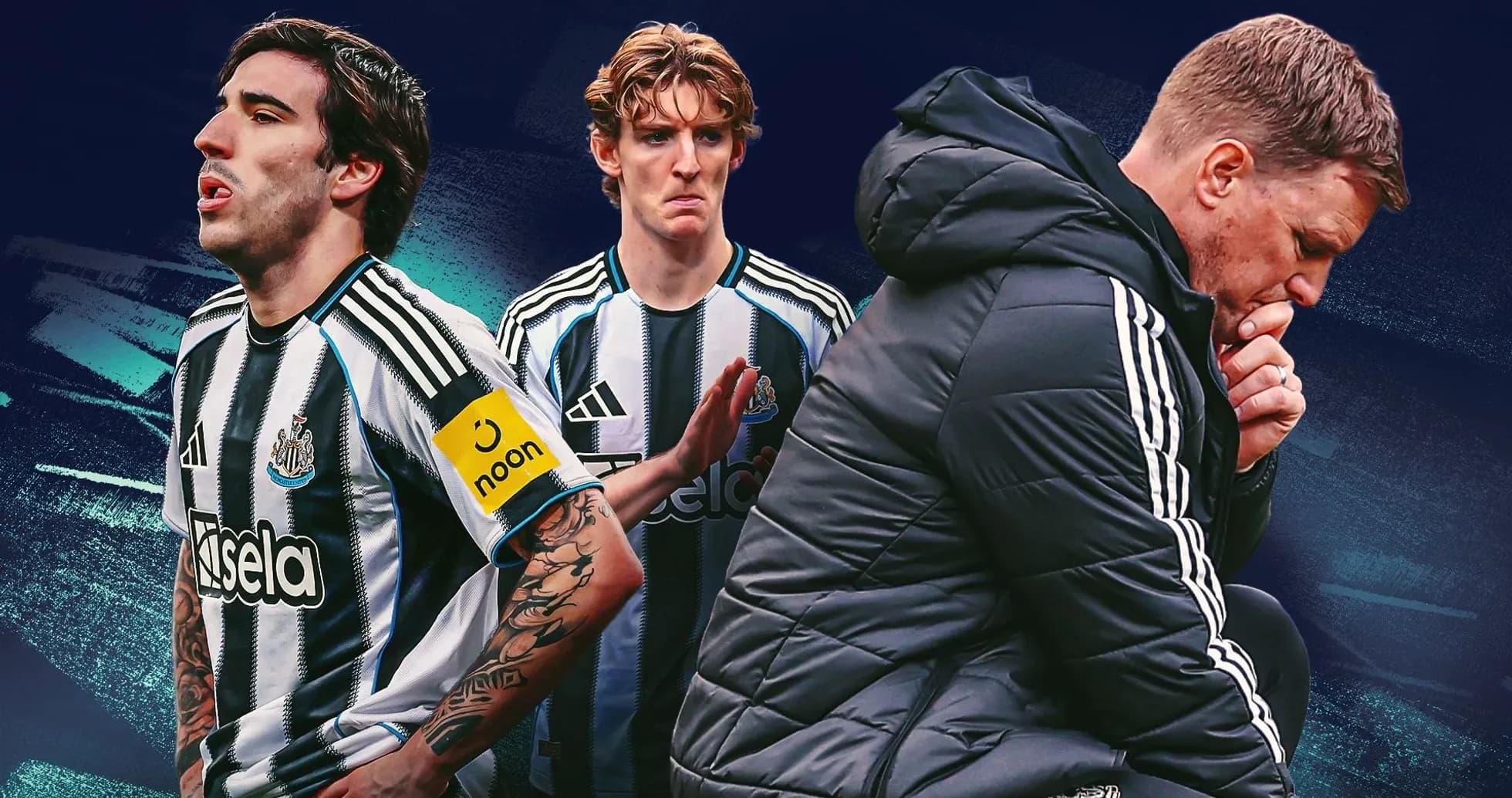
Newcastle United Faces Crisis at St. James' Park
The mood around St. James’ Park has curdled. What began as a blip has hardened into a crisis, and Newcastle United now find themselves staring at the wrong end of the table with a manager who suddenly looks and sounds like a man running out of answers.
In the 2026 form table, Newcastle sit 17th. Two points clear of Wolves, whose relegation has already been confirmed in real life, and sinking fast. Saturday’s 2-1 defeat by Bournemouth – a third straight league loss by the same scoreline – was their eighth defeat in 11 Premier League games. That run includes a derby loss to Sunderland and is bettered only by Tottenham, whose own collapse has dragged them into genuine relegation trouble.
This is not just a wobble. It’s a sustained slide.
Cup dreams have evaporated just as brutally. Manchester City swatted Newcastle aside in both the FA Cup and the Carabao Cup, ending their defence of the latter without ceremony. In Europe, Barcelona finished the job with cruelty, smashing them 7-2 at Camp Nou in the second leg of their Champions League last-16 tie. A season that began with talk of consolidation among the elite has dissolved into damage limitation.
For most of Eddie Howe’s reign, the bond between head coach and supporters has been unshakeable. He hauled the club away from relegation, twice steered them into the Champions League, and delivered a first major trophy in 70 years by beating Liverpool at Wembley in 2025. That sort of history buys time. It buys patience.
This feels different.
Boos rolled around St. James’ Park at full-time against Bournemouth, a sound almost unthinkable a year ago. Newcastle are not completely cut adrift from the pack chasing European spots, but the form table, the volume of teams above them and the sheer lack of momentum make a late surge look increasingly fanciful.
Alan Shearer, the club’s greatest goalscorer and never one to throw grenades lightly, voiced what many are now thinking on The Rest is Football podcast. He wondered aloud whether Howe has the energy – or the opportunity – to go again.
“As tough as it is for Eddie, I don't know what is going to happen with him,” Shearer said. “I listened to his interview afterwards, I watched him on the touchline, I just think, is he going to want to go again? Is he going to get a chance to go again?
“If all things are equal then I would like him to stay, but does he feel he is going to have the chance? Does he want to do it again? Are Newcastle United going to have to sell? I don't see Eddie Howe in charge of Newcastle next season, unfortunately. I look at his interview and I'm not sure the fight is there.”
Those words cut close to the bone because they chimed with what people saw. Howe, usually composed but quietly steely, sounded worn down after Bournemouth.
Sky Sports say his job is safe until the end of the season and that his position will not be reviewed before then. On current trajectory, that season is likely to end with Newcastle’s lowest league finish since relegation in 2015-16.
Before the Bournemouth game, Howe insisted his “fire” for the job still burned “very, very strongly”. Ninety minutes and another defeat later, his tone had shifted.
“I am very aware that eight defeats out of 11 is not good enough,” he admitted. “Winning games is the very simple remedy, but it's very hard to deliver. Momentum is against us and you can feel that in the big moments in games. There was a lack of goalmouth action from our perspective and we haven’t defended anywhere near well enough. We're not quite there at the moment. What's happening is systemic. I'm beginning to say the same things over and over again. That's a great frustration.”
The word “systemic” hung in the air. This is not about a missed chance here or a refereeing call there. It is about a team whose structure, confidence and belief have drained away.
The crowd let them know it. Boos at full-time, groans as attacks broke down, a stadium that once felt like a wave now reduced to a murmur. Speaking to Match of the Day, Howe looked and sounded like a man feeling the weight of that shift.
“[It's] Disappointing when you are not delivering for your supporters,” he said. “That is the ultimate disappointment when you feel you are letting people down who come here and support us. If they are critical of us, we have to accept that as that's the game we are in.”
He tried to draw a line between external noise and internal drive.
“There is so much media attention on the club because it is such a huge global fanbase, and you understand that you are in the business to win. I understand the frustrations of everybody else. My own internal motivation never changes regardless of results. I want to help players grow and develop and try and produce a winning team.”
The problem for Howe is that too many of the players he pushed hardest to bring in are nowhere near producing that winning team.
Newcastle’s big-money attacking rebuild after Alexander Isak’s acrimonious departure last summer has misfired badly. Howe was heavily involved in recruiting Nick Woltemade, Yoane Wissa and Anthony Elanga, a trio that cost around £180 million. None has come close to justifying the outlay.
Woltemade exploded out of the blocks and looked, briefly, like a clever answer to the Isak question. Then the goals stopped. His last league strikes came in December, a brace against Chelsea, and his form has fallen off a cliff in 2026.
Wissa’s season never really started. A knee injury robbed him of the first half of the campaign and he has not rediscovered his Brentford levels since returning, still waiting for his first league goal of the year. In their absence, Anthony Gordon and William Osula have been asked to lead the line at various points, a patchwork solution that has yielded little consistency.
Elanga, so electric for Nottingham Forest in 2024-25, has been a shadow of that player. No league goals, a single assist, and none of the sustained threat that persuaded Newcastle to move for him. Jacob Ramsey, another high-profile arrival and a midfielder with an eye for goal, has also struggled to settle, his adaptation slowed by an ankle problem.
That is the recruitment picture coming in. The picture going out may be even more alarming.
Howe himself acknowledged before Bournemouth that the club stands on the brink of major change.
“There's a few players out of contract and you've got some big players who have done amazing things for the club maybe entering their final few months of their time here,” he said. “You've got possibly players leaving in the summer and that natural evolution on that side, which happens at a football club.
“So, I can understand why the [term the] 'end of a cycle' might be used. What that looks like is unknown. It's always unknown. It's almost impossible to predict a summer transfer window and say, 'this will happen' or 'that will happen'. It's been impossible in every window I've ever managed because the moving forces in football are so difficult to predict.”
Those lines did nothing to lift the gloom. If anything, they deepened it. When a manager starts talking openly about the “end of a cycle”, supporters hear one thing: this group, the one that carried them back into Europe and to Wembley, is about to be broken up.
During his post-match press conference on Saturday, Howe was asked whether his squad still shared that “fire” he had spoken about. He paused for seven seconds before answering. On Tyneside, that silence was deafening.
The players most likely to be at the centre of this summer’s upheaval are well known. Sandro Tonali, Bruno Guimaraes, Tino Livramento and Anthony Gordon are all attracting serious attention. Kieran Trippier is already confirmed to be leaving as his contract winds down. Fabian Schar, a long-serving defender, could follow. Remarkably, reports suggest Woltemade or Wissa might be moved on after just a single season.
Tonali has been heavily linked with Arsenal and Manchester United. Guimaraes is also on United’s radar and is known to be admired by Pep Guardiola at Manchester City. Livramento, too, features on the lists of both Arsenal and City and is likely to be allowed to depart if the right offer arrives.
Gordon is the latest to be thrust into the rumour mill. Bayern Munich are said to be keen on the £75m-rated England winger as competition for Luis Diaz on the left, and the 25-year-old is understood to be open to a move. Woltemade, at this stage, has only been loosely linked with Bayern or Chelsea, but even those early whispers underline how fragile Newcastle’s squad feels.
The logic behind selling is clear enough. Newcastle must navigate the Premier League’s Profit and Sustainability Rules, and player trading is the most obvious lever to pull. Yet all of this is unfolding against a backdrop of uncertainty around the club’s owners, Saudi Arabia’s Public Investment Fund.
PIF are tightening their spending in response to the Iran war and wider economic pressures, including the looming 2034 World Cup. Last week, Newcastle chairman and PIF governor Yasir Al-Rumayyan confirmed that the fund is reviewing “some deals and investments”. A 70 per cent stake in Al-Hilal has already been sold for £276m, and there are strong rumours that PIF could even walk away from LIV Golf, the breakaway project launched in 2022 to challenge the PGA Tour.
The BBC reports that PIF remain “totally committed” to Newcastle and that the club will be “unaffected” by this recalibration of priorities. Those assurances may hold, but the question lingers: how insulated can any club be when its majority owner is cutting back elsewhere?
What is certain is that this summer will bring upheaval. A squad at the end of its cycle, a manager under scrutiny, star players linked with exits, an ownership group rebalancing its portfolio – all of it converging on a club that, not long ago, was being held up as the Premier League’s coming force.
Already in the eye of the storm, Newcastle are bracing for a transfer window that could define not just Howe’s future, but the entire direction of the project on Tyneside.