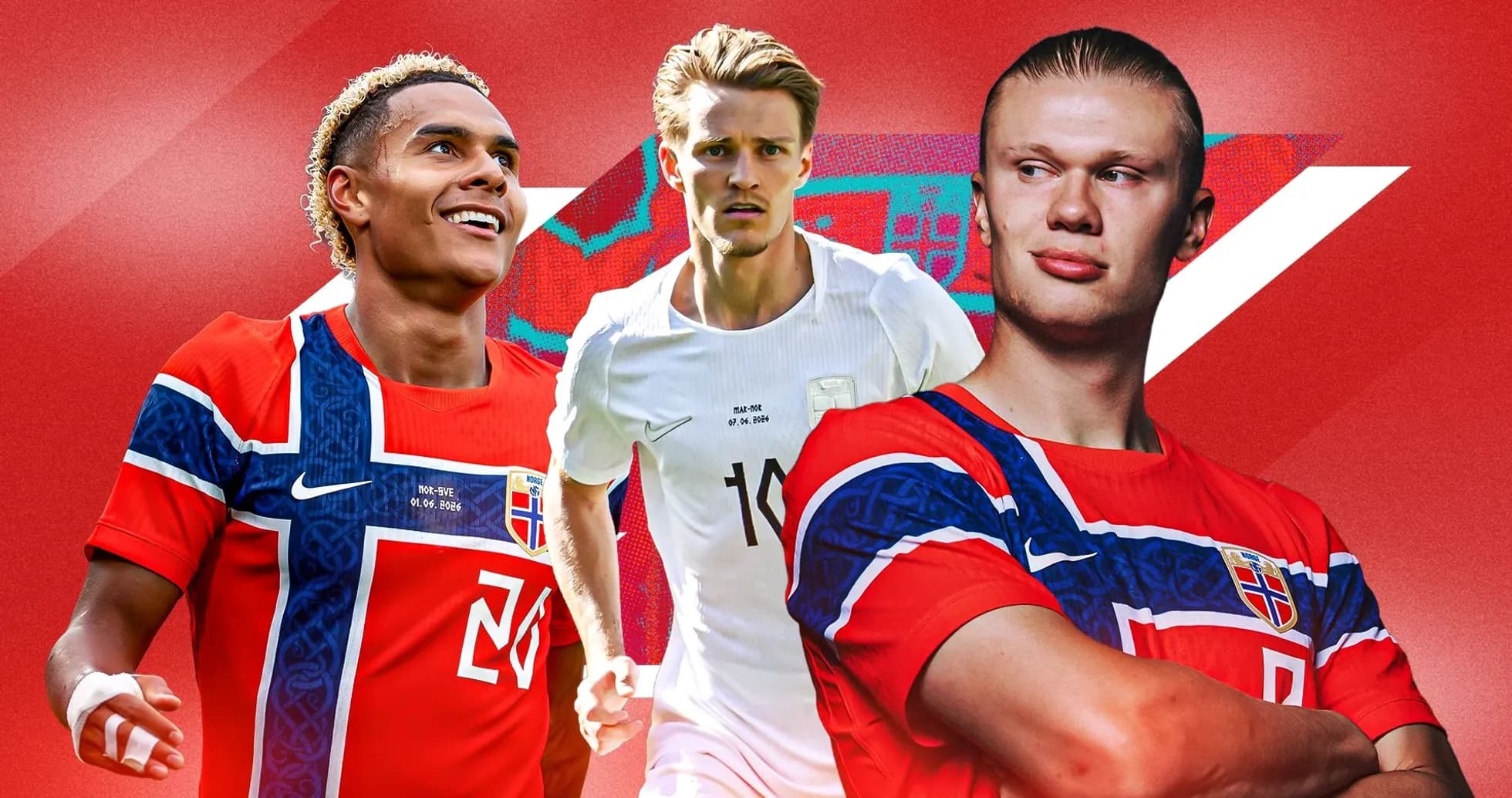
Norway's World Cup Squad: More Than Just Haaland
Erling Haaland will dominate the billboards and the television promos, but Norway are arriving in North America with far more than a one-man show. Stale Solbakken has built a side that attacks from unexpected angles, leans on a ruthless right-back, and hides a surprising amount of firepower behind its superstar No.9.
This is not the Norway of old. It’s a team that wants to hurt you from everywhere.
Wing talent built to feed a monster
The brief is simple: find Haaland early, find him often. The cast around him is anything but.
On the left, Antonio Nusa looks set to own the touchline. The 21-year-old RB Leipzig winger is slippery, fearless and already productive at international level. Six goal contributions in six qualifying games underline his impact, with Italy suffering most. He scored and assisted in a 3-0 home win, then turned up again in the 4-1 demolition in the return fixture. Defenders think they’ve got him contained; he glides past, changes direction, is gone.
Behind him waits Andreas Schjelderup, another young attacker with serious upside. The 22-year-old arrives off a surge under Jose Mourinho at Benfica, where he racked up 10 combined goals and assists in 14 league matches in the second half of the season. He also hit a brace against Real Madrid in the Champions League in January, a statement performance on the biggest club stage. Schjelderup is not yet a guaranteed starter for his country, but inside the Norway camp there’s little doubt: he is tracking towards stardom.
The right flank looks different. Taller. Meaner.
Alexander Sorloth, the 6'5" Atletico Madrid striker, is often deployed wide on the right. On paper, it sounds awkward. On the pitch, it’s a problem for opponents. Out of possession, he’ll do a job on the flank. Once Norway have the ball, he drifts infield to join Haaland in the box, turning one focal point into two. He matched his minutes with output in qualifying as well, producing eight goal contributions in eight games.
If Solbakken wants something a little more traditional, he can turn to Oscar Bobb. The Fulham man has not exactly exploded since moving to Craven Cottage, but he offers a different profile: tighter touches, more orthodox wing play, a calmer tempo. Jens Petter Hauge, revived at Bodo/Glimt after his AC Milan chapter, has also forced his way into the squad despite not featuring in qualifying. His club form, including eye-catching performances in those remarkable Champions League wins over Manchester City and Inter, was too strong to ignore.
Odegaard, the conductor
The wings and the forwards will grab the highlights, but Norway’s heartbeat lies in midfield. It’s a zone Solbakken can fill with players hardened by the Premier League and the Champions League.
Martin Odegaard is the undisputed leader. Arsenal’s captain can still divide opinion in England, where his influence sometimes ebbs and flows over a long season, but he rarely drifts through games in a Norway shirt. Even in an injury-hit campaign, he missed three of eight qualifiers and still managed seven assists, including a hat-trick of them in a single game against Israel. No one in Europe set up more goals in qualifying.
Either side of him, there is substance and steel. Sander Berge, Fulham’s defensive midfielder, patrols the base, breaks up play and gives Odegaard the platform to roam. Fredrik Aursnes, another Benfica regular, offers the legs and intelligence of a modern No.8, shuttling between boxes and knitting phases together.
Aursnes’ story adds a twist. Two years ago, he walked away from international football, saying he wanted “more time and freedom to prioritise other things in my life besides football”. In February, he changed his mind. Now, without playing a single minute in qualifying, he looks set to start at the World Cup. It’s a remarkable return, and Norway will lean heavily on his experience.
There is depth, too. Patrick Berg, the composed Bodo/Glimt captain, can slot in without fuss. Kristian Thorstvedt and Morten Thorsby, both based in Italy, bring versatility and bite. Solbakken has options to adjust without ripping up his plan.
Still, everything in the middle of the pitch bends around Odegaard. He is the link between the wide dribblers and the central destroyer up front, the man trusted to slide passes into Haaland’s stride or switch play into Nusa’s feet. If Norway are to navigate the “Group of Death”, they need their captain in full command.
Striker depth behind the superstar
Haaland will start every game if his body allows it. That is the expectation inside the camp and outside it. But Norway are not left helpless if the unthinkable happens.
Sorloth is the first in line to step into the centre-forward role. His record for the national team is respectable, and he heads to the World Cup after a 20-goal season with Atletico Madrid, achieved without being an automatic starter. He offers a different kind of chaos to Haaland, but the same commitment.
Solbakken knows exactly what he has. Speaking to FIFA, the Norway coach said: “Alexander brings a lot of physicality, and he's a loyal player that can play in different positions up front. Sometimes he plays together with Erling, sometimes he plays a little to the right. He's a goal threat, but he's also an assist threat. But the best thing is that he works so hard for the team, sometimes in a position that he maybe doesn't prefer."
Behind him, Jorgen Strand Larsen is more than a token third-choice. The Crystal Palace forward has adapted quickly to the Premier League since his 2024 arrival and carries real momentum into the tournament. He warmed up with a brace in a friendly against Sweden and also scored against Italy in qualifying. Even with Haaland fit, Strand Larsen is expected to see minutes, especially with Sorloth often starting wide.
Norway’s centre-forward pool, once a weakness, now looks like a quiet strength.
The right-back who plays like a winger
The most intriguing part of Solbakken’s blueprint sits on the right touchline, and it isn’t Sorloth.
Norway’s so-called unconventional approach from wide areas is built around Julian Ryerson. Officially, he’s the right-back. Functionally, he’s one of their main creative forces. When Norway have possession, Sorloth steps infield, effectively forming a front two with Haaland. That movement clears a runway for the Borussia Dortmund defender to thunder down the flank.
Ryerson doesn’t just overlap; he delivers. His 18 Bundesliga assists in the 2025-26 season tell their own story. He hits early crosses, deep crosses, low cut-backs. With Haaland and an inverted Sorloth attacking the box, his deliveries arrive to a crowd of giant targets.
Set pieces only deepen the threat. Ryerson’s dead-ball quality is a major weapon, with a significant chunk of those assists coming from corners and free-kicks. In a tight group, one well-worked routine, one vicious ball into a crowded six-yard box, could tilt a game. Opponents will pore over his clips. Stopping him is another matter.
A nation finally back on the big stage
For all the tactical quirks and statistical firepower, this World Cup carries an emotional weight in Norway that numbers can’t quite capture. It has been 28 years since they last walked out at football’s biggest event. A generation has grown up watching other nations’ flags fill the stands.
Solbakken felt it in his bones on the night qualification was secured. “I think it means a lot for the whole nation, especially the common supporter,” he told FIFA. “I think it's been hard for everyone to sit home at every World Cup back to when I played in 1998. Fifty-thousand fans came to meet us [after qualification was confirmed] on a Monday in minus four [degrees], so that says it all. They have waited for this moment for so long, and now it's finally here."
Reality, though, bites hard. Norway have landed in a brutal group with France, Senegal and Iraq. There is no talk of fairy tales from the coach, only of possibilities.
"I don't think we are dark horses to get all the way," Solbakken said. "I think we are dark horses in terms of, on our day, we can maybe beat a stronger opponent. But to say that we are dark horses for the whole tournament is too far. We are in a very hard group. I think it will be very tight and hopefully we have the organisation and the match-winners to get through."
He wants this World Cup to redefine what people think when they hear “Norway”. “For Norway, this is the World Cup to express themselves - to show the world that we play, maybe, a different kind of football than what we have done before, and that we are an offensive team with good individuals that work hard for each other. My dream scenario? I won't talk about it, because my dreams are for myself. But hopefully we can get the best out of the team and on our day, then we can beat anyone."
If Haaland catches fire, the narrative will write itself. The real question is whether this deeper, sharper Norway can turn that one blazing star into something bigger – a team that doesn’t just return to the World Cup, but announces it plans to stay.