Old Trafford Showdown: Manchester United vs Aston Villa for Champions League Spots
On 15 March 2026, Old Trafford stages a heavyweight Premier League clash with a distinctly European flavour as Manchester United host Aston Villa. Both sides are locked on 51 points after 29 matches, sitting 3rd and 4th respectively, separated only by goal difference. With the top four race tightening, this feels less like a routine league fixture and more like a direct play-off for Champions League status.
A. Taylor will take charge in Manchester, where United’s home strength and Villa’s away resilience collide in what promises to be a tactically rich, emotionally charged afternoon.
Form guide and statistical landscape
The table tells you these are near equals; the underlying numbers suggest they go about it in very different ways.
Manchester United have built their position on strong home form. At Old Trafford they have:
- 9 wins, 3 draws, 2 defeats from 14 matches
- 27 goals scored (1.9 per game)
- 16 conceded (1.1 per game)
They are generally more expansive at home, averaging 1.8 goals per game overall and carrying genuine attacking variety. However, 40 goals conceded across 29 matches (1.4 per game) hints at a side that always gives opponents a chance.
Aston Villa, by contrast, are slightly more conservative but highly efficient. Across their 29 matches they have:
- 39 goals scored (1.3 per game)
- 34 conceded (1.2 per game)
Away from Villa Park, they remain competitive:
- 6 wins, 4 draws, 4 defeats from 14 away games
- 18 goals scored (1.3 per game)
- 19 conceded (1.4 per game)
United come into this with a league form line of LWWDW in their last five, suggesting a team that has found a degree of rhythm and resilience after setbacks. Villa’s recent pattern of LLDWD points to a side whose blistering mid-campaign surge has cooled, but which still rarely rolls over.
Tactically, the contrast is clear in the data. United have alternated mainly between 3-4-2-1 (18 times) and 4-2-3-1 (11 times). That flexibility allows them to either match Villa’s midfield or overload central zones with an extra centre-back stepping into play. Villa have been more stable: 4-2-3-1 in 25 league matches, occasionally shifting to 4-4-2 or 4-2-2-2. That consistency underpins their structure, pressing triggers, and attacking patterns.
Head-to-head: a modern rivalry with wild swings
The last five meetings form a self-contained mini-drama between these two clubs, and it has had everything.
- On 21 December 2025 at Villa Park, Aston Villa edged a tight contest 2-1, having gone in level at 1-1 at half-time. It was a statement home win that underlined their top-four credentials.
- On 25 May 2025 at Old Trafford, Manchester United were controlled and clinical in a 2-0 victory, turning a 0-0 interval into a comfortable home success.
- On 6 October 2024 at Villa Park, the sides cancelled each other out in a 0-0 stalemate, a rare cagey chapter in an otherwise open series.
- On 11 February 2024 at Villa Park, United came away with a 2-1 away win, having led 1-0 at the break and managing the second half with maturity.
- On 26 December 2023 at Old Trafford, United produced one of the defining comebacks of the recent era. Trailing 0-2 at half-time, they turned the game around to win 3-2, a result that still stings in Birmingham.
Across these five matches, United have three wins, Villa one, and one draw. Old Trafford in particular has been a difficult place for Villa: a 3-2 defeat and a 2-0 defeat in the two most recent trips, with United scoring five times across those games.
The pattern is clear: Villa have shown they can hurt United, but United have repeatedly found a way to raise the tempo and seize the decisive moments, especially in Manchester.
Key players and attacking threats
For United, Bryan Mbeumo has become a central attacking reference point. With 9 league goals and 3 assists in 24 appearances, he offers:
- 50 shots, 29 on target – constant end-product threat
- 38 key passes – creativity from wide or half-spaces
- A strong work rate, underlined by 19 tackles and 6 interceptions
Alongside him, Benjamin Šeško’s numbers (8 goals in 24 appearances, despite only 13 starts) scream efficiency. With 27 shots on target from 43 attempts, he brings penalty-box presence and aerial power that can trouble Villa’s centre-backs, especially if United lean on crosses from wing-backs in a 3-4-2-1.
Villa’s response comes from a dynamic duo:
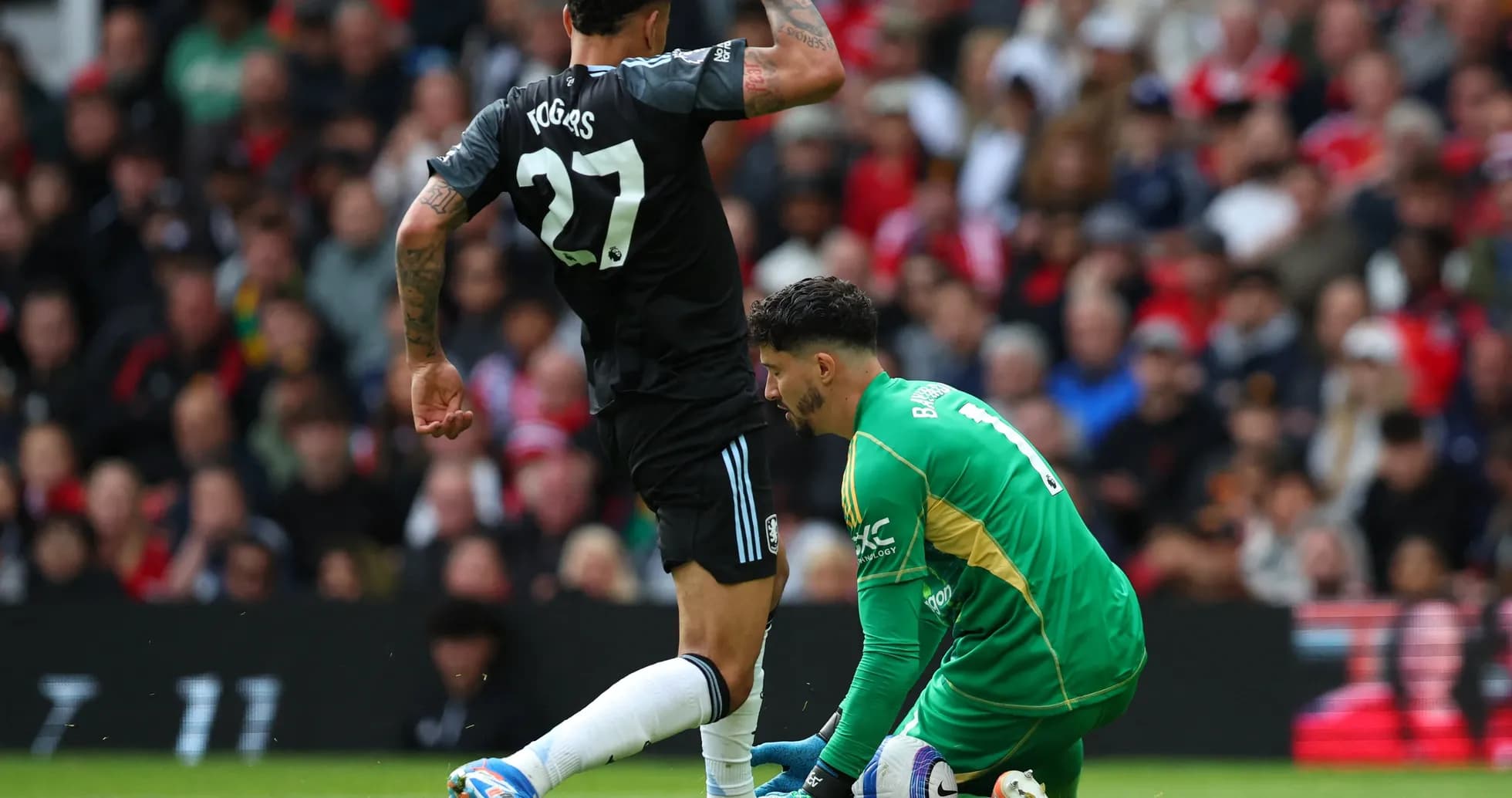
- Morgan Rogers: 8 goals and 5 assists, 47 shots (27 on target), 35 key passes, and 98 dribble attempts with 32 successes. He is the connector between midfield and attack, capable of drifting into pockets between United’s lines, especially if they use a back three.
- Ollie Watkins: another 8 goals, 1 assist, and 25 shots on target from 40 attempts. His movement across the front line, attacking channels and half-spaces, is designed to stretch defences and open lanes for runners like Rogers.
Neither side has leaned heavily on penalties in the league context: United have converted all three of their spot-kicks this campaign, while Villa have not taken any. That underlines how much of their output has come from open play and structured attacking patterns.
Team news and selection puzzles
Manchester United have defensive concerns. P. Dorgu (hamstring) and M. de Ligt (back) are both ruled out, removing depth and experience from the back line. L. Martinez (calf) is listed as questionable, as are J. Moorhouse (injury) and M. Mount (knock).
If Martinez does not make it, United’s ability to build from the back under pressure and defend space aggressively could be compromised. In a 3-4-2-1, that might force a more conservative selection of centre-backs, which in turn affects how high the wing-backs can push.
Aston Villa’s absentees are spread across key zones. H. Elliott (injury), A. Garcia (muscle), B. Kamara (knee), and Y. Tielemans (ankle) are all out, significantly thinning central midfield options and rotation possibilities. J. Sancho is unavailable due to loan agreement rules, denying Villa a creative wide option against his parent club, while M. Cash is questionable with a knock.
Without Kamara and Tielemans, Villa’s double pivot will be under scrutiny. Protecting the back four at Old Trafford and still feeding Rogers and Watkins in transition will demand huge physical and tactical discipline from whoever starts in those holding roles.
Tactical battle lines
United’s home numbers and formation history suggest they will try to seize the initiative. In a 3-4-2-1, expect:
- Wing-backs high and wide, pinning Villa’s full-backs
- Two attacking midfielders (with Mbeumo a prime candidate) rotating between lines
- Šeško or another central striker attacking crosses and second balls
Villa’s 4-2-3-1 is designed to:
- Compress central spaces with a disciplined double pivot
- Launch quick transitions through Rogers carrying the ball and combining with Watkins
- Use full-backs carefully, choosing moments to overlap without exposing themselves to counters
United’s card data hints at late-game intensity: a high share of yellow cards from 76-90 minutes suggests they often play on the edge as matches open up. Villa, meanwhile, show a spike in cards between 46-60 minutes, a sign of aggressive starts to second halves.
The verdict
This is a meeting of two top-four contenders with distinct identities: United, powerful and flexible at home; Villa, structured and dangerous on the break. The head-to-head record and Old Trafford factor tilt the balance slightly towards the hosts, but Villa’s away resilience and front-line quality mean this is unlikely to be one-way traffic.
Expect United to dominate territory and shots, Villa to carve out fewer but high-quality chances through Rogers and Watkins. With both sides missing important midfield and defensive pieces, transitions could decide it.
Edge to Manchester United, but by the finest of margins – and whatever happens, the outcome will echo loudly in the Champions League race.