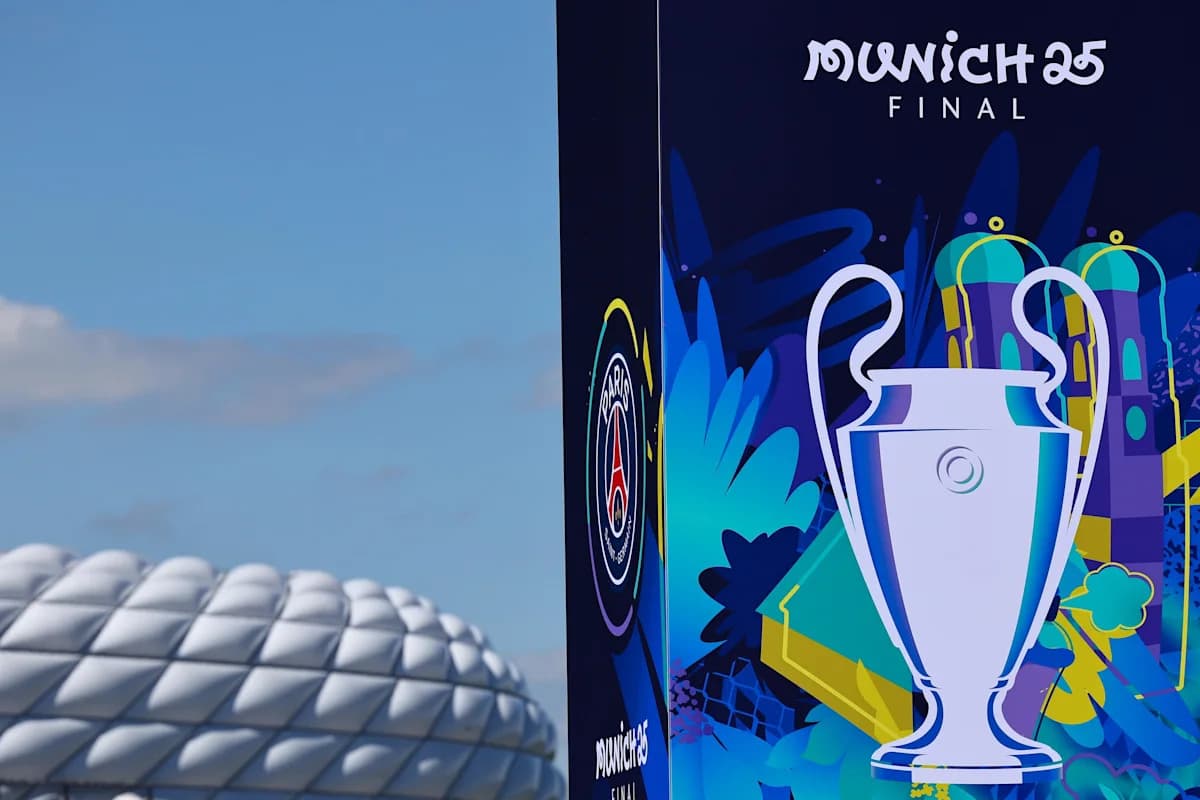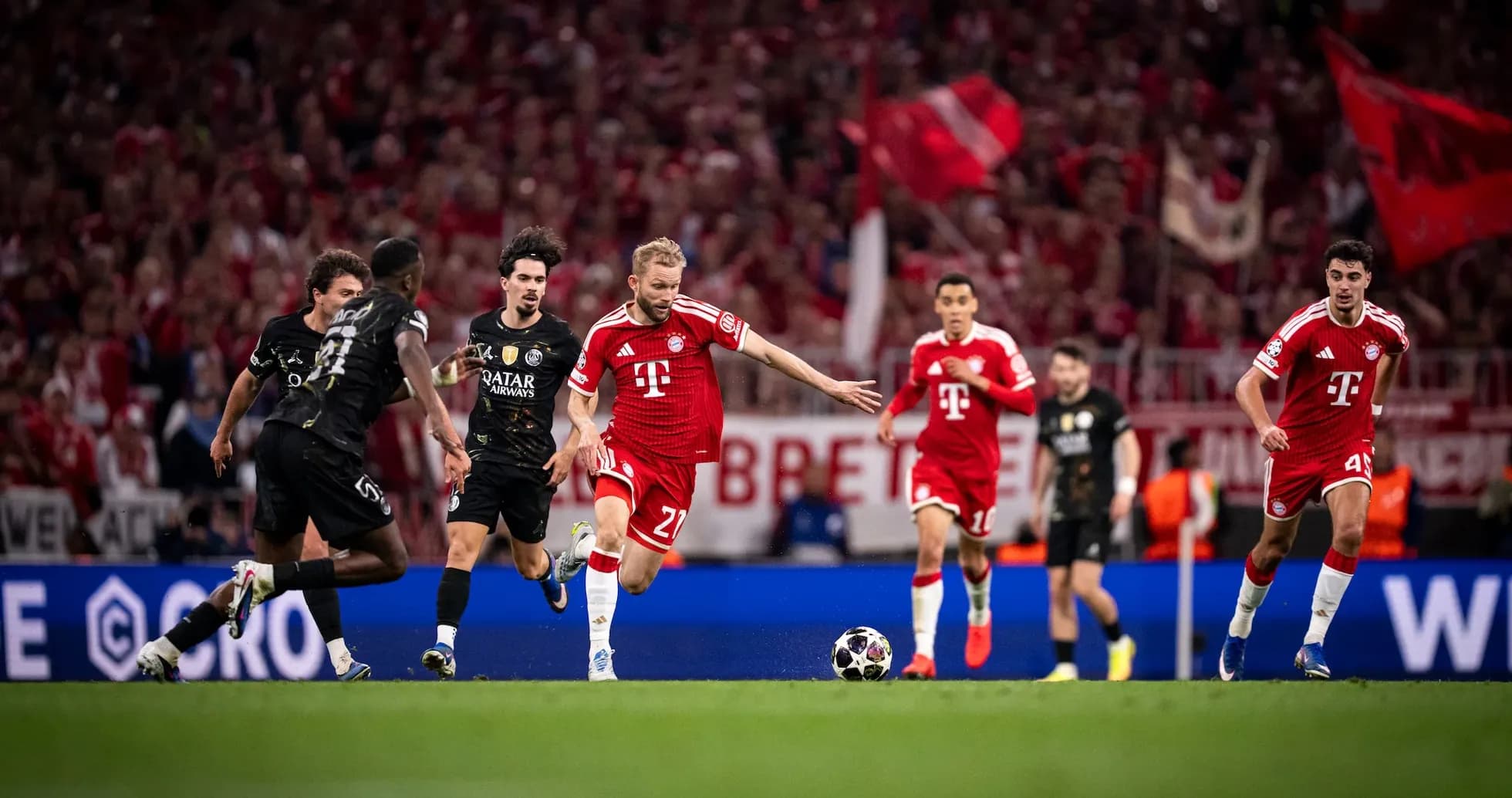
Bayern München and Paris Saint Germain Draw 1–1 in Tactical Clash
Allianz Arena staged a semi-final that split cleanly between Paris Saint Germain’s early vertical punch and Bayern München’s long, methodical siege. The 1–1 draw reflected that duality: PSG struck after three minutes and then receded into a compact 4-3-3 block, while Bayern, with 66% possession and 18 shots, spent most of the evening trying to prise open a narrow, disciplined defence before Harry Kane finally levelled on 90 minutes. Expected goals (1.4 vs 1.03) and saves (6 by M. Neuer, 5 by M. Safonov) underline a finely balanced contest in which Bayern controlled territory but never fully broke PSG’s transitional threat.
First Half
Ousmane Dembele’s opener at 3' defined the tactical starting point. PSG built quickly down the left: K. Kvaratskhelia received and attacked the channel, drawing Bayern’s back line across before sliding a diagonal ball into Dembele, who had drifted into the right half-space. The finish was routine, but the pattern was clear – PSG’s front three were positioned high and wide to exploit early-phase disorganisation in Bayern’s 4-2-3-1 rest defence.
Nuno Mendes’ yellow card on 8' for a foul signalled the intensity of Bayern’s immediate response, with M. Olise and L. Diaz repeatedly isolating the full-back and forcing him into aggressive interventions. Jonathan Tah’s booking on 33', officially for argument, reflected Bayern’s frustration at struggling to convert possession into clear chances against PSG’s compact mid-block. Just before the interval, Kvaratskhelia was booked at 45+3' for time wasting, underlining PSG’s willingness to slow the game and protect their 1–0 half-time lead.
Second Half
The second half became a rolling tactical chess match shaped by substitutions. At 65', B. Barcola (IN) came on for O. Dembele (OUT), slightly shifting PSG’s right side from a dribbling, one‑v‑one profile to a more direct runner in behind. Bayern responded two minutes later: A. Davies (IN) came on for J. Stanisic (OUT) at 67', pushing the left flank higher and giving Bayern a true overlapping threat. On 68', Kim Min-Jae (IN) replaced J. Tah (OUT), adding more aggression in front-foot defending but also more risk on the turn.
PSG doubled down on defensive reinforcement at 76', when L. Hernandez (IN) came on for D. Doue (OUT) and L. Beraldo (IN) replaced F. Ruiz (OUT). This effectively converted PSG’s 4-3-3 into something closer to a 5-4-1 in long phases, with Hernandez and Mendes (before his withdrawal) playing more conservatively and Beraldo giving extra central defensive cover. Bayern’s response was to inject more verticality between the lines: N. Jackson (IN) came on for J. Musiala (OUT) at 79', moving Kane into more flexible pockets and asking Jackson to run the last line.
The disciplinary tone remained sharp. Luis Diaz saw yellow on 78' for argument in the middle of Bayern’s sustained pressure phase, a sign of emotional load as PSG’s deep block continued to repel attacks. On 85', Bayern introduced L. Karl (IN) for D. Upamecano (OUT), a bold move that sacrificed a central defender for an extra midfielder, while PSG brought on S. Mayulu (IN) for N. Mendes (OUT), further stiffening the left side and allowing a narrower, more central defensive posture. Marquinhos’ yellow for a foul at 86' came as he repeatedly stepped out of the line to confront Kane between the lines. Deep into added time, Joshua Kimmich was booked at 90+7' for argument, capping a night of high psychological strain on Bayern’s leaders.
Equaliser
Kane’s equaliser at 90' was the logical end-point of Bayern’s structural adjustments. With Davies high and wide, Bayern could finally pin PSG’s last line across the full width. The goal stemmed from a left-sided surge: Davies overlapped from deep, received in stride and delivered a low ball into the box, where Kane, now operating as a roaming nine, arrived between centre-backs to finish. The assist from Davies was the payoff for Kompany’s decision to replace the more conservative Stanisic and to later remove a centre-back for an extra midfielder, accepting defensive exposure in pursuit of volume and quality of entries into the area.
Statistical Overview
Structurally, Bayern’s 4-2-3-1 was possession-dominant but initially too sterile. Kimmich and A. Pavlovic formed a double pivot that recycled the ball efficiently (Bayern completed 496 of 570 passes at 87%), yet for long stretches they circulated in front of PSG’s midfield line rather than breaking it. J. Musiala operated as the central 10, but PSG’s trio of Vitinha, J. Neves and Ruiz kept the central corridor congested, forcing Bayern to rely on wide combinations through Olise and Diaz. The lack of early overlapping from Stanisic and relatively conservative starting positions from Laimer limited Bayern’s ability to stretch PSG horizontally until Davies’ introduction.
PSG’s 4-3-3 without the ball was the game’s key defensive structure. With only 34% possession and 301 passes (213 accurate, 71%), Enrique Luis’ side accepted a low-pass, low-possession profile, prioritising vertical transitions. Vitinha and Neves screened passing lanes into Kane and Musiala, while Ruiz slid wide to support against Bayern’s left. The front three pressed selectively, mainly on triggers – backward passes or loose touches – rather than in a high, continuous press. Once ahead, PSG increasingly retreated into a compact mid-to-low block, especially after the 76' double defensive substitution.
In goal, M. Neuer’s six saves against PSG’s seven shots on target underscored Bayern’s vulnerability in defensive transition. PSG produced 15 shots (eight inside the box, seven from distance) from relatively limited possession, with an xG of 1.03. Neuer’s shot-stopping marginally overperformed his xG conceded, in line with the 0.23 goals prevented figure. At the other end, M. Safonov made five saves against Bayern’s six shots on target, with Bayern generating 1.4 xG but scoring only once. His own 0.23 goals prevented suggests that both keepers performed at a near-identical shot-stopping level, each adding similar value above expectation.
Statistically, Bayern’s overall form in this match was that of a dominant, territory-controlling side: 66% possession, 18 total shots, 13 from inside the box, but only one corner and relatively few clear cut chances until late. Their Defensive Index on the night was mixed – they limited PSG to 15 shots but conceded too many high-quality transitions early, reflected in the early goal and Neuer’s workload. PSG’s overall form was defined by efficiency and compactness: fewer passes, more corners (8 vs 1), and a shot profile that nearly matched Bayern’s quality despite far less ball. Disciplinary balance was exact – three yellow cards per team – but the timing of PSG’s early time-wasting and Bayern’s late arguments showed which side was protecting and which was chasing. In the end, the 1–1 felt like a fair synthesis: Bayern’s structural dominance offset by PSG’s early incision and resilient defensive organisation.