Pakistan’s Bowlers Shine as India Falter in Asia Cup Final
Pakistan’s seamers and canny change-ups turned a high-scoring final into a late-overs choke for India, as a flurry of wickets under pressure dragged the Asia Cup firmly to the men in green.
What began as a free-scoring contest slowly morphed into a trial of nerve. Pakistan passed it. India didn’t.
Pakistan’s innings: fireworks, then a stumble
The tone of the day was set early. At 62, India struck their first blow when Hayam Khan skipped down the track once too often. The bowler pushed it wider, tempting the big swing; Hayam’s slog turned into a reaching waft, the outside edge flying through to the keeper. Pakistan 62 for 1, and India briefly breathed.
Abdul Qadir then tore up the script. He went after anything tossed up, turning a measured spell from Arjun Rajput into a personal highlight reel. But Arjun refused to panic. He adjusted, teased Qadir a little wider outside off, and at 197, the pressure finally snapped the partnership. Qadir, again looking to go aerial, was too early into the stroke, slicing a thick leading edge straight to cover. One of the most entertaining 80s of the tournament ended with a misjudged cut and a rueful walk back: Pakistan 197 for 2, the game still wide open.
Usman Khan ensured the platform didn’t go to waste. He manipulated the gaps, punished anything short, and when he did fall, it took a mis-hit against the run of play. On 240, he moved away to carve the ball over the vacant long-off region, but didn’t find the middle. The flat-batted stroke sailed only as far as mid-off. A brilliant innings ended with his bat raised and a standing ovation from the dressing room: Pakistan 240 for 3, the launchpad set for a 330-plus total.
India clawed back with craft, not brute force. Ahmed Hussain never quite looked settled, and at 299, his semi-struggle finally ended. A slower ball gripped in the pitch, dragged wider outside off. Ahmed danced down, drifting across his stumps, one hand coming off the handle as he lost shape. He could only spoon a catch to extra cover, where Sehwag made no mistake. Pakistan 299 for 4, momentum tilting.
What followed was an over that changed the mood of the ground. At 305, Farhan Yousaf sank to one knee and aimed a monstrous slog at another slower ball. The ball went miles up, not miles long, and long-on settled under it. Six runs and two wickets in the over – India suddenly had Pakistan wobbling at 305 for 5.
The wobble turned into a mini-collapse. At 311, HA Dar was gifted a full toss on the hips, a ball that should have disappeared. Instead, his flick flew straight to square leg. Another soft dismissal, another Indian cheer. Pakistan 311 for 6, the innings losing shape just when it should have been exploding.
Hamza Zahoor’s dismissal at 317 summed up Pakistan’s muddled endgame. Presented with a slot ball outside off, he went for the straight slog but failed to middle it, picking out long-off. Pakistan 317 for 7, the finish line still some way off.
The spectre of the slower ball loomed over the closing overs, and when pace finally returned, it did so with brutal precision. At 332, Niqab Shafiq decided he had to swing. He received a pace-up yorker instead. His bat came down across the line; the ball rifled straight past it and into the stumps. Pakistan closed on 332 for 8 – a big score, but not an untouchable one on this surface.
India’s chase: promise, then a collapse under the lights
India began their reply with intent. VK Vineeth looked to take on the short ball, but Pakistan’s quicks used the pitch and their height smartly. On 146, a bouncer targeted his back shoulder. Vineeth swivelled deep in the crease to pull, only to see the ball balloon off the outer part of his bat to midwicket. India 146 for 2, and the chase still well within control, but Pakistan had a foothold.
Arjun Rajput then anchored the innings, knitting together the chase with calm strokes and sharp running. When he fell, the entire mood of the contest changed. At 172, trying to force the tempo, he punched at a back-of-a-length ball angling away. The outside edge flew to the keeper, who made no mistake. The bowler shot an arm up, the fielders roared, and Pakistan knew they had removed the big fish. India 172 for 3, the equation now as much about temperament as runs.
Abdul Qadir’s earlier fireworks with the bat were matched by Pakistan’s discipline with the ball. They tightened the screws in the middle overs, forcing India’s middle order to manufacture shots rather than build them.
The turning point came as the chase moved into its nerve-jangling phase. At 217, LR Raichandani lost his shape completely. Presented with a full ball at the stumps, he slashed across the line, only to pick out midwicket. The catch was a moment to remember: the fielder launched himself into the air, clutching a one-hander that sent Pakistan’s players racing in from all angles. India 217 for 5, and Pakistan, as the commentary put it, had one hand on the trophy.
India tried to counter-punch through ADB Savsani, but the pitch and Pakistan’s variations kept tightening the noose. At 251, whatever Farhan Yousaf said in the huddle clearly hit home. A cutter was pounded into the surface outside off, and Aryan Savsani threw everything at it. He didn’t get the distance. Deep cover point charged in and dived forward to complete another crucial catch. India 251 for 7, the chase now teetering.
The pressure only intensified. At 252, KP Patel tried to run a short ball down to third man. The delivery kicked and angled across him, finding the edge. Zahoor dived forward to take a clean catch, then in the same motion under-armed the ball into the stumps at the striker’s end. For a moment, confusion reigned: was it a catch, was it a run out? The decision came back as caught behind. Pakistan erupted again. India 252 for 8, their lower order exposed and the target still distant.
From there, the result felt inevitable. Pakistan’s earlier stutters with the bat were forgotten as their bowlers, armed with cutters, slower balls and the odd well-directed bouncer, closed out the game with icy control.
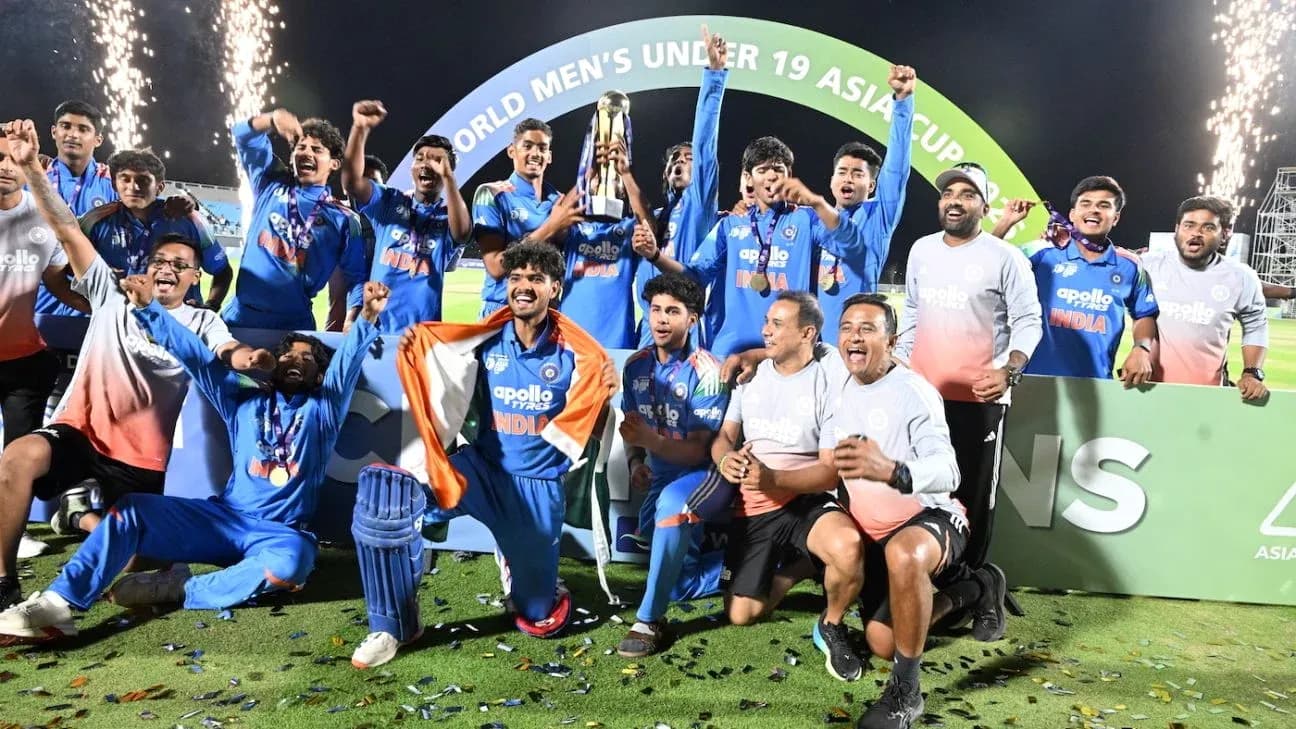
India had started the day chasing a trophy. By the end, they were chasing shadows – of missed chances, of a platform not converted, and of a Pakistan side that refused to blink when it mattered most.