Portugal's Emotional Victory: Honoring Diogo Jota
Cristiano Ronaldo stood alone in the glare of the floodlights, a red No. 21 shirt stretched out in front of him, the noise of Toronto Stadium folding into something quieter, more respectful.
Portugal had just survived Croatia. A 2-1 World Cup knockout win, sealed in stoppage time, should have been pure euphoria. Instead, it became something else: a night of remembrance, a night for Diogo Jota.
A Win Wrapped in Grief
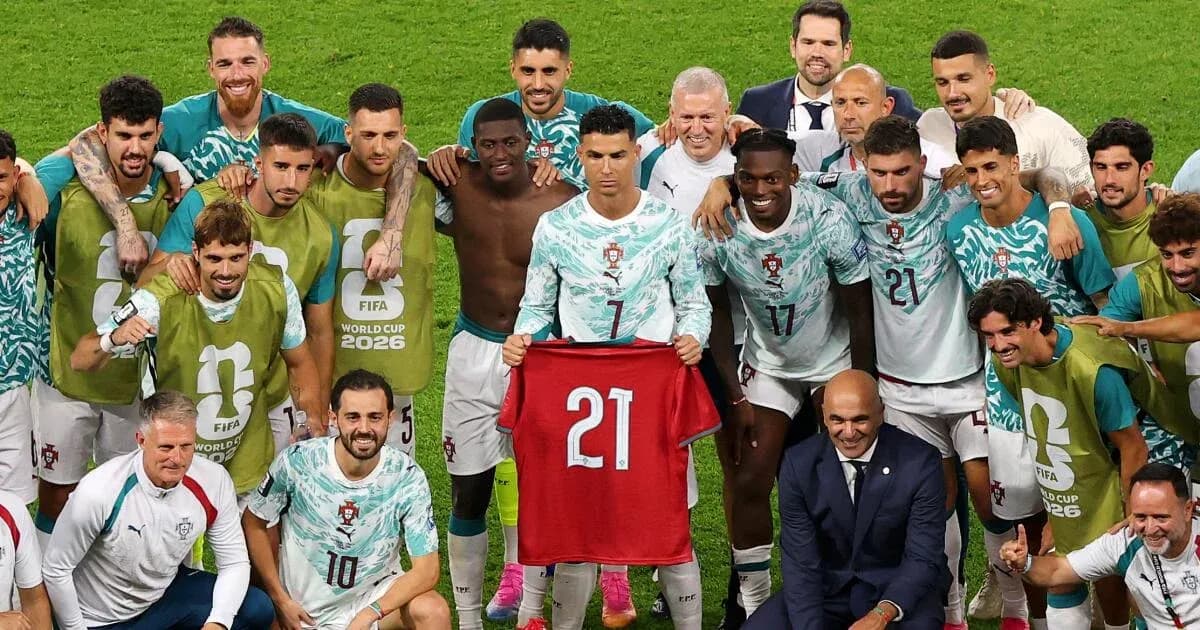
At the final whistle, Portugal’s players gathered in the center circle, the tension of a wild finish still etched on their faces. Some grinned, some simply exhaled. In the middle, serious and composed, stood their captain.
Ronaldo held Jota’s Portugal jersey — red, No. 21 — as the squad posed for a photo on the pitch. Around him, teammates beamed. He did not. The weight of the moment sat differently on his shoulders.
Then came the gesture that turned a victory into a tribute. Ronaldo pulled the shirt over his own, the number of a teammate who would never wear it again now pressed against his chest. He walked slowly across the field, clapping, nodding, taking in the roar. Emotion caught up with him as he acknowledged the crowd, the celebration tinged with grief.
Later, speaking to Portugal’s Sport TV, he gave the night its meaning.
“It’s a special day, for our Jota, who is up there illuminating us,” he said. “We know he’s present with us and it only made sense to win today to honor him in the best way.”
On X, he posted the team photo with a message that cut straight to the point: “We won for ourselves, for Diogo, and for Portugal!!! LET’S GO!!!!”
Drama, Then Deliverance
The game itself had all the turmoil of a World Cup knockout tie. Croatia, stubborn and streetwise, pushed Portugal to the edge. When the breakthrough finally came, it was the 41-year-old who dragged his team back.
In the 68th minute, Ronaldo stepped up to the spot and buried his penalty to make it 1-1, a familiar script in an unfamiliar phase of his career. The goal steadied Portugal and rattled Croatia.
The pressure built. The clock ticked. Portugal pushed.
Deep into stoppage time, the release arrived. Goncalo Ramos rose and met a cross with a firm header, steering in what would become the winner. Bedlam in the stands, bedlam on the pitch.
The chaos wasn’t finished. Croatia thought they had forced extra time with a late effort, only for the goal to be ruled out for offside just before the final whistle. Relief washed over Portugal’s players, a collective exhale after a night that refused to settle.
Ramos, still catching his breath, made it clear where his mind had been.
“We think about him every day,” he told Fox Sports, speaking of Jota. “It’s even more special to win this game in this day. And he gives us strength every day and for every game.”
A Stadium Remembers No. 21
From the moment the anthem played, Jota’s presence lingered over the occasion. His image appeared on the big screen as Portugal’s national anthem rang out, a face once part of the lineup now part of the memory.
In the 21st minute — his Portugal shirt number — sections of the Portugal support rose to their feet. They unfurled a banner bearing his image, a simple, powerful tribute in a sea of red and green. Balloons marked with his number floated upward, drifting into the night sky above Toronto Stadium.
It was a coordinated act of remembrance, but it felt organic, raw. A fan base claiming one of its own, refusing to let his story fade.
A Life Cut Short, A Legacy That Endures
Just after midnight on July 3, 2025, Jota and his brother, André Silva, died in a single-car crash near Zamora, Spain. Jota was 28. Silva was 25.
For Portugal, the loss went beyond statistics. Jota, a clinical finisher with sharp movement and a ruthless eye for goal, had played nearly 50 times for his country. He made the 2022 World Cup squad but never stepped on the pitch, sidelined by injury. Even from the bench, he remained part of the group’s fabric, a player teammates trusted and coaches valued.
His club career told a similar story. At Liverpool FC, he scored 65 goals in 182 games, a relentless, intelligent forward who thrived in big moments and embraced the demands of Anfield. The bond between player and club has not dimmed.
On Wednesday, Liverpool unveiled a memorial at Anfield dedicated to “Jota and Silva.” Sculptor Emma Rodgers designed the monument, named “Forever 20” in honor of Jota’s Liverpool jersey number. It stands as a permanent reminder that his impact stretched beyond goals and games, into the hearts of those who watched him, worked with him, and loved him.
The club’s message on X captured the scale of that loss and the depth of that connection.
“Today, as every day, we remember Diogo Jota and André Silva, who tragically passed away one year ago,” Liverpool wrote. “Through immeasurable loss and incalculable pain, the impact they made and the legacies they left behind — not only within the footballing world, but in the hearts and minds of so many around the world — has shone through over the last 12 months.
“All of our love, support, thoughts and prayers continue to be with Diogo and André’s families, friends and all those whose lives were touched by them. Forever in our hearts, forever our number 20.”
Playing for the Absent
For Portugal, this World Cup run is about more than tactics and form. Nights like this, with late winners and disallowed goals and a captain in tears wearing a fallen teammate’s shirt, reveal the emotional undercurrent driving a squad.
They are playing for themselves, for a nation, and, unmistakably, for Diogo Jota.
On the eve of the one-year anniversary of his death, Portugal found a way to win. Not cleanly. Not comfortably. But with the kind of stubborn, late drama that Jota himself would have relished.
The tournament moves on. The stakes will rise. The games will get harder.
The question now is simple: how far can a team go when every knockout night feels like a promise kept to someone who should still be there?