Raphinha's Transformation: From Ballon d'Or Snub to Barcelona's Star
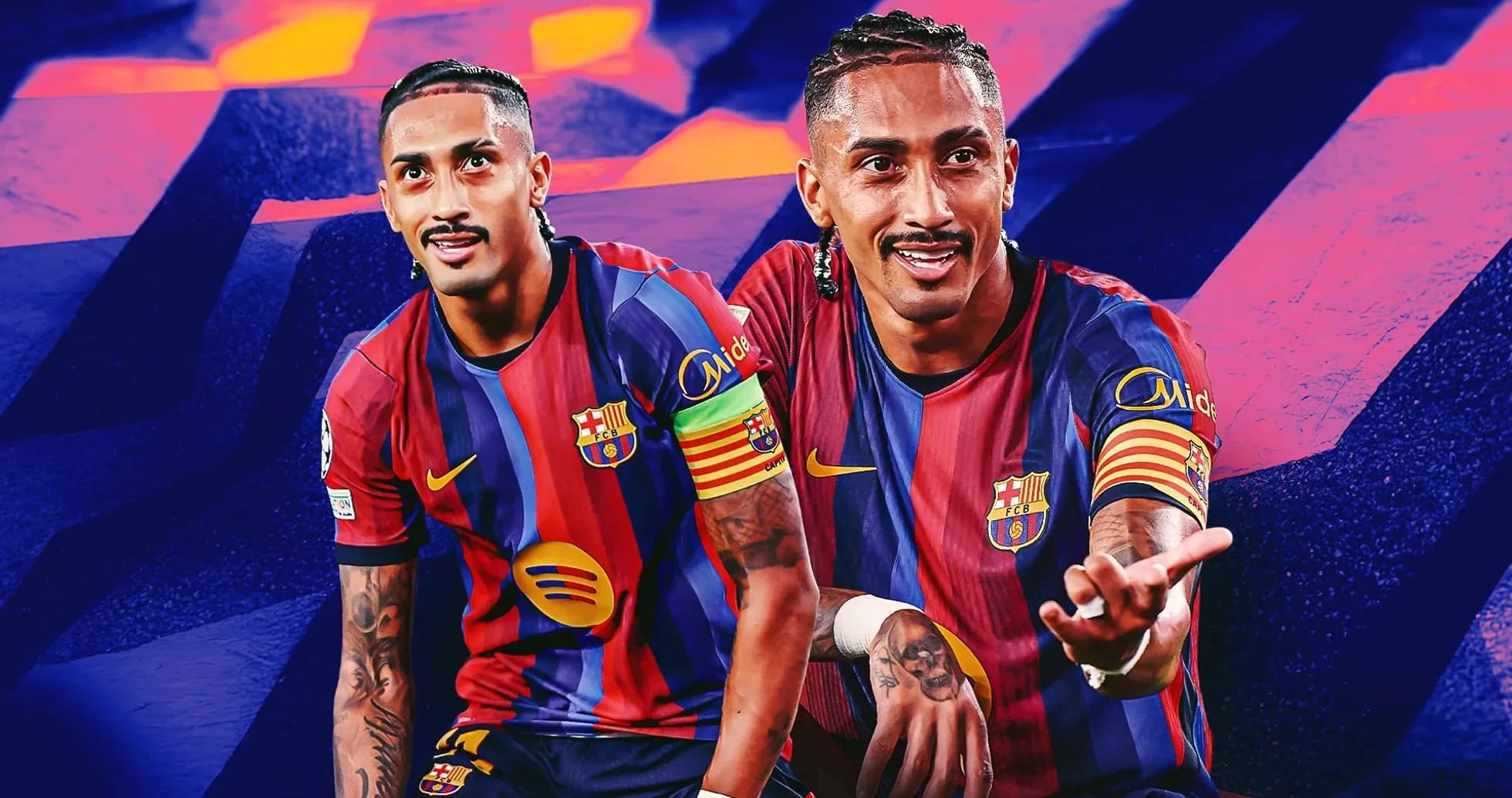
A year ago, Raphinha was broken. Hamstring after hamstring, 125 days out, a World Cup wrecked, his Ballon d'Or dream gone. Sixty goal contributions in 2024-25, then just 29 the following season. From unstoppable to unavailable.
Now he looks like the best player on the planet.
Hansi Flick has dragged him into the middle of the pitch and handed him the keys to Barcelona’s attack. The transformation has been violent, spectacular and, in the eyes of his coach, scandalously underappreciated.
“He is far too good not to be on that list, but we can’t change it,” Flick snapped when Raphinha’s name was nowhere to be seen among the 30 Ballon d'Or nominees. It was not a complaint from a manager looking for excuses. It was a statement made with the calm of a man who knows what he has in his dressing room.
He had just watched Raphinha tear Feyenoord apart.
A winger turned assassin
Raphinha has spent most of his Barca career hugging the touchline. Under Flick, he has become the spearhead.
The Champions League opener against Feyenoord felt like a coming-out party for this new version. His first goal was pure theatre. He collected a slightly loose pass from Lamine Yamal, slipped by one defender, glided into the box and shaped to shoot. Instead, he sold an outrageous dummy that left two more Feyenoord defenders on the turf, then rolled the ball into the net as if he had all the time in the world.
The second was centre-forward craft straight from a manual. When Dani Olmo picked up the ball in the centre-circle, Raphinha initially moved towards him, dragging his marker with him. Then he spun and burst into the opposite channel, took Olmo’s through ball in stride and whipped a low finish across the goalkeeper. Textbook movement. Clinical end product.
Barca ran out 5-1 winners. Raphinha walked off with Player of the Match and the air of a man who had just announced a new era.
“Rapha has played fantastic,” Flick said. “He's on another level - he's unbelievable."
The numbers agree. Eleven goals already this season – no Barcelona player in the last 60 years has started a campaign that fast. Not even Lionel Messi. Messi hit 10 in his first seven games in 2012-13, and twice reached nine at this stage. Ronaldo Nazário only matched nine in 1996-97.
Raphinha has gone beyond them.
Flick’s perfect focal point
The shift explains why Barca’s attack suddenly feels turbocharged. Robert Lewandowski used to pin centre-backs with his back to goal. Ferran Torres attacked space with clever, angled runs. Raphinha does both jobs and then adds chaos.
At 29, he roams between the lines, never static, always searching. His acceleration and tight control drag defences out of shape, his link play stitches moves together, and when the space opens, he is usually the first to see it.
That movement has turned the flanks into a playground for Yamal and Anthony Gordon. Raphinha’s constant drifting pulls centre-backs and holding midfielders into uncomfortable areas, leaving corridors for the wingers to attack. When defenders finally adjust, he is already ghosting into the gap they’ve left behind.
Racing Santander felt that first-hand in La Liga. Barca smashed them 7-2, Raphinha walking away with the match ball. Two of his goals came from the spot, but the one in between summed up his new role. Olmo again threaded the needle, Raphinha slipped between the centre-backs unnoticed, took a single touch and guided a half-volley into the corner. No fuss. No panic. Just a striker who knows exactly where the goal is.
On the ball, he makes everything look simple. Off it, he is a nuisance. The press starts with him, sprinting, harassing, forcing hurried clearances and bad decisions. Flick demands intensity and dynamism from his front line. Raphinha delivers both, with a razor edge.
Somewhere in a quiet office, the Barca coach must be relieved that the club never closed a deal for Julián Álvarez. The attack is humming without him, and the transfer budget can now be pointed at other weak spots.
Chasing the ghost of R9
Barcelona know what a Brazilian phenomenon looks like. Romario, Rivaldo, Ronaldinho, Neymar – the lineage is heavy. Yet Ronaldo’s single season in 1996-97 still sits on its own shelf.
Ronaldo arrived from PSV for a world-record fee, 20 years old and already a force of nature. In 49 games he scored 47 goals, tearing through defences with a blend of raw pace, brute strength and cold-blooded finishing. He lifted the Copa del Rey, the UEFA Cup Winners' Cup and the Supercopa de España, picked up the Pichichi with 34 league goals, won the European Golden Shoe and then the 1997 Ballon d'Or.
He left behind a highlight reel that still feels unreal: the solo run against SD Compostela, the hat-trick to overturn Atlético Madrid 4-3 in the Copa del Rey. Sir Bobby Robson simply called him “the most spectacular player I've ever seen.” Laurent Blanc compared him to a freight train with a ball at his feet.
Ronaldo – ‘R9’ – was a fixed reference point up top, the tip of every attack. Raphinha floats more, but the instinct is the same. He is just as direct, just as ruthless when the gap appears. He does not need five chances to score. Often he needs one.
If this level holds, the comparison will stop sounding like sacrilege. Matching Ronaldo’s 47 goals would be outrageous; delivering a treble on top of it would push him into a different conversation altogether.
A captain who refuses to stand still
What makes this run even more dangerous for opponents is that Raphinha refuses to see himself as complete.
“I will never say I am performing well; I always strive to improve everything I can,” he said after the Racing demolition. “I am happy with the goals, and with the win, and that is the most important thing, but we have to keep improving.”
He stressed how “comfortable” he now feels through the middle and pointed directly at Flick for his evolution. “He is the coach who changed the way I think and how I see myself. I am extremely grateful.”
Without Flick, he might not even be at Camp Nou.
The first two years in Barcelona were underwhelming. Under Xavi, he never fully nailed down a starting place, often shuffled around, never entirely trusted as the main man. A departure in 2024 felt like a realistic option.
Flick arrived and made a different calculation. He saw potential, not frustration. Responsibility, not rotation.
When Marc-André ter Stegen left on loan for Ajax in the summer, Flick did not hesitate. He handed Raphinha the armband permanently. For the first time in the club’s history, Barcelona had a Brazilian captain in Catalunya. The risk has paid off handsomely.
Raphinha leads with his legs and his lungs. He presses like a squad player fighting for a contract, not a star protecting his status. He demands the ball when games tighten, insists on being the one to decide them. The younger players have a living example of what “team-first” actually looks like.
A frontline with teeth – and depth
Barca lost Lewandowski and Torres, and let Marcus Rashford return to Manchester United. On paper, that is a lot of firepower walking out the door. On the pitch, Flick’s side are sharper than ever.
Raphinha is the headline act, but he is not alone. Gordon, Karim Adeyemi and Gabriel Jesus have all settled quickly. Flick can now also turn to 18-year-old Hamza Abdelkarim, promoted from Barca B and already part of the rotation.
“Raphinha, Gabby and Hamza are three different profiles, but there are other ways we could play,” Flick has said. “Anthony and Karim can also play in this position (as striker). Or Dani Olmo. Dani has showed us in last two years he can play there - the same with Fermin [Lopez]. We have a lot of options.”
Those options matter. So does the way Flick uses them.
Raphinha’s body has already betrayed him once. To avoid a repeat, his minutes are being managed with care. Flick has taken him off early against Feyenoord, and in league wins over Athletic Club and Racing, protecting his captain’s legs while the scoreline allows it.
The same caution is being applied to Yamal, whose partnership with Raphinha is fast becoming one of Europe’s most thrilling double acts. When a centre-back leans towards Yamal, the teenager simply slips the ball inside, trusting that Raphinha is already sprinting into the blind-side channel. Most of the time, he is.
Yamal does not seem bothered about sharing the stage. In fact, he looks liberated by it. Flick has a dressing room full of big names, but no one is jostling for headlines. The ego management is as impressive as the tactics. The collective edge is sharp.
Towards the Hall of Fame
Barcelona’s history with Brazilian geniuses is rich, but selective. Not everyone gets a permanent seat next to Ronaldo, Romario, Rivaldo, Ronaldinho and Neymar.
Raphinha is forcing that conversation.
He is the captain who almost left, the winger turned nine, the Ballon d'Or outsider playing like a frontrunner. He presses like a role player, finishes like an elite striker and carries himself like a man who knows exactly what this season could become.
If he keeps this pace, the question will not be whether he deserves a Ballon d'Or nomination. It will be whether, in a club obsessed with its past, he has just carved out a place alongside R9 in Barca’s Hall of Fame – and how many trophies he will be holding when he gets there.