Real Madrid vs Girona: A Tactical Analysis of Their 1–1 Draw
Real Madrid and Girona shared a 1–1 draw at Estadio Santiago Bernabéu in La Liga’s Regular Season - 31, a result that reflected Madrid’s territorial dominance but also Girona’s resilience and efficiency in key moments. The hosts controlled possession, generated far more shots and the higher xG, yet failed to turn that superiority into a decisive advantage. Federico Valverde’s opener early in the second half was cancelled out by Thomas Lemar, and despite sustained late pressure, Paulo Gazzaniga and Girona’s compact block preserved a point.
The halftime score was 0–0, consistent with a first period where Real Madrid controlled the game but lacked incision, while Girona sat in a mid-to-low block and threatened only sporadically in transition.
The disciplinary narrative began on 35', when Kylian Mbappé received a yellow card for argument, signalling growing frustration as Madrid struggled to convert pressure into chances. The breakthrough arrived on 51': Federico Valverde finished a move created by Brahim Díaz, whose assist rewarded his drifting between the lines from the right side of midfield.
Girona’s response was swift. On 62', Thomas Lemar equalised with a normal goal, assisted by Arnau Martínez. The move underlined Girona’s plan: progress via the right flank and attack Madrid’s defensive line once drawn out.
The first substitution wave came on 64'. For Real Madrid, D. Huijsen (IN) came on for Eder Militao (OUT), while A. Guler (IN) replaced J. Bellingham (OUT), signalling a shift towards fresher legs in the back line and more creativity between the lines. Simultaneously for Girona, A. Ruiz (IN) came on for C. Echeverri (OUT), a like-for-like change at centre-forward but with more hold-up potential.
Girona adjusted further on 70': B. Gil (IN) replaced A. Ounahi (OUT), and H. Rincon (IN) came on for T. Lemar (OUT), removing the goalscorer but adding fresh wide energy and defensive workrate on the flank.
On 76', Valverde was booked for a foul, reflecting Madrid’s need to counter-press aggressively after losing their lead. Madrid then rebalanced on 79': A. Tchouameni (IN) came on for E. Camavinga (OUT), adding a more positional holding midfielder, while F. Mendy (IN) replaced F. Garcia (OUT) at left-back to strengthen defensive stability and overlapping power.
The attacking push intensified on 84', when G. Garcia (IN) replaced B. Diaz (OUT), adding a more direct forward profile. At the same time Girona brought in F. Beltran (IN) for I. Martin (OUT), reinforcing central control, and on 85' C. Stuani (IN) entered for an unnamed outgoing player, clearly aimed at providing a penalty-box reference for long balls and crosses. The final card came on 88', with Hugo Rincón booked for a foul, emblematic of Girona’s increasingly reactive defending under pressure.
Real Madrid Formation
Real Madrid set up in a 4-4-2 with Andriy Lunin in goal, a back four of Daniel Carvajal, Éder Militão, Raúl Asencio and Fran García, a midfield line of Federico Valverde, Jude Bellingham, Eduardo Camavinga and Brahim Díaz, and a front pair of Kylian Mbappé and Vinicius Júnior. The structure was fluid: Bellingham frequently pushed into the half-spaces, Brahim tucked inside from the left of the four, and Valverde oscillated between wide-right and interior eight roles, giving Madrid a lopsided attacking shape resembling a 4-3-3 in possession.
Their dominance is reflected in 61% possession, 600 total passes with 92% accuracy, and 22 total shots, 18 of them inside the box. The plan was clear: progress through short combinations and rotations in midfield, then overload the final third with Mbappé and Vinicius attacking depth while Brahim and Bellingham occupied pockets between Girona’s lines. Ten corner kicks underline sustained territorial control, while only 9 fouls show Madrid largely defended through counter-pressing and positioning rather than repeated tactical fouling.
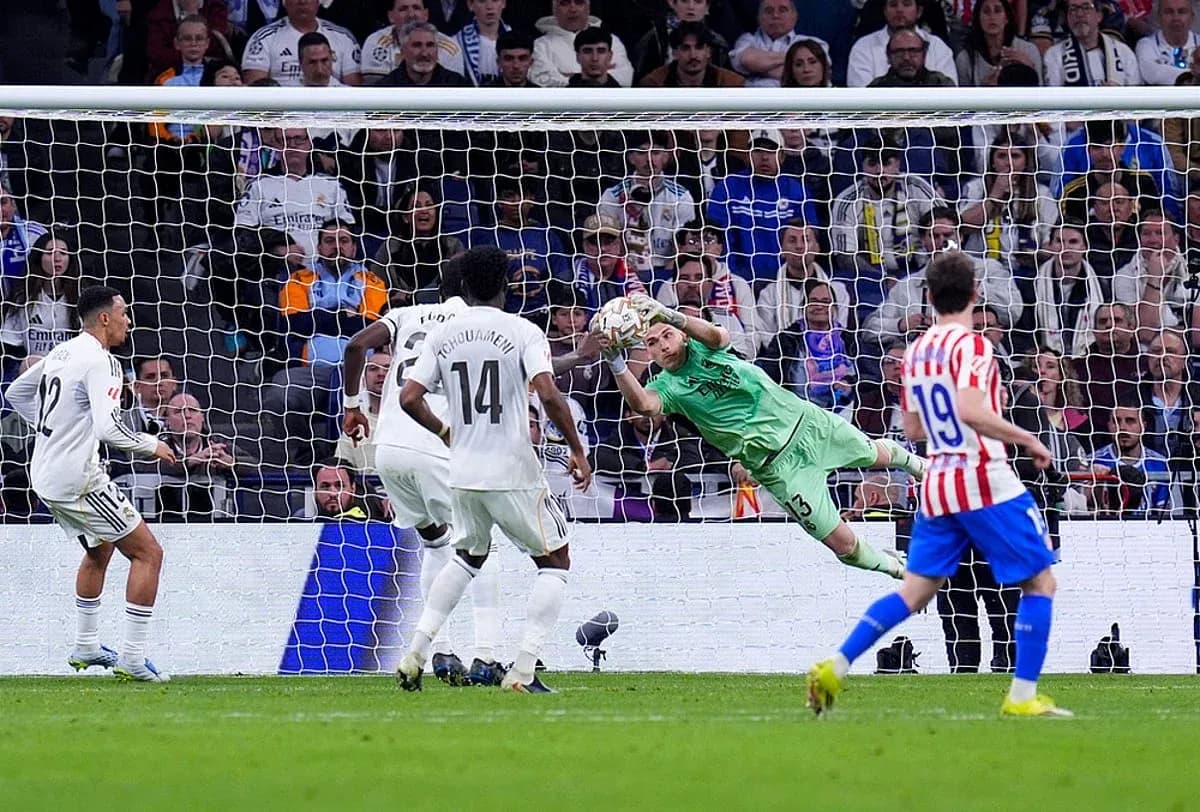
Lunin faced only 2 shots on target and made 1 save, underlining how little Girona created from open play despite their equaliser. With expected goals at 2.3 and goals prevented at 0, Madrid’s keeper was largely a spectator, and the defensive line’s main issue was not volume of chances conceded but the one key action they failed to manage on Girona’s equaliser.
Girona Formation
Girona’s 4-2-3-1, with Paulo Gazzaniga in goal, a back four of Arnau Martínez, Alejandro Francés, Vitor Reis and Álex Moreno, a double pivot of Iván Martín and Axel Witsel, an advanced line of Viktor Tsygankov, Thomas Lemar and Azzedine Ounahi behind Claudio Echeverri, was designed to absorb pressure and counter selectively. Their 39% possession, 390 passes (87% accuracy) and just 10 total shots (4 inside the box) confirm a reactive approach. However, the quality of their one key attacking sequence, finished by Lemar, was enough to match Madrid on the scoreboard.
Gazzaniga’s role was decisive: 7 saves against 9 shots on target from Real Madrid, with Girona’s goals prevented listed as 0 but his volume of stops clearly underpinning the result. Girona committed 13 fouls and took only 1 corner, again highlighting a low-block, last-line defending model, especially after the 70' substitutions when wide players like Bryan Gil and Hugo Rincón were tasked primarily with tracking Madrid’s full-backs and helping double on Vinicius and Mbappé.
Statistically, Real Madrid’s overall form in this match looked strong in attacking volume and control, but their defensive index is mixed: they limited Girona’s xG to 0.52 and shots on target to 2, yet conceded at a crucial moment. The card count finished 2 yellows for Madrid (Mbappé for argument, Valverde for a foul) and 1 for Girona (Hugo Rincón for a foul). The xG gap of 2.3 vs 0.52 and the shot disparity (22 vs 10) frame this as two points dropped for Madrid in terms of process, while Girona’s compact structure, Gazzaniga’s 7 saves and effective in-game adjustments delivered a highly efficient away draw.