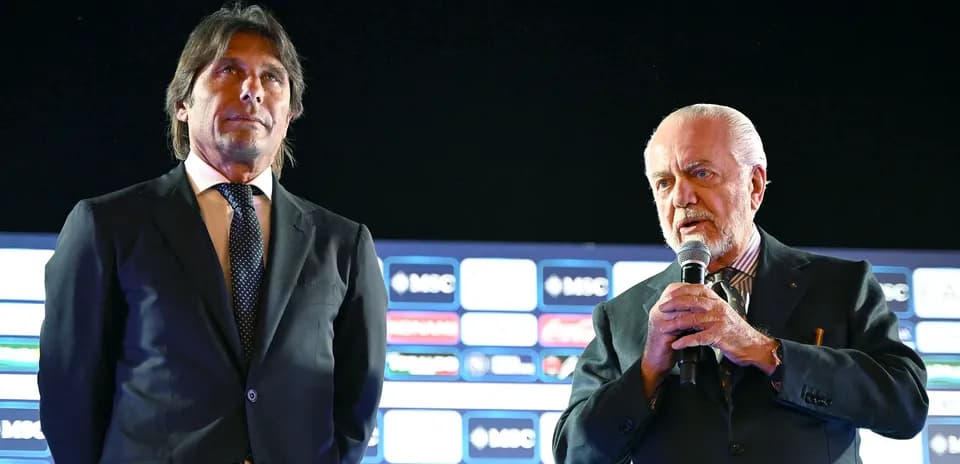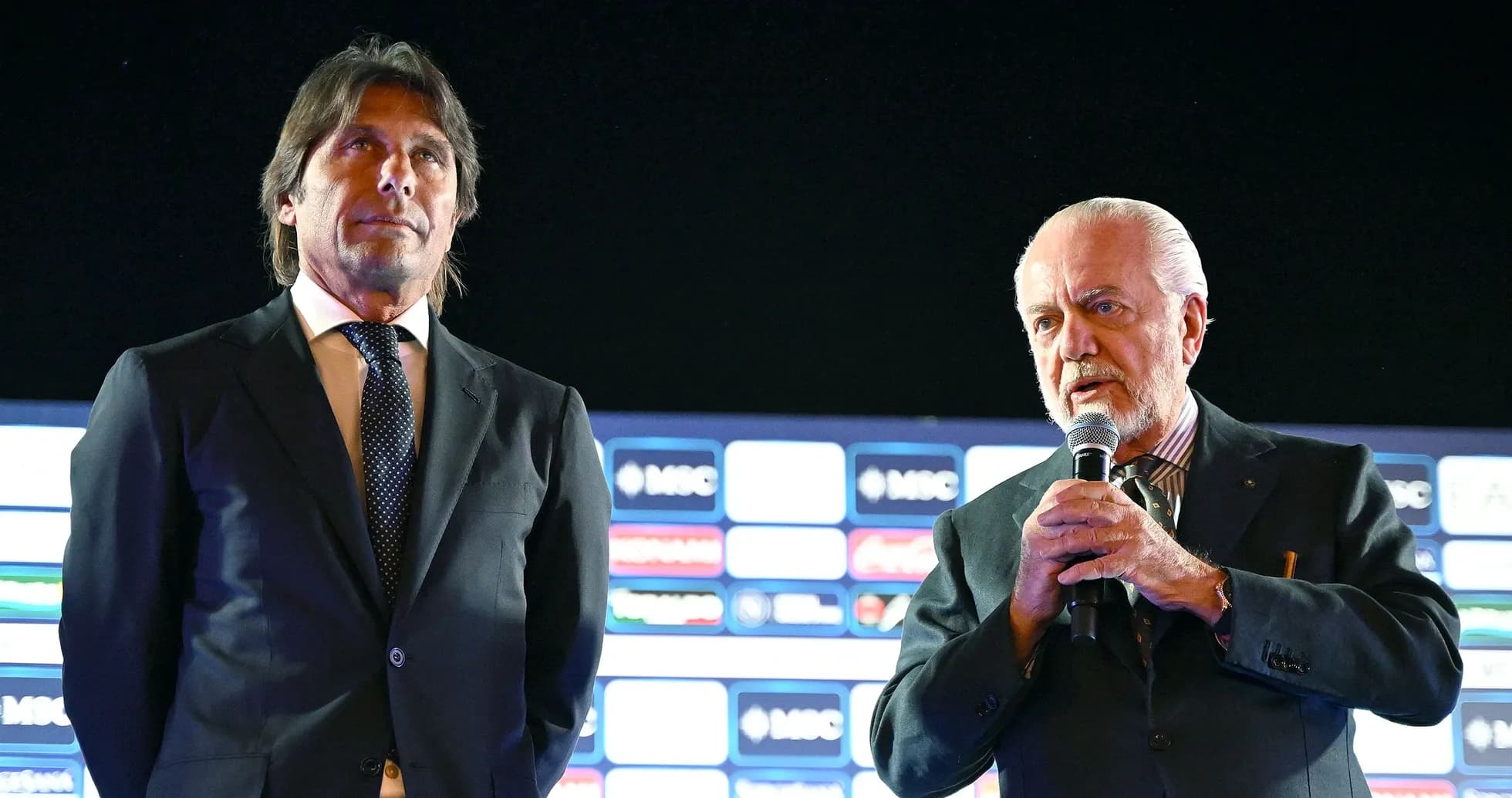
Antonio Conte could return to the Azzurri dugout – but only, Aurelio De Laurentiis insists, if Italian football finally gets its house in order.
The Napoli president has made it clear he would not stand in Conte’s way if the national team came calling, as the Italian Football Federation (FIGC) scrambles to find a new head coach after Gennaro Gattuso’s resignation. Yet his support came wrapped in a stinging indictment of the federation’s current state.
Gattuso walked away after Italy’s World Cup play-off final defeat to Bosnia-Herzegovina, a result that plunged the four-time world champions into yet another existential crisis. The loss capped a disastrous qualification campaign and triggered renewed fury over the direction – and competence – of the FIGC.
Into that chaos steps the name that always commands attention: Antonio Conte.
Conte, the Natural Candidate
Conte knows the job and the pressure that comes with it. He took charge of the national team in 2014 after leaving Juventus, where he had already forged a reputation as an obsessive, demanding winner.
Across 25 matches with the Azzurri, he delivered 14 victories and suffered only five defeats, dragging a limited squad to the Euro 2016 quarter-finals and pushing Germany to penalties before bowing out. His tenure ended there, but his reputation did not.
Since leaving Coverciano, Conte has stacked up titles and high-profile posts: a Premier League crown with Chelsea, a Serie A title with Inter, a turbulent spell at Tottenham, and then the Scudetto with Napoli last season. Few Italian coaches carry his blend of tactical authority and emotional intensity.
No surprise, then, that his name now sits at the top of the list as Italy search for a new figurehead.
De Laurentiis: “He Would Desist”
Speaking to CalcioNapoli24, De Laurentiis addressed the growing noise around Conte and the vacant Azzurri role. His stance was strikingly open.
If Conte wants the national team job and comes to him, De Laurentiis said he would agree to let him go. No fight. No public row. No drawn-out saga.
But he does not believe Conte will jump into the current mess.
“Conte new coach of the national team? If Antonio asked me, I think I would say yes,” De Laurentiis said, before turning his fire on the federation. He described Conte as “very intelligent” and argued that, “as long as there is no serious interlocutor, and up to now there have been none, I believe he would desist in imagining himself at the head of something completely disorganised.”
The message was blunt: Italy do not just need a coach. They need a structure worthy of a coach like Conte.
Triple World Cup Absence and a Federation in Pieces
The pressure on the FIGC has not built overnight. It has erupted.
Italy’s failure against Bosnia-Herzegovina means they will miss the World Cup in 2018, 2022 and 2026 – an unthinkable run for a country that once defined itself by its performances on the biggest stage. What was once a blip has hardened into a pattern.
This latest qualifying campaign started under Luciano Spalletti, then lurched into emergency mode when Gattuso was brought in late to rescue their hopes. He managed eight games, winning six, but the defeats – first to Norway in the final group match, then to Bosnia-Herzegovina in the play-off – wiped out any sense of progress.
The fallout has been brutal. FIGC president Gabriele Gravina stepped down. Gianluigi Buffon, serving as delegation chief, followed him out. The federation now looks leaderless at the very moment it needs clarity and authority.
Into that vacuum, De Laurentiis has stepped with a clear, controversial prescription.
“Cinderella” Serie A and a Call for Malagò
The Napoli owner has long railed against the way Italian football is run. This time, he went further, backing a specific name to take control.
He wants Giovanni Malagò, the president of CONI, to act as commissioner and then as FIGC president. In De Laurentiis’ view, Malagò is the right figure to impose order, redesign the power structure and give the federation the credibility needed to attract a coach of Conte’s stature.
He then turned to the domestic game’s role in that system – and did not hold back.
“Italian football is Serie A which is considered like a Cinderella,” he argued. He pointed out that the top flight holds only 18% of the power within the federation, while amateurs and players command the majority. For a league that effectively bankrolls the system, he called that balance “an absurdity”.
Without Serie A, De Laurentiis stressed, the federation would not exist. Yet the clubs that pour around €130 million a year into the FIGC find themselves sidelined in key decisions.
Conte and the Crossroads
This is the backdrop against which Conte’s name hovers over the national team once more: a broken qualifying cycle, a federation in transition, and a domestic league that feels underrepresented and undervalued.
De Laurentiis has opened the door. The FIGC vacancy has created the opportunity. The question is whether Italian football can convince one of its most demanding coaches that this time, unlike the last three World Cup cycles, it finally intends to change.