Real Madrid Dominates Oviedo in 2-0 Victory at Estadio Santiago Bernabéu
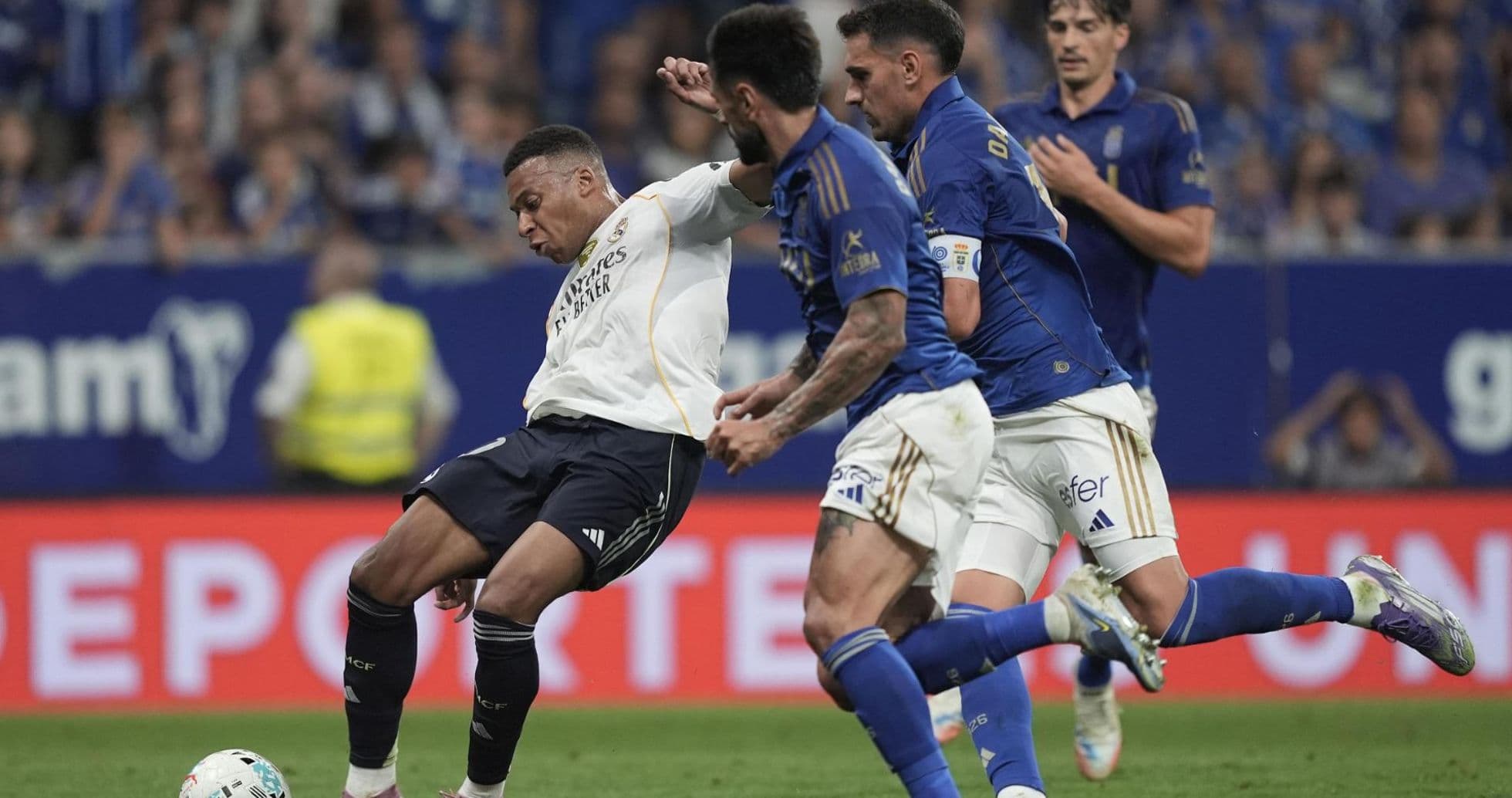
Real Madrid’s 2-0 win over Oviedo at Estadio Santiago Bernabéu was a controlled, structurally coherent performance built on territorial dominance, intelligent wide play and a clear use of the bench to increase technical superiority as the game wore on. With 65% possession, 19 total shots and only 9 conceded, Alvaro Arbeloa’s side translated statistical control into a mature tactical display that never really allowed Guillermo Almada Alves Jorge’s 4-3-3 to breathe.
I. Executive Summary
Real Madrid, set up in a 4-4-2, imposed a high-possession, positional game that pinned Oviedo’s 4-3-3 deep for long stretches. The hosts’ 616 passes at 93% accuracy versus Oviedo’s 325 at 85% underlined the structural gap in build-up quality. Two goals – one just before half-time, one entering the final ten minutes – reflected both phases of their plan: first to stretch and exhaust Oviedo’s block, then to punish them once fresh attacking quality arrived from the bench. Defensively, Real Madrid allowed just 1 shot on target and required only 1 save from Thibaut Courtois, while Oviedo’s A. Escandell had to make 5 saves to keep the scoreline respectable.
II. Scoring Sequence & Disciplinary Log
There were no yellow or red cards for either side; discipline did not materially disrupt tactical rhythms. The match events were defined instead by goals and substitutions.
The breakthrough came at 44'. G. Garcia (Real Madrid) — assisted by B. Diaz — finished a move that typified the hosts’ approach: a midfield line of four circulating the ball until the passing lane into the front two opened. Diaz, operating from the right half-space as a nominal midfielder, found Garcia between lines, and the forward converted to make it 1-0. That strike set the half-time score at Real Madrid 1-0 Oviedo, fully aligned with the underlying pattern of 65% possession and a clear shot volume advantage.
In the second half, Arbeloa and Almada both turned to their benches to adjust the tactical dynamic. At 54', S. Cazorla (IN) came on for I. Chaira (OUT) for Oviedo, an attempt to add control and progressive passing from midfield. Real Madrid responded with a double change at 64': D. Carvajal (IN) came on for T. Alexander-Arnold (OUT), and J. Bellingham (IN) came on for A. Tchouameni (OUT), injecting fresh energy and verticality in the right channel and central lane.
At 69', Real Madrid reshaped their front line as K. Mbappe (IN) came on for G. Garcia (OUT), while Oviedo introduced H. Hassan (IN) for T. Fernandez (OUT), trying to gain more direct threat up front. Arbeloa then refreshed his wide and creative sectors at 77': C. Palacios (IN) came on for B. Diaz (OUT), and D. Yanez (IN) came on for F. Mastantuono (OUT), maintaining technical quality between lines.
Oviedo’s final structural tweaks arrived at 79', with L. Ahijado (IN) for N. Vidal (OUT) and P. Agudin (IN) for N. Fonseca (OUT), rebalancing the back line and midfield.
The decisive second goal followed almost immediately. At 80', J. Bellingham (Real Madrid) — assisted by K. Mbappe — made it 2-0. The goal encapsulated the impact of the substitutions: Mbappe attacking space and drawing defensive attention, then supplying Bellingham arriving from midfield to finish. No VAR interventions or disciplinary incidents altered the flow; the match closed at 2-0 with Real Madrid in full control.
III. Tactical Breakdown & Personnel
Arbeloa’s 4-4-2 was built on a clear positional framework. The back four of T. Alexander-Arnold, R. Asencio, D. Alaba and A. Carreras provided width and secure first-phase circulation. With 616 total passes and 570 accurate (93%), Real Madrid’s back line and double pivot of E. Camavinga and A. Tchouameni (later Bellingham) were rarely pressed into mistakes. The structure was classic: full-backs high and wide, two central midfielders staggering their positions to offer vertical lanes, and wide midfielders B. Diaz and F. Mastantuono tucking into half-spaces to overload Oviedo’s midfield trio.
In attack, the front pairing of G. Garcia and Vinicius Junior offered complementary profiles. Garcia, scorer of the 44' goal, frequently dropped to connect play, while Vinicius stretched the left channel, forcing Oviedo’s right-back N. Vidal into deep positions and preventing Oviedo’s 4-3-3 from stepping up cohesively. The 11 shots inside the box (out of 19 total) show how consistently Real Madrid managed to penetrate the penalty area rather than relying on speculative efforts.
Oviedo’s 4-3-3, with N. Fonseca, S. Colombatto and A. Reina in midfield, was designed to compact central zones and break through the front three of I. Chaira, F. Vinas and T. Fernandez. However, with only 35% possession and 9 shots (7 inside the box, but just 1 on target), their attacks were sporadic and often reliant on transitions or set pieces. The 5 corner kicks did provide some territorial relief, but Real Madrid’s central defenders Alaba and Asencio controlled aerial spaces effectively.
The goalkeeper dimension underlined the strategic balance. Courtois, credited with 1 save and 0.16 goals prevented, had a largely supervisory role, protected by a defensive block that limited Oviedo’s shot quality (xG 1.03). A. Escandell, by contrast, faced 7 shots on goal and made 5 saves, also with 0.16 goals prevented, reflecting the volume and quality of Real Madrid’s chances (xG 1.46). The fact that Real Madrid scored 2 from 1.46 xG suggests clinical finishing, particularly from Garcia and Bellingham, rather than overperformance by Escandell.
Substitutions sharpened Real Madrid’s tactical edge. Carvajal maintained width and crossing threat on the right while adding defensive security. Bellingham’s arrival in central midfield shifted the dynamic from control to penetration; his late run for the 80' goal is typical of a midfielder operating between Oviedo’s lines, exploiting tired legs. Mbappe’s introduction for Garcia reoriented the attack toward depth and pace, forcing Oviedo’s back four to drop and creating pockets for Bellingham and the advanced wide players.
Oviedo’s changes, especially the introduction of S. Cazorla, aimed to add composure and line-breaking passes, but the structural issue remained: their 4-3-3 struggled to progress through Real Madrid’s compact 4-4-2 mid-block. With Real Madrid committing only 7 fouls to Oviedo’s 14, the hosts controlled tempo without resorting to disruptive tactics, while Oviedo’s higher foul count reflected reactive defending and late challenges as they chased the ball.
IV. The Statistical Verdict
The numbers validate Real Madrid’s tactical plan. With 65% possession and a 616–325 passing advantage, the home side dictated where and how the game was played. Their 19 shots to Oviedo’s 9, and 7 on target to 1, aligned with the xG balance of 1.46 to 1.03. This was not a freak result; it was a controlled two-goal victory in line with chance quality and volume.
Defensively, Real Madrid’s low foul count (7) and minimal workload for Courtois point to a high Defensive Index performance: they limited both shot quantity and clarity, while maintaining discipline and avoiding cards entirely. Oviedo’s 14 fouls, 5 saves from Escandell and repeated structural adjustments through substitutions underline a team largely on the back foot, relying on resistance rather than proactive control.
In synthesis, Real Madrid’s 4-4-2 delivered a balanced, high-possession display, with key contributions from G. Garcia and J. Bellingham in front of a secure defensive platform. Oviedo’s 4-3-3 never fully solved the hosts’ positional structure, and the 2-0 scoreline at Estadio Santiago Bernabéu accurately reflects the tactical and statistical gulf on the night.