Valencia and Rayo Vallecano Draw 1-1: A Tactical Analysis
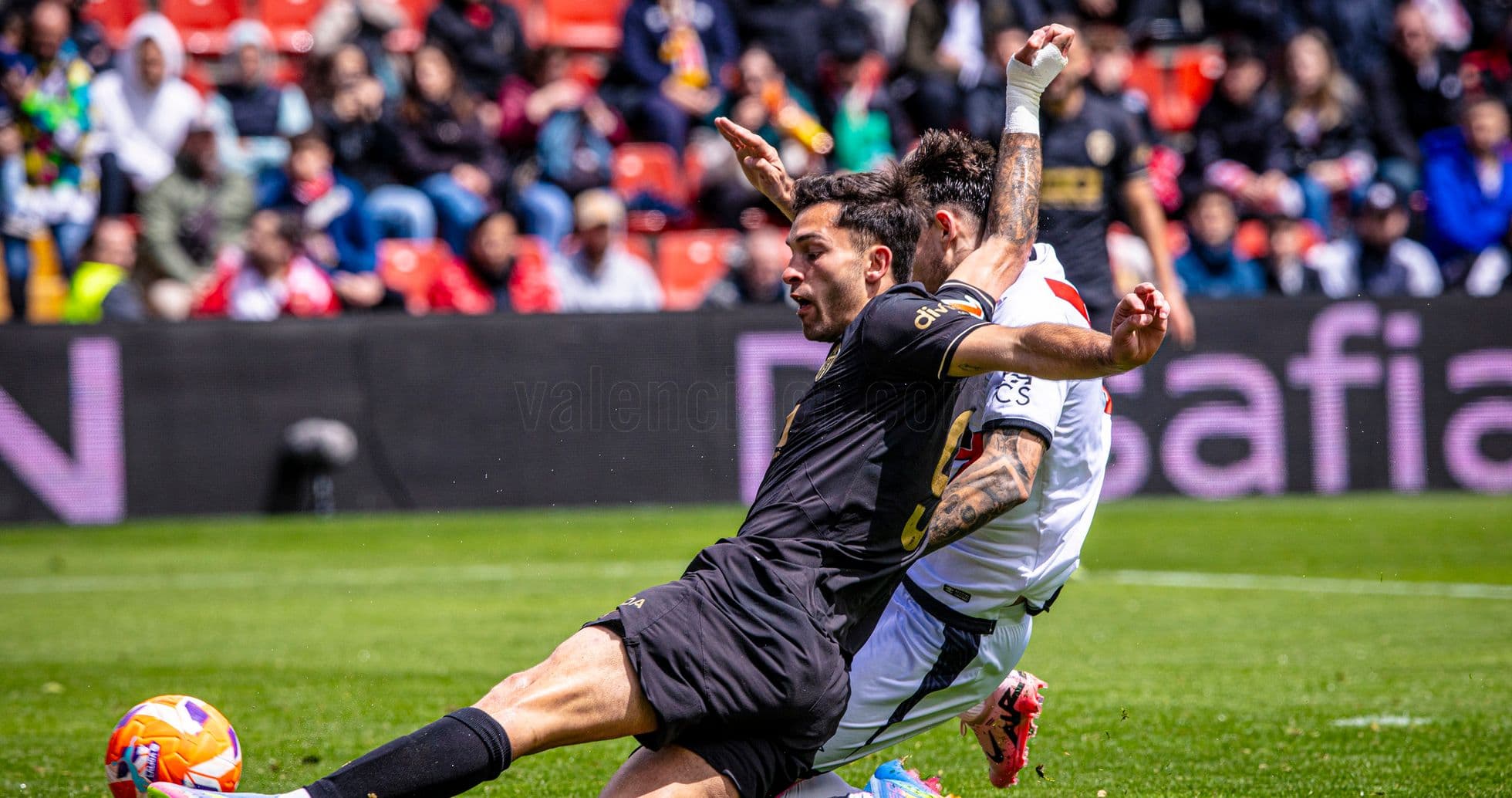
The Mestalla floodlights had barely cooled when the table told its own story. Following this result, Valencia sit 11th on 43 points, Rayo Vallecano 10th on 44, both locked in a mid-table arm wrestle that this 1-1 draw did little to resolve. Over 36 league matches, Valencia’s goal difference stands at -12, a reflection of 39 goals scored and 51 conceded. Rayo’s is marginally healthier at -6, with 37 for and 43 against. Two sides with similar records, different identities – and a match that underlined both.
I. The Big Picture – Structures and Seasonal DNA
Valencia went with their most familiar skin: a 4-4-2 that has been their default shape, used in 22 league fixtures. S. Dimitrievski anchored a back four of Renzo Saravia, C. Tarrega, E. Comert and José Gayà, with a classic flat midfield of D. Lopez, Pepelu, G. Rodriguez and Luis Rioja behind the front pair of H. Duro and Javi Guerra. It is a structure that mirrors their season: pragmatic, compact, and built on organization more than attacking flair. At home this campaign they average 1.3 goals scored and 1.2 conceded, a narrow edge that relies heavily on defensive discipline.
Rayo Vallecano arrived in their own established configuration. Inigo Perez’s 4-2-3-1 has been deployed 22 times in La Liga, and here it was again: A. Batalla in goal, a back four of I. Balliu, F. Lejeune, N. Mendy and P. Chavarria, shielded by the double pivot of O. Valentin and G. Gumbau. Ahead of them, a fluid band of three – F. Perez, P. Diaz and Pacha – operated behind lone forward R. Nteka. Rayo’s season has been defined by control and balance rather than volume; overall they average 1.0 goals for and 1.2 against, but at home they are tighter (0.8 conceded) and more productive (1.2 scored) than on their travels, where they score 0.8 and concede 1.6.
The draw at Mestalla felt like the collision of those identities: Valencia’s home solidity against Rayo’s structured, possession-friendly 4-2-3-1, with neither side quite able to bend the other out of shape.
II. Tactical Voids – Absences and Discipline
Both coaches had to navigate significant absences that subtly reshaped the contest.
Carlos Corberan was without L. Beltran (knee injury), J. Copete (ankle), M. Diakhaby (muscle) and D. Foulquier (knee). The consequence was a back line that leaned heavily on Comert and Tarrega for central stability and on Gayà’s experience and leadership from left-back. Gayà, who has already collected 6 yellow cards and 1 red in the league, walked a familiar tightrope between aggression and risk, but his presence was non-negotiable given the lack of defensive depth.
For Rayo, the absences were just as defining. I. Akhomach (muscle injury), A. Garcia, Luiz Felipe and D. Mendez (all injured) reduced options in both boxes, but the suspension of Isi Palazón after a red card was the most glaring void. Isi’s season has been a paradox of productivity and volatility: 3 goals, 3 assists, 10 yellow cards and 1 red, plus a penalty record that includes 2 scored and 1 missed. His absence stripped Rayo of their most natural right-sided creator and a set-piece threat, forcing Perez to rely more on F. Perez and P. Diaz to generate final-third quality.
Disciplinary trends for both sides hinted at the game’s tone. Valencia’s yellow-card peak comes late, with 22.86% of their bookings arriving between 76-90 minutes – a sign of fatigue, desperation, or both. Rayo, meanwhile, spread their cautions more evenly but also carry a dangerous red-card profile: 1 dismissal between 46-60 minutes, 2 between 61-75, 2 more from 76-90, and a remarkable 3 from 91-105. This is a team that can lose control emotionally just as the match enters its decisive phase.
III. Key Matchups – Hunter vs Shield, Engine Room vs Enforcer
The marquee attacking figure in this fixture, at least on paper, was Rayo’s Jorge de Frutos. With 10 league goals and 1 assist, plus 47 shots (26 on target), he is their primary finisher and one of La Liga’s more efficient wide forwards. Even though he started on the bench here, his presence in the squad shaped Valencia’s defensive approach: the hosts knew that any late introduction of de Frutos would test a back line that concedes 1.4 goals per match overall and 1.6 on their travels, but is slightly more secure at home.
The “Hunter vs Shield” dynamic therefore revolved less around a single duel and more around the structural question: could Rayo’s relatively modest attack – 37 goals in total, split as 22 at home and 15 away – break down a Valencia side whose home record is defined by narrow margins and nine clean sheets overall?
In midfield, the “Engine Room” battle was vivid. For Valencia, Luis Rioja and Javi Guerra are the creative heartbeat. Rioja leads La Liga’s assist charts for the club with 6, adding 2 goals and 37 key passes from 798 total passes at 79% accuracy. Guerra matches him with 6 assists of his own, 29 key passes from 942 total at 81% accuracy, and a notable defensive output that includes 6 blocked shots and 23 interceptions. Together, they form a dual-threat axis: Rioja stretching play from the flank, Guerra knitting phases between lines and offering late runs.
Opposite them, Rayo’s enforcers were O. Valentin and G. Gumbau, with the option of unleashing P. Ciss from the bench. Ciss is a fascinating figure: 2 goals, 51 tackles, 15 blocked shots and 35 interceptions, but also 8 yellow cards and 2 reds. He embodies Rayo’s capacity to dominate the central third physically while living dangerously on the disciplinary edge. N. Mendy, too, contributes to that defensive steel, having blocked 21 shots and committed 30 fouls this season, evidence of a centre-back willing to put his body on the line and accept the bookings that follow.
The match in Valencia’s midfield corridor therefore hinged on whether Rioja and Guerra could escape the clamp of Valentin, Gumbau and potentially Ciss. Every time Guerra received between the lines, he was stepping into a zone patrolled by players who specialize in disrupting rhythm – and who do not hesitate to take cards to do it.
IV. Statistical Prognosis – xG Shadows and Defensive Solidity
There is no explicit xG data in the snapshot, but the season-long numbers sketch the underlying probabilities that shaped this 1-1 outcome. Heading into this game, Valencia’s overall scoring average of 1.1 goals per match against Rayo’s 1.0 suggested a low-scoring affair, especially with both sides’ away attacks limited to 0.8 goals on their travels. The fact that both teams have identical away goal tallies (15 each) underscores their shared struggle to consistently create high-quality chances away from their comfort zones.
Defensively, Rayo’s overall concession rate of 1.2 goals per match, combined with 11 clean sheets, marks them as slightly more robust than Valencia, who concede 1.4 overall despite 9 clean sheets. Yet Valencia’s home profile – 24 scored, 22 conceded – indicated that they were likely to at least find the net once at Mestalla, especially against a Rayo back line missing Luiz Felipe and with Mendy’s card-prone aggression a constant variable.
The late-game discipline trends added another layer to the probabilistic picture. With Valencia’s yellow-card surge in the 76-90’ window and Rayo’s history of late reds, the final quarter of an hour was always the zone of maximum volatility, where a marginal xG edge could be overturned by a reckless challenge or a tired foul.
In the end, the 1-1 draw felt like the statistically logical midpoint of two converging trajectories. Valencia’s 4-4-2 provided structure but limited overloads; Rayo’s 4-2-3-1 offered control without a ruthless edge in the box, especially without Isi Palazón. De Frutos’ 10-goal season hinted at a late twist that never quite materialized, while Rioja and Guerra’s creative instincts were partially neutralized by Rayo’s enforcers.
Following this result, both sides remain locked in their shared narrative: solid, competitive, but still searching for the extra layer of attacking clarity that would turn narrow matches like this from draws into defining wins.