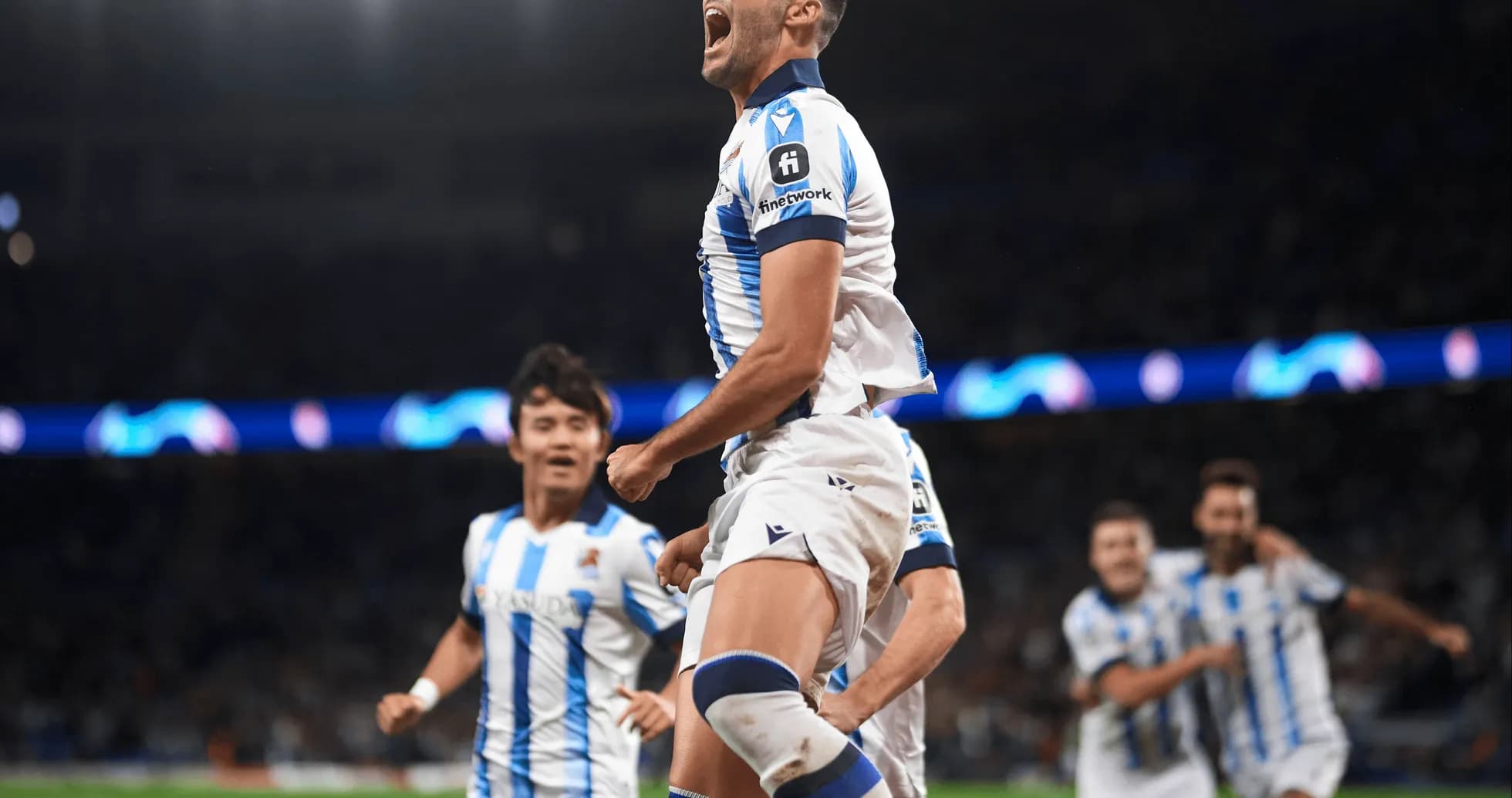
Real Sociedad vs Alaves: Tactical Analysis of 3–3 Draw
Real Sociedad and Alaves produced a chaotic 3–3 draw at Reale Arena in La Liga’s Regular Season - 31, a match that swung repeatedly on structural choices rather than sheer volume of chances. Real Sociedad’s 4-2-3-1 under Pellegrino Matarazzo tried to assert control through possession and positional play, while Quique Sanchez Flores’ 5-3-2 for Alaves leaned on compactness, wing-back aggression and direct threat from the front two. The data underlines how thin the margins were: both sides finished with 12 shots, but Real Sociedad’s 54% of the ball and superior pass completion (83% vs 80%) were offset by critical defensive errors and late-game volatility, including a red card for Sergio Gómez.
The scoring opened in the worst possible way for Real Sociedad’s back line. On 3', Duje Ćaleta-Car, under early pressure, turned the ball into his own net for Alaves, exposing the risk in Matarazzo’s build-up: a high defensive line with centre-backs asked to circulate under pressure. Real Sociedad’s response was structurally coherent. On 14', Luka Sučić arrived from the advanced midfield line to finish a move created by Ander Barrenetxea, who attacked from the left half-space. The pattern reflected the 4-2-3-1’s intention: Barrenetxea wide and aggressive, Sučić as a vertical 10 exploiting gaps between Alaves’ midfield and back five.
Alaves’ 5-3-2 struck back on 24' through Ibrahim Diabaté, whose goal came from the visitors’ capacity to break quickly once they bypassed Real Sociedad’s double pivot of Beñat Turrientes and Carlos Soler. The own goal at 27' by Antonio Sivera, credited to Real Sociedad, was more a product of Alaves’ instability under pressure than crafted chance creation, but it restored parity at 2–2 and highlighted the fragility in both teams’ defensive mechanics.
After the interval, Matarazzo moved early. At 46', Gonçalo Guedes (IN) came on for Ander Barrenetxea (OUT), a like-for-like swap in terms of zone but with a different profile: Guedes offering more direct running and inside dribbling than touchline width. On 54', Takefusa Kubo (IN) replaced Brais Méndez (OUT), adding a sharper 1v1 threat and more verticality from the right. The payoff was almost immediate. At 60', Orri Steinn Óskarsson finished to give Real Sociedad a 3–2 lead, assisted by Kubo, whose introduction clearly shifted the right flank dynamic. That same minute, Alaves responded structurally: Lucas Boyé (IN) came on for Ibrahim Diabaté (OUT), moving from a more pure runner to a back-to-goal forward capable of linking and holding.
The disciplinary thread began to reshape the emotional tone. At 59', Abderrahman Rebbach saw yellow for a foul, a sign of Alaves’ wing-backs being stretched by Guedes and Kubo. On 64', Kubo himself was booked for a foul, illustrating the high defensive work rate demanded of Real Sociedad’s wingers in transition. At 66', Ángel Pérez received a yellow card for argument, capturing Alaves’ growing frustration as Real Sociedad controlled more of the ball. Flores reacted simultaneously: at 66', Carles Aleñá (IN) came on for Jon Guridi (OUT), and Ander Guevara (IN) replaced Pablo Ibáñez (OUT), freshening the midfield with more passing security and legs.
Matarazzo then rotated his attack to manage energy and game state. On 72', Pablo Marín (IN) came on for Orri Steinn Óskarsson (OUT), shifting the front structure towards a more conservative, midfield-heavy shape rather than a fixed number nine. At 86', Luken Beitia (IN) replaced Sučić (OUT) and Aihen Muñoz (IN) came on for Aritz Elustondo (OUT), effectively reinforcing the defensive block and full-back areas to protect the 3–2 lead. Flores made his own late adjustment at 86', Denis Suárez (IN) replacing Ángel Pérez (OUT), pushing more technical quality into the final third from the right side.
The closing minutes were defined by discipline and VAR intervention. At 90+2', VAR triggered a card upgrade review for Sergio Gómez, and by 90+3' he was shown a red card for a foul, turning Real Sociedad’s late-game management into a ten-man survival exercise. At 90+9', Guedes was booked for argument, reflecting the tension of defending under numerical inferiority. At 90+10', Denis Suárez was also booked for argument, as Alaves pushed emotionally and territorially. The final twist came with Lucas Boyé’s goal, assisted by Denis Suárez at 90', bringing the match to 3–3 and validating Flores’ decision to introduce a stronger link-forward and a creative right-sided midfielder.
From a tactical lens, Real Sociedad’s 4-2-3-1 was built to dominate the ball and create through the half-spaces. With 506 passes and 420 completed (83%), they largely achieved territorial control, especially through Turrientes and Soler recycling possession and feeding the advanced line of Sučić, Méndez/Kubo, and Barrenetxea/Guedes. The attacking midfielder and wide players consistently looked to attack the channels outside Alaves’ central back three, forcing Rebbach and Ángel Pérez into deep, reactive positions. However, the structure left Ćaleta-Car and Aritz Elustondo exposed in early build-up, culminating in the catastrophic own goal on 3'. Late in the match, the shift towards more defensive substitutions (Beitia, Muñoz) was logical but, combined with the red card to Sergio Gómez, dragged the block too deep and surrendered initiative.
Defensively, Real Sociedad’s goalkeeper Álex Remiro registered 0 saves, which is striking in a match where his side conceded three times. It underlines that Alaves’ goals came from high-quality or uncontested situations (including the own goal and late box presence) rather than speculative shooting. Real Sociedad’s Defensive Index in this match, inferred from 0 saves, 3 goals conceded, and an xG against of 1.13, was clearly below par relative to their possession control; they allowed chances that bypassed the keeper entirely.
Alaves’ 5-3-2, by contrast, was compact but reactive. With 427 passes (343 accurate, 80%), they accepted less of the ball (46% possession) and focused on verticality through Diabaté and later Boyé. The wing-backs, Rebbach and Ángel Pérez, were key in both the defensive and disciplinary story: constantly under pressure from Real Sociedad’s wingers, they were forced into fouls and arguments as they tried to stem wide overloads. Antonio Sivera made 2 saves, and while he conceded three (including his own goal), the defensive unit around him limited Real Sociedad to 4 shots on target from 12 attempts, keeping the hosts’ xG to 0.94. That balance – conceding territory but limiting shot quality – is consistent with a Flores side prioritising block integrity over high pressing.
Statistically, the match narrative is almost inverted by the numbers. Real Sociedad, with more possession, better passing accuracy, more corners (9 vs 5) and equal total shots (12–12), should, on paper, have been in a position to close out the game. Their xG of 0.94 versus Alaves’ 1.13, however, reveals that Alaves created marginally better-quality chances despite having fewer shots on target (2 vs 4). The card count – 2 yellows and 1 red for Real Sociedad against 3 yellows for Alaves – further contextualises the late collapse: playing with ten men, emotional strain visible in argument-related bookings (Guedes, Ángel Pérez, Denis Suárez), Real Sociedad’s Overall Form in this fixture dipped sharply in the final minutes.
In summary, Real Sociedad’s superior possession structure and attacking rotations were undermined by a poor Defensive Index on the day and critical individual errors, while Alaves’ conservative 5-3-2, backed by disciplined (if occasionally volatile) defending and impactful substitutions in Boyé and Denis Suárez, extracted maximum value from limited attacking volume to secure a 3–3 draw that the underlying xG numbers narrowly support.