Real Sociedad's 2-0 Victory Over Levante: Tactical Insights and Key Players
The Reale Arena has seen Real Sociedad in many guises this season, but this 2-0 win over Levante felt like the most distilled version of their current identity: a flawed, streaky side in the table, but one that, at home, can still dictate the rhythm and dismantle a struggling visitor with a clear, coherent plan.
Coming into Matchday 30, the standings painted a pragmatic picture. Real Sociedad sat seventh on 41 points, almost perfectly balanced with 46 goals for and 45 against. At home, though, they have been closer to a European contender: eight wins from 15, 29 goals scored, 21 conceded, averaging 1.9 goals per game in San Sebastian. Levante arrived 19th with 26 points, their goal difference at -16 and a season defined by fragility — 50 goals conceded across 30 fixtures and only six wins in total.
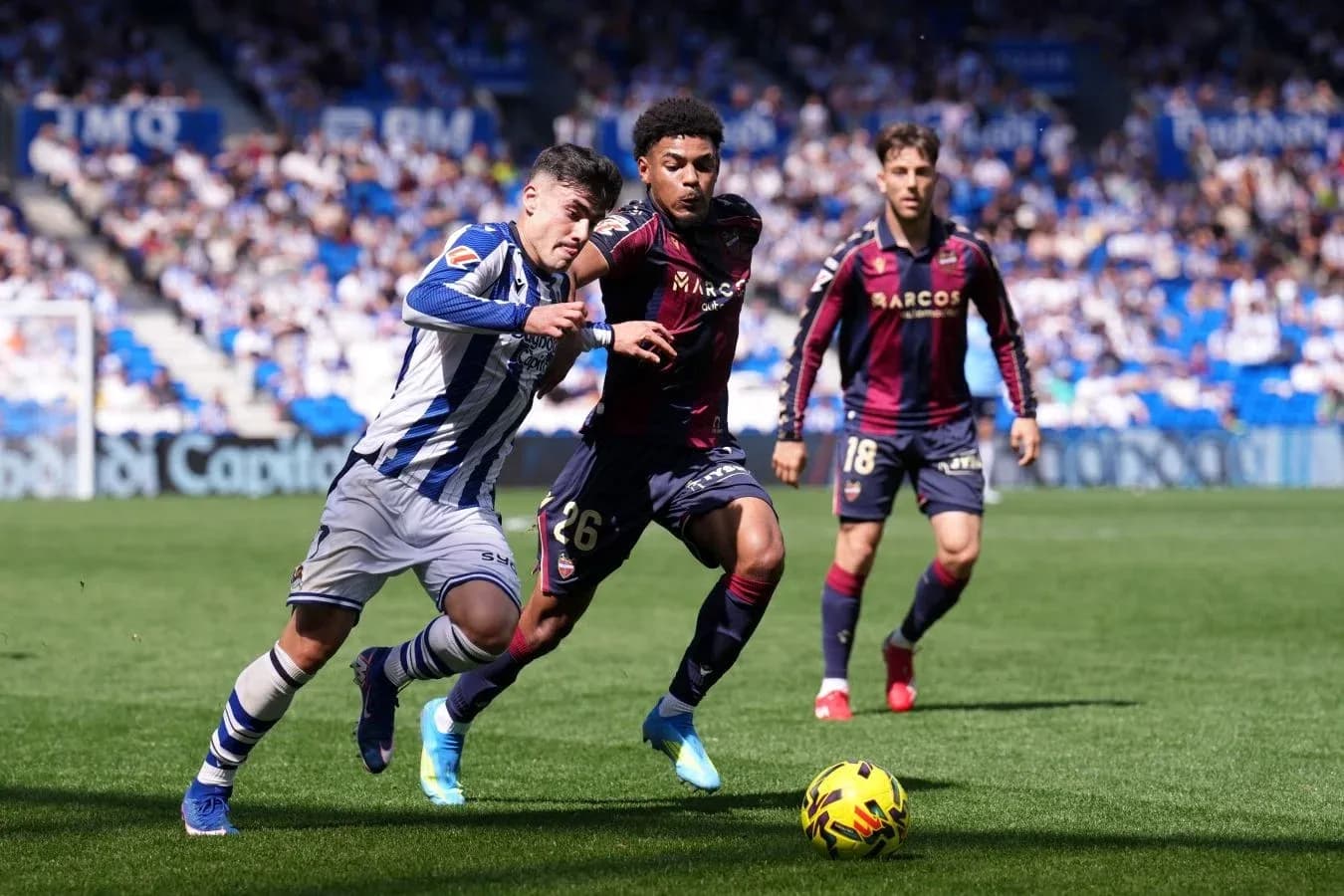
On the pitch, the formations told you how each manager saw the day. Pellegrino Matarazzo went with a 4-2-3-1, leaning into control and verticality. Luis Castro answered with a 4-3-3 that, in practice, often flattened into a 4-5-1 without the ball, trying to compress space and survive. The halftime scoreline of 1-0 to Real Sociedad confirmed the pattern: the hosts dictating, Levante largely absorbing. By full time, the 2-0 felt like a logical extension of the season-long numbers rather than a one-off.
The Butterfly Effect: Absences and Adjustments
Real Sociedad’s injury list has quietly forced a structural rethink. Without I. Zubeldia (thigh injury), A. Odriozola and I. Ruperez (both knee injuries), plus J. Gorrotxategi and J. Ochieng (muscle problems) and Y. Herrera (calf injury), Matarazzo has been nudged towards a more improvised back line and double pivot. The absence of Zubeldia, a defender who has already collected eight yellow cards and built his reputation on 13 blocked opponent attempts and 21 interceptions, removes a natural organiser and enforcer from the heart of the defence.
Into that void stepped J. Martin and D. Caleta-Car as the central pairing, flanked by S. Gomez and J. Aramburu. Aramburu is not just any full-back; he is among the most carded players in La Liga, with nine yellows to date. His profile is pure modern defender: 91 tackles, 39 interceptions, and 8 blocked opponent shots, constantly walking the disciplinary tightrope. That edge is both a weapon and a risk, especially for a side whose yellow-card spikes come after the break — 22.95% of their cautions between 46-60 minutes and 19.67% from 76-90, with another 8.20% in stoppage time (91-105). The message: Real Sociedad become more aggressive and more vulnerable to bookings as games stretch.
Levante’s own absentees — R. Brugue and U. Elgezabal (knee), plus D. Varela Pampin and U. Vencedor (inactive) — trimmed Castro’s options, particularly in terms of defensive rotation and ball progression from deep. For a squad already battling relegation and carrying a five-game losing streak as their longest run this season, the margin for adaptation was thin.
Discipline was always going to be a subplot. Levante’s yellow cards are heavily concentrated late: 20.29% between 76-90 minutes and 15.94% from 91-105, with meaningful spikes also in the 31-45 (14.49%) and 46-60 (17.39%) windows. Combine that with three red cards spread across 16-30, 46-60 and 91-105, and you get a side that tends to fray precisely when pressure peaks. Against a home team that grows more assertive after the interval, that timing was ominous.
The Chess Match: Hunters, Shields and the Engine Room
The headline duel was always going to be Mikel Oyarzabal against a Levante defence that has conceded 24 away goals in 15 matches. Oyarzabal entered the day with 12 league goals and 3 assists, ranked seventh in the competition by rating. His profile is that of a complete attacking reference: 55 shots (31 on target), 37 key passes, and a flawless penalty record this season — 5 scored from 5 attempts. With Real Sociedad’s season-long penalty record also perfect (6 from 6), any infringement in or around the box was likely to be punished.
Around him, the supporting cast was designed to stretch and probe. Gonçalo Guedes, on eight goals and four assists in La Liga, started from the left in the “three” behind Oyarzabal. His 24 key passes and 39 dribble attempts (18 successful) underline his role as a hybrid scorer-creator. On the opposite flank, A. Barrenetxea offered directness, while L. Sucic operated as the central connector, linking the double pivot of B. Turrientes and C. Soler to the front line.
Levante’s shield was a back four anchored by M. Sanchez, one of the league’s more active full-backs defensively. Sanchez has 69 tackles, 29 interceptions and has blocked 5 opponent attempts, but he also carries eight yellow cards — another player who lives on that disciplinary edge. Inside him, Dela and M. Moreno had to deal with Oyarzabal’s movement between the lines and Guedes attacking the half-spaces. In front, the midfield trio of J. A. Olasagasti, O. Rey and I. Losada tried to compress central zones, but Levante’s season-long numbers — 1.7 goals conceded per game overall, 1.6 away — suggested that sustained resistance over 90 minutes would be difficult.
The engine-room duel tilted decisively towards Real Sociedad. Even without a dedicated league-leading assist specialist in the data, their structure funnels creativity through multiple lanes: Oyarzabal’s 37 key passes, Guedes’ 24, and the deeper distribution of players like Soler and Turrientes. Levante, by contrast, lean more on moments than systems. Their goals-for average of 1.1 both home and away speaks to sporadic threat rather than sustained pressure, and their 11 matches without scoring underline how easily their attack can be neutralized when the first press is broken.
From the bench, Matarazzo had genuine game-changers. Brais Méndez, despite a red card earlier in the campaign, brings six goals, two assists and 23 key passes from midfield, plus a composed penalty record (1 scored, 0 missed). Takefusa Kubo offers one-on-one incision, while forwards like O. Oskarsson, J. Karrikaburu and Wesley provide varied profiles if a different type of focal point is needed. Levante’s options — J. Morales, I. Romero, K. Etta Eyong, T. Abed — add energy and direct running, but in a match where territory and control were tilted towards the hosts, their impact was always likely to be reactive rather than defining.
Verdict: Where the Game Was Decided
Statistically, this fixture always leaned towards a Real Sociedad home win. A side averaging 1.9 goals per home game, with only one home blank all season, facing a defence that concedes 1.6 away and has already shipped 50 overall, is a mismatch on paper. The 2-0 scoreline fits that pattern neatly.
The decisive factor was the intersection of Real Sociedad’s attacking peak and Levante’s defensive frailty. Oyarzabal’s movement and penalty threat, combined with Guedes’ dual role as scorer and creator, consistently exploited the spaces around Sanchez and Dela. Behind them, a makeshift but disciplined back four, marshalled by Aramburu’s intensity, ensured Levante’s sporadic counters never developed into sustained pressure.
Layer on top the disciplinary trends — Real Sociedad’s controlled aggression after the break against Levante’s late-game unraveling — and this felt less like an upset or a surge in form, and more like the season’s underlying numbers finally expressing themselves over 90 minutes at the Reale Arena.