Roma's Tactical Masterclass Defeats Bologna 2–0
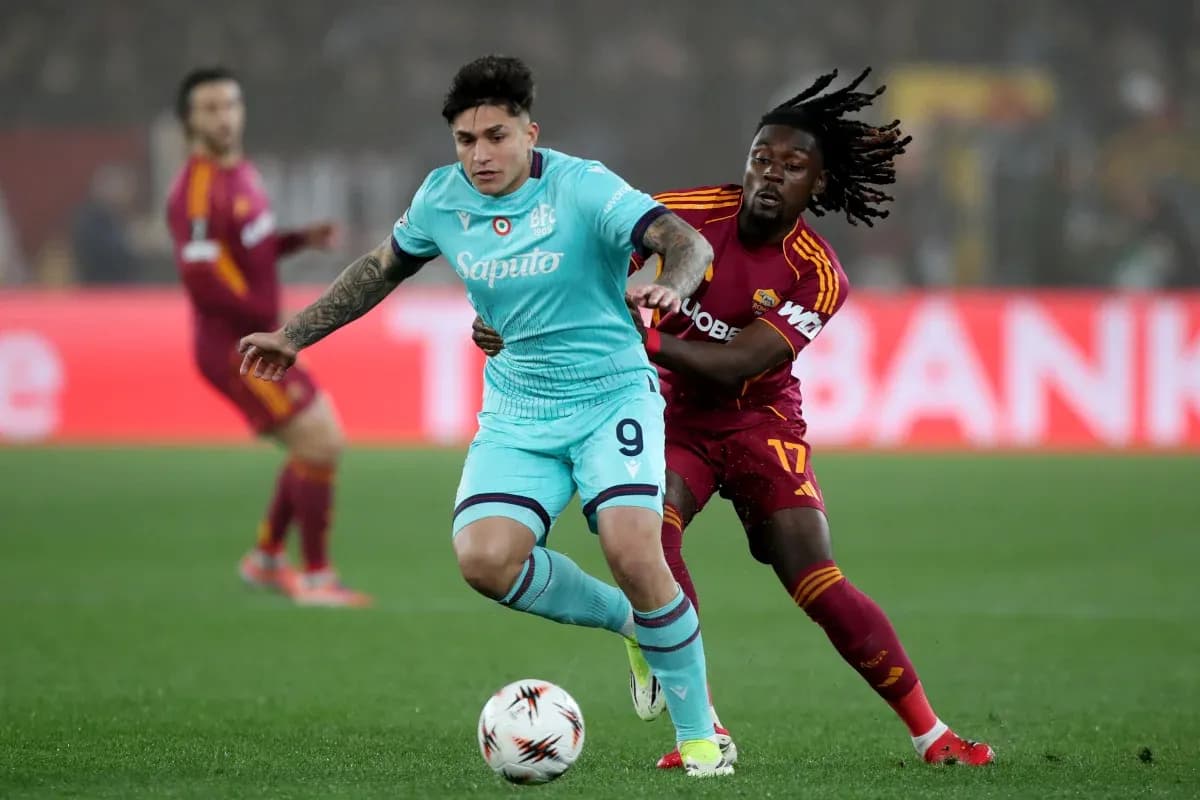
Bologna’s 2–0 home defeat to AS Roma at Stadio Renato Dall’Ara was defined less by territory and volume of possession than by Roma’s ruthless exploitation of transition moments and superior penalty-box clarity. Despite Bologna owning 60% of the ball, Roma’s early strike from D. Malen and a clinical second from N. El Aynaoui before the interval allowed the visitors to manage the game from a structurally secure 3-4-2-1 block. Roma’s lower share of possession (40%) was offset by a far higher attacking efficiency, reflected in a 2.14 xG to Bologna’s 0.55, and supported by controlled aggression and compact spacing between their back three and double pivot.
Roma’s scoring sequence was direct and emblematic of their tactical plan. On 7 minutes, D. Malen attacked space in behind Bologna’s back three, finishing a move initiated and assisted by N. El Aynaoui. The pattern—Roma springing quickly from a deeper starting position—immediately stressed Bologna’s high defensive line. On 45 minutes, the roles reversed: Malen dropped and combined, feeding N. El Aynaoui, who converted to make it 2–0. That second goal arrived just before halftime, locking in a 0–2 interval scoreline that shaped the second half’s dynamics: Bologna chasing, Roma compressing and countering selectively.
Disciplinary events were entirely on the Roma side and underlined their combative defensive approach. At 46', Mario Hermoso received a yellow card for a foul, a direct marker of Roma’s readiness to break Bologna’s rhythm immediately after the restart. At 66', Devyne Rensch, who had entered at halftime, was booked for a foul, reflecting the same tactical foul logic on the right side. On 69', Neil El Aynaoui also saw yellow for a foul, indicating Roma’s midfield line repeatedly stepped in with contact to prevent Bologna from accelerating through central lanes. Bologna, despite committing 10 fouls, received no cards, while Roma ended with three yellows and 16 fouls, a clear tactical choice to prioritize disruption over disciplinary cleanliness.
Substitutions followed a clear chronological and tactical pattern. At 46', Bologna made two attacking adjustments: J. Zortea (IN) came on for J. Miranda (OUT), and J. Odgaard (IN) came on for S. Castro (OUT), both moves aimed at adding energy and verticality down the flanks and in the front line. Roma responded simultaneously: Devyne Rensch (IN) came on for Z. Celik (OUT), refreshing the right wing-back slot with a more defensively oriented profile to protect the lead.
At 61', Roma doubled down on defensive consolidation and fresh legs in the front block: R. Vaz (IN) came on for M. Soule (OUT), and D. Ghilardi (IN) came on for M. Hermoso (OUT), the latter substitution also removing a booked defender. Bologna’s next change at 66' was structural: L. De Silvestri (IN) came on for Joao Mario (OUT), adding aerial presence and crossing threat on the right. At 77', Bologna pushed further: N. Cambiaghi (IN) came on for R. Orsolini (OUT) and M. Vitik (IN) came on for E. Fauske Helland (OUT), seeking more direct running and physicality. Roma, in turn, introduced P. Dybala (IN) for D. Malen (OUT) at 77', trading depth runs for ball retention and counter-control. Finally, at 90+4', J. Ziolkowski (IN) came on for N. Pisilli (OUT), a late rotation to close out the game.
Tactical Overview
Tactically, both teams mirrored each other’s 3-4-2-1, but with very different emphases. Bologna’s back three of T. Heggem, J. Lucumi, and E. Fauske Helland held a high line, supported by a midfield box of R. Freuler and L. Ferguson, with Joao Mario and J. Miranda as wing-backs. This structure aimed at territorial dominance and wide overloads, reflected in 519 total passes and 82% accuracy. However, their possession was largely sterile: only 2 shots on target from 10 attempts and just 0.55 xG. The wing-backs often received high and wide, but Roma’s compact 5-4-1 defensive shape (wing-backs dropping alongside the back three, Soule and Pisilli narrowing in front of Cristante and N. El Aynaoui) forced Bologna into circulation outside the block rather than penetrative passes into S. Castro’s feet.
Roma’s defensive plan hinged on the coordination of the back three (G. Mancini, E. Ndicka, M. Hermoso initially, later D. Ghilardi) with the double pivot of B. Cristante and N. El Aynaoui. They accepted long spells without the ball, using aggressive stepping from the outer centre-backs to challenge Bologna’s forwards between the lines, while the wing-backs, Z. Celik then Devyne Rensch on the right and Wesley Franca on the left, tracked Bologna’s wing-backs diligently. The three yellow cards for fouls show how often Roma were prepared to halt Bologna’s progress at source rather than allow clean entries into the final third.
In possession, Roma were far more vertical. With only 341 passes at 73% accuracy, they prioritized progression over recycling. Malen’s movement was central: starting as the spearhead, he alternated between attacking depth and dropping into pockets, creating space for M. Soule and N. Pisilli to attack the half-spaces. The first goal—Malen finishing a move created by N. El Aynaoui—came from a quick vertical connection through midfield, while the second flipped the pattern, Malen assisting N. El Aynaoui. These actions explain Roma’s high xG (2.14) despite just 7 total shots: their chances were clear and central, not speculative.
Goalkeeping and Statistical Summary
Goalkeeper realities underline the game’s territorial paradox. F. Ravaglia for Bologna registered 0 saves, meaning Roma’s two shots on target both resulted in goals. Roma’s M. Svilar, by contrast, made 2 saves from Bologna’s 2 shots on target, preserving the clean sheet. Both keepers are credited with 0 goals prevented in the data, indicating the chances that did arrive were either finished clinically (in Roma’s case) or not of a high enough quality to stretch Svilar beyond routine work.
Statistically, the verdict is stark: Bologna’s 60% possession, 7 corners, and 519 passes produced limited penalty-box threat and no goals. Roma, with 40% possession, matched Bologna’s shots on target (2–2), but their shot quality was significantly higher, aligning with the 2.14 vs 0.55 xG split. Fouls and cards further illustrate the strategic divide: Bologna’s 10 fouls and zero bookings point to a more passive defensive posture, whereas Roma’s 16 fouls and three yellow cards reflect a deliberate, high-commitment approach to disrupting Bologna’s rhythm. The overall form on the day favored Roma’s efficiency and tactical discipline, while Bologna’s defensive index is undermined by conceding twice from limited on-target attempts, a reminder that structural control must be matched by concentration and box defending to translate dominance into results.