Roma Dominates Torino in Serie A Clash
Under the Turin dusk at Stadio Olimpico Grande Torino, this felt less like a routine league fixture and more like a stress test of two footballing identities. On one side, Torino, 14th in Serie A and still searching for a stable platform after four games, brought a five-man defensive line and a clear intention to suffer without the ball. On the other, league leaders AS Roma arrived with a perfect record and a ruthless attacking profile that had already produced 12 goals and an imposing goal difference of 11.
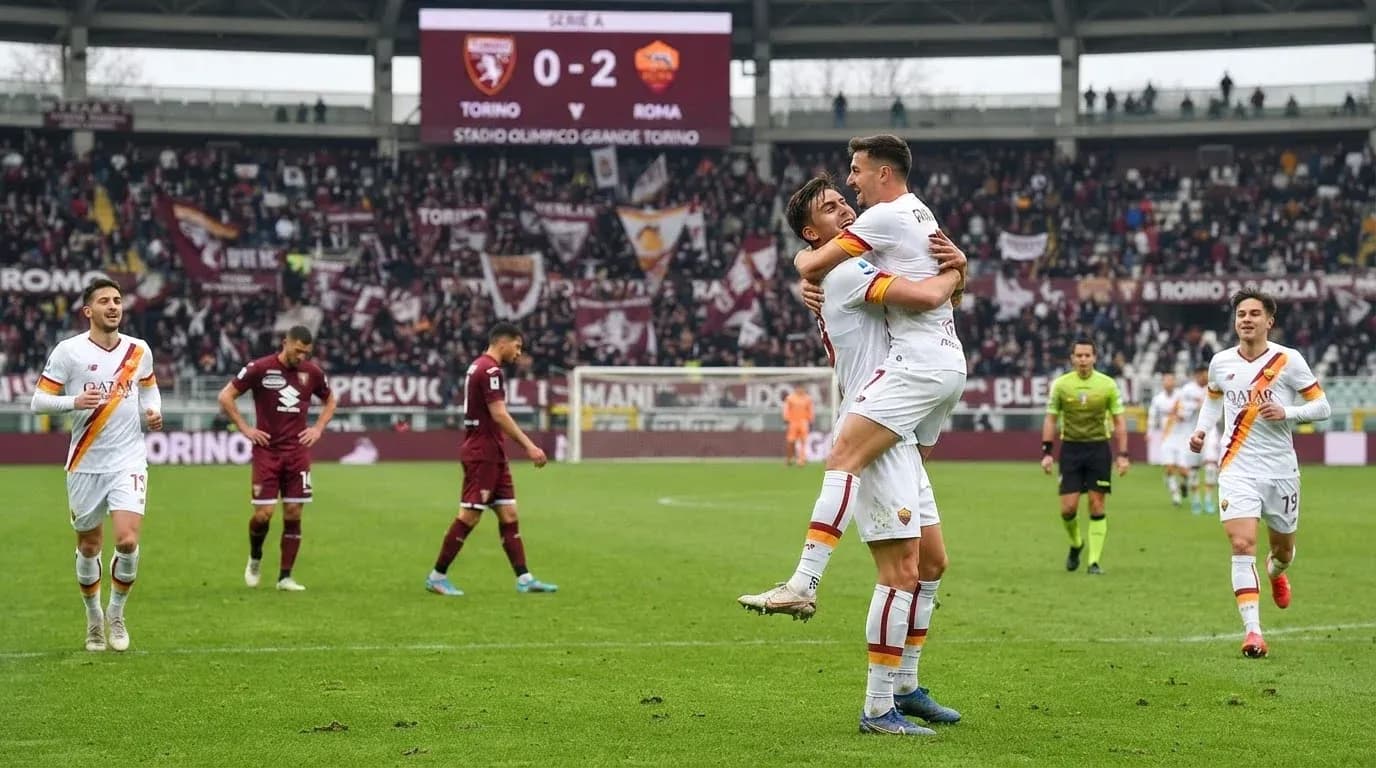
Final Score: Roma 2 - 0 Torino
The 2–0 final score to Roma told a story that had been foreshadowed by the season’s early numbers. Heading into this game, Torino had taken just 3 points from 4 matches, with 4 goals scored and 7 conceded overall. At home, the picture was even more stark: 2 defeats from 2, just 1 goal scored and 4 conceded, no clean sheets and one home match already without scoring. Ignazio Abate’s choice of a 5-3-2 was as much about damage limitation as it was about structure.
Across the halfway line, Roma came into Turin in full flight. Top of the table with 12 points from 4, they had scored 12 and conceded only 1 overall. On their travels, they were flawless: 2 away wins from 2, 6 goals scored and none conceded. Their attacking average on the road stood at 3.0 goals per game and their overall defensive record – 1 goal conceded in 4 matches – underlined why they were yet to taste defeat or even a draw.
Abate’s Torino were built around density and reaction. Lucas Perri in goal sat behind a compact back five of R. Belghali, E. Comert, S. Coco, P. Comuzzo and N. Fortini. The wing-backs, Belghali and Fortini, were tasked with the impossible dual mandate: hold Roma’s wide threats while providing any semblance of width in transition. Inside, G. Gineitis, R. Mandragora and K. Fitz-Jim formed a narrow midfield trio, more screen than springboard, charged with plugging central lanes and tracking Roma’s half-space runners. Up front, G. Simeone and N. Vlasic were less a traditional strike pair and more the first line of resistance, angling their pressing to deny easy progression into Roma’s pivots.
The absences only deepened Torino’s structural problems. C. Adams, their most efficient finisher so far with 2 goals from 3 appearances, was ruled out with a muscle injury. P. Pellegri, another central option, also missed out with a knee injury, while C. Casadei’s rest and F. Israel’s shoulder issue trimmed depth further. Without Adams’ penalty-box presence and Pellegri’s ability to attack crosses, Torino’s 5-3-2 became even more about survival than threat.
Roma’s shape, by contrast, was a statement of control. Piero Gasperini Gian lined his side up in a 3-4-2-1, a system that has already become their default this season. M. Svilar anchored a back three of G. Mancini, L. Balerdi and M. Hermoso, a unit built not only to defend but to initiate play through the lines. Ahead of them, the wing-backs E. Lulli and N. Molina stretched the pitch horizontally, while B. Cristante and N. Pisilli formed a double pivot capable of both screening counters and dictating tempo.
The real artistry, though, lived in the band of three. P. Dybala and M. Soule floated between the lines behind D. Malen, creating an ever-shifting triangle that Torino’s back five struggled to track. Dybala, already leading Serie A in assists with 4 from 3 appearances and averaging 14 key passes across those games, operated as Roma’s primary conductor, receiving in pockets, turning, and threading passes into the channels. Soule, who had 2 goals and 1 assist heading into this match, offered a more vertical, dribble-heavy threat, attacking the inside-right lane and combining with Molina’s overlaps.
At the tip of the spear, Malen was the embodiment of Roma’s cutting edge. With 5 goals in his first 3 league appearances, from 11 shots and 7 on target, he arrived in Turin as Serie A’s most in-form finisher. His duel numbers – 21 contested, 12 won – and 13 attempted dribbles with 8 successful highlighted a forward who doesn’t just finish moves but also initiates and sustains them. Against a Torino side conceding an overall average of 1.8 goals per game and 2.0 at home, his movement between Comert and Coco always threatened to pry open the defensive shell.
The tactical voids were clear. Torino’s home attacking average of 0.5 goals per match, combined with Roma’s away defensive average of 0.0 goals conceded per game and 2 clean sheets overall, set up a clash where every Torino chance would be a minor miracle. Without Adams, the home side lacked a natural outlet to attack the space behind Roma’s advanced wing-backs. Simeone could press and harry, Vlasic could drop to link, but neither offered the same penalty-area gravity.
Roma, meanwhile, had their own absences to manage. M. Bah (knee injury) and E. Ndicka (illness) reduced options at the back and in rotation, but did little to blunt the starting XI. The continuity of the 3-4-2-1, already used twice in the league before this, meant automatisms were intact: wing-backs arriving late at the far post, Dybala drifting into the left half-space to receive on his stronger foot, Soule ghosting beyond the striker when Malen dropped short.
In the “Hunter vs Shield” matchup, Roma’s front three overwhelmed Torino’s numbers. A side that had failed to keep a single clean sheet overall and had already failed to score once at home was always likely to be pinned back by a team averaging 3.3 goals per game overall and 4.0 on their travels before this fixture. The “Engine Room” battle was similarly tilted: Cristante’s positional discipline and Pisilli’s energy gave Roma a stable platform, while Mandragora and Gineitis spent more time shuttling laterally than progressing the ball.
Discipline offered one of the few areas where Torino might have hoped for a foothold. Heading into the match, their yellow cards were concentrated entirely in the 16–30 minute window (100.00% of their cautions), suggesting a tendency to overreach early. Roma, conversely, spread their bookings evenly across the first 60 minutes – 33.33% in each of the 0–15, 31–45 and 46–60 intervals – a sign of an aggressive but controlled press. In a game where Torino would inevitably spend long spells without the ball, avoiding an early yellow that pinned a wing-back or centre-back was critical; once forced to defend with less intensity, their low block would fray.
From a statistical prognosis perspective, everything pointed towards a Roma win with a low probability of Torino breaching Svilar’s goal. Torino’s overall attacking average of 1.0 goal per game was heavily inflated by their away output; at home, the 0.5 average combined with Roma’s defensive steel made a Torino goal an outlier. Roma’s offensive power, their ability to create volume through Dybala’s chance creation and Malen’s finishing, and their perfect away record suggested that even a modest xG edge would be converted into a multi-goal margin.
Following this result, the narrative holds: Roma look every inch a side built to sustain a title challenge, their 3-4-2-1 humming with synchronised movement and individual brilliance. Torino, by contrast, remain a team in search of balance, their five-man defence providing numbers but not yet the control or counter-punching threat required to trouble the division’s elite.