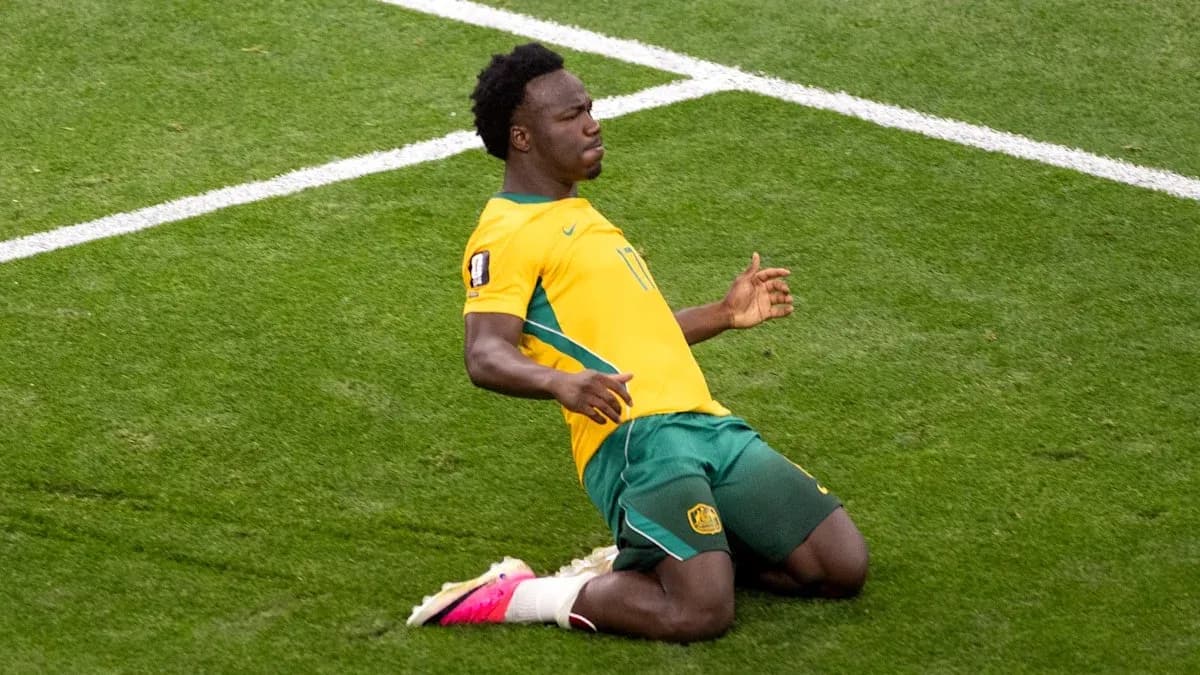
Socceroos Advance: Concerns Over No.9 Role After Paraguay Draw
The Socceroos are through. The job is done. But the way they got there has left two former internationals shifting uneasily in their seats.
Australia’s 0-0 draw with Paraguay sealed a place in the round of 32 at the FIFA World Cup, a result that will look tidy and uncomplicated on paper. On the pitch, it was anything but. The standout attacking threat was not a striker, not a winger, not a No.10.
It was Jordan Bos.
Bos shines as emergency fix
Jacob Italiano’s late injury scratched him from the right side of Tony Popovic’s line-up and forced a reshuffle that many had been waiting to see. Popovic pushed Melbourne City left-back Aziz Behich across to the left vacancy and turned to Bos to fill the right.
It looked like a gamble. It played like a masterstroke.
Bos tore into the role with the energy of a player who has been waiting all his life for this kind of stage. He drove at defenders, offered an outlet, and repeatedly looked like the one player capable of unsettling a rugged Paraguayan back line.
That, for Scott McDonald and Robbie Slater, was exactly the problem.
“Up front is a bit of a worry when we’re looking at Jordy Bos as one of the most threatening (for Australia),” Slater said on Stan Sport’s Added Time, his concern cutting through the post-match relief.
The pressure Paraguay absorbed came more from a makeshift wide option than from the men picked to lead the line. For a World Cup knockout contender, that imbalance is a warning flare.
No.9 role under the microscope
McDonald, a former Socceroos striker who understands the loneliness of the role, saw the same issue from a different angle. On a night when the spotlight should have fallen on Mo Toure or Nestory Irankunda, it drifted instead to a young full-back-turned-winger.
Toure stayed on the bench. Irankunda, usually a winger, was again asked to operate as Australia’s No.9.
For McDonald, that experiment has a clear ceiling.
“There is a problem in terms of the No.9. Not bringing (Mo) Toure on instead of Tete Yengi tells me today that there’s no trust there,” he said.
That one decision said plenty. If the coach won’t turn to Toure when the game cries out for a different kind of threat, what does that do to a young striker’s belief?
“Does he go and start him (Toure) out of the blue in the next game? You just can’t tell with Tony. But as a striker, being Toure, I don’t like that. That doesn’t fill me with confidence that my coach trusts me.”
The message to the forwards, intentional or not, is brutal: whoever goes up there is on a hiding to nothing.
Irankunda’s thankless shift
Nestory Irankunda lived that reality against Paraguay. Thrown into the central role again, the 20-year-old battled for scraps against a fierce, physical South American defence that gave him no room to breathe.
“No matter who we put up there, it’s a thankless task up there,” McDonald said. “Look at Nestory (on Friday), he had very little and was living off scraps.”
Without a traditional box presence, Australia’s attacks often died before they reached dangerous areas. Irankunda drifted, as natural wingers do, looking for space that simply wasn’t there.
“When he plays up top, we don’t have a box outlet. Jordy Bos playing on the right-hand side was brilliant and it gave us that outlet.”
The contrast was stark. Bos, out of position, looked like the release valve. Irankunda, in the No.9 shirt, looked like a square peg.
McDonald admitted Irankunda was always going to be a concern as a No.9 or even a No.10, not because of his talent, but because of the sheer demands of those roles at this level. Holding the ball, occupying centre-backs, timing runs into crowded central areas – it’s specialist work.
“Look, he’s gotta hold it up a little bit better,” McDonald said. “I think at times he struggled because it’s not his natural game.”
Paraguay knew exactly where the danger lay. They locked up the middle with a back three, squeezed the space, and tracked Irankunda in numbers. Whenever he tried to pull wide, the system and the opposition shape closed the door.
“There was no space. They were aware of his threat also, with three taking care of him. But he probably sometimes needs to be more in central positions and wait for things to happen.”
Learning the art of the striker
McDonald reached for the modern benchmark.
“As we see the best strikers in the world – like Erling Haaland – they’re not interested any more. They just get into the right areas and allow others and trust others to do the dirty work then get on the end of things.”
That is the shift Irankunda has not yet made. He wants to create, to drive at defenders, to take shots from the edge of the box. It’s the instinct of a winger, not a penalty-box predator.
“That’s not naturally probably where (Irankunda) thinks. He wants to be the guy creating that and doing things, getting on the edge of the box and having shots. So if you’re gonna play that role, you just need to play it a little bit more smarter and be a bit more patient.”
Patience. Penalty-area movement. Aerial presence. The old truths of the No.9 role still matter, especially in the green and gold.
“I didn’t like it either. I mean, for the majority of my career it was always you played off the big man or whatever,” McDonald said.
Then came the line that should echo inside every Australian striker’s head.
“But I’ve always said it, if you can head it, you’ve got a better chance of being a No.9 for the Socceroos. It’s as simple as that.”
Australia marches on, carried in part by a fearless young full-back playing out of position. The question now is whether someone, anyone, in that front line will step up and make sure the story of this World Cup isn’t that the Socceroos went deep without ever truly finding their No.9.