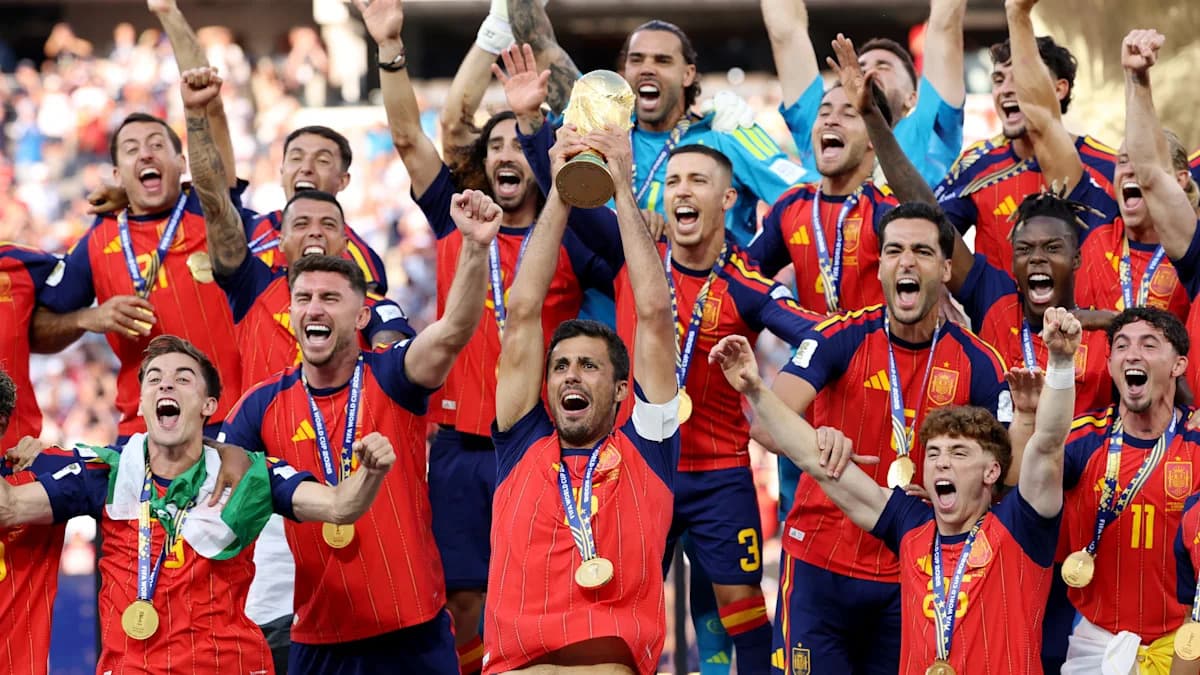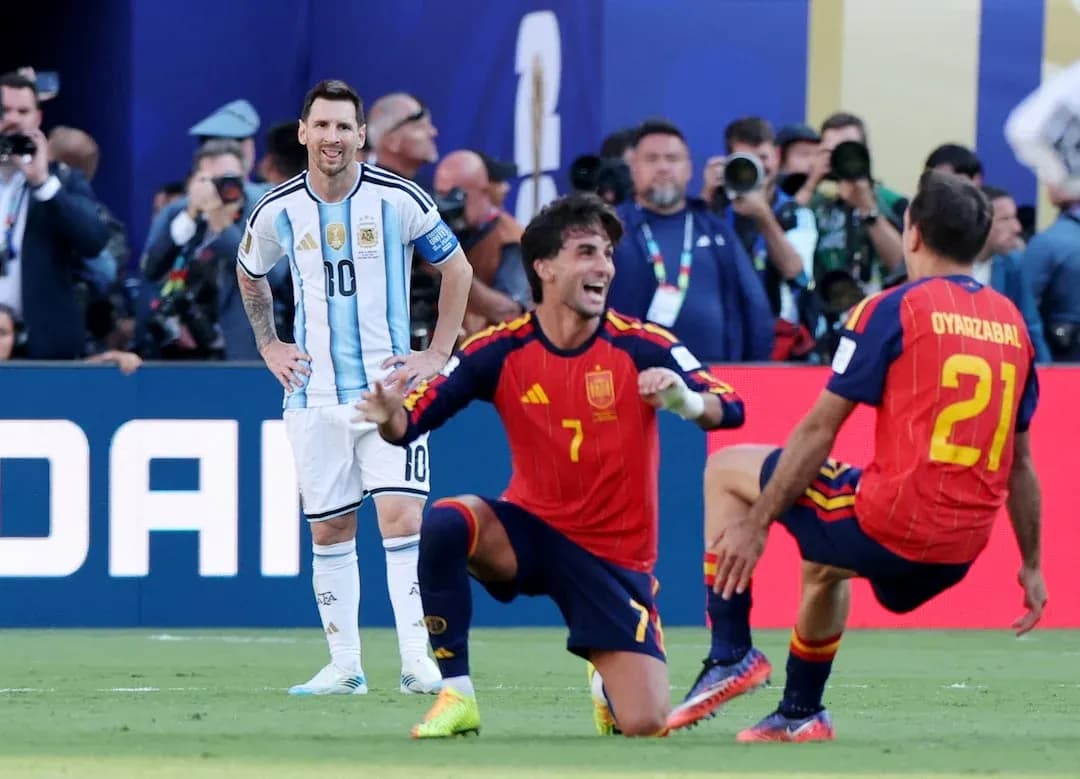
Spain Crowned World Champions After 1-0 Victory Over Argentina
Spain 1-0 Argentina (after extra time) at MetLife Stadium, East Rutherford, crowns Spain as world champions, edging a cagey World Cup Final with a single extra-time strike. Spain add a further three points to their flawless tournament path, while Argentina’s perfect run from the group phase ends one game short of retaining the title.
Match Report
The final unfolded as a tense, tactical contest with discipline and substitutions playing a central role before Ferrán Torres finally broke through in extra time.
At 41', Argentina picked up the first booking: 41' Lisandro Martínez (Argentina) — yellow card (Foul), a reflection of Spain’s early territorial dominance and Argentina’s increasing reliance on contact to slow the game.
Three minutes later, Argentina made a defensive reshuffle. At 44', Nicolás Otamendi replaced Lisandro Martínez (Argentina), an early centre-back change that suggested either a precaution over fitness or a tactical preference for Otamendi’s aerial presence against Spain’s wide service.
On the stroke of half-time, Argentina altered their attacking structure: at 45', Leandro Paredes replaced Nicolás Iván González (Argentina), moving from a more vertical left-sided threat to an extra midfielder to gain control in central areas.
Argentina’s combative approach continued after the interval. At 52', Leandro Paredes (Argentina) — yellow card (Argument), underlined the emotional edge as Spain’s possession game frustrated the holders.
On 58', Argentina adjusted again at right-back: Nahuel Molina replaced Gonzalo Montiel (Argentina), seeking fresher legs to cope with Lamine Yamal’s threat on Spain’s right and to offer more thrust in transition.
Spain responded with a double attacking change on 62'. Ferrán Torres replaced Mikel Oyarzabal (Spain), adding more depth-running in behind, while Pedri replaced Fabián Ruiz (Spain), injecting extra control and line-breaking passing between the lines.
At 70', Argentina made a second defensive reset and a change in midfield energy: Facundo Medina replaced Cristian Romero (Argentina), and Giuliano Simeone Baldini replaced Rodrigo De Paul (Argentina), effectively refreshing the back line and adding a more direct runner in Simeone to press Spain’s build-up.
Spain then refreshed both their left side and central creativity at 75'. Nico Williams replaced Alejandro Baena Rodríguez (Spain), bringing more one-v-one explosiveness from wide, and Mikel Merino replaced Daniel Olmo Carvajal (Spain), adding physicality and late runs from midfield to attack Argentina’s box.
Argentina’s discipline continued to fray under pressure. At 82', Enzo Fernández (Argentina) — yellow card (Dissent), followed by 90+2' Cristian Romero (Argentina) — yellow card (Dissent), highlighted how often they were defending deep and appealing decisions rather than controlling the ball.
As extra time began, Spain looked to maintain intensity in the centre and protect against counters. At 99', Martín Zubimendi replaced Rodrigo Hernandez Cascante (Spain), giving fresher defensive legs in midfield, and Eric García replaced Aymeric Laporte (Spain), a like-for-like change at centre-back to preserve concentration and mobility in the back line.
Argentina, chasing a way back into the game, made a surprising structural change at 102', bringing on an extra defender: Marcos Senesi replaced Julián Álvarez (Argentina), effectively sacrificing a forward for defensive solidity and perhaps targeting set-piece strength.
The tension on the Argentina bench was evident at 104', when Lionel Sebastián Scaloni (Argentina) — yellow card (Dissent), was booked, symptomatic of a side increasingly on the back foot against Spain’s sustained pressure.
The decisive moment arrived at 106'. Spain goal — Ferrán Torres (assisted by Nico Williams). Williams, who had been stretching Argentina’s left since his introduction, again found space to deliver, and Torres converted to make Spain’s territorial and shot dominance count, putting them 1-0 up in extra time.
Argentina’s final notable action in the book came at 111', Alexis Mac Allister (Argentina) — yellow card (Foul), as they pushed desperately and increasingly risked tactical fouls to halt Spanish counters. Spain then managed the remaining minutes with controlled possession and disciplined structure to close out the 1-0 victory after extra time.
Fixture Statistics & Tactical Audit
- xG: Spain — not provided vs Argentina — not provided
- Possession: Spain 65% vs 35% Argentina
- Shots on Target: Spain 12 vs 0 Argentina
- Goalkeeper Saves: Spain 0 vs 11 Argentina
- Blocked Shots: Spain 3 vs 1 Argentina
The statistical profile underlines how Spain controlled this final both territorially and in chance volume. With 65% possession, 20 total shots and 12 on target against just 2 shots and none on target for Argentina, Spain’s approach was methodical and patient, circulating the ball and repeatedly probing wide areas, particularly through Lamine Yamal and later Nico Williams. Argentina’s 11 saves from Emiliano Martínez show how often Spain worked the goalkeeper, even if many efforts came from outside the box, as indicated by Spain’s balanced shot distribution (11 from outside, 9 inside). Argentina, by contrast, produced only 1 shot inside the box and 1 from distance, reflecting how effectively Spain’s rest defence and counter-press smothered transitions. The 3-1 edge in blocked shots for Spain also shows their readiness to shoot under pressure, while Argentina were forced into a low block and reactive defending. Given the disparity in shots on target (12-0) and territorial control, the 1-0 scoreline actually flatters Argentina; Spain’s win was fully aligned with the underlying performance, even if it required extra time to translate dominance into a goal.
Standings Update & Seasonal Impact
Spain entered the knockout phase from Group H with 7 points, 5 goals scored and none conceded. Adding this 1-0 win in the Final takes them to 10 points in the competition’s cumulative record, with 6 goals for and still just 0 against, improving their goal difference to +6. They complete the campaign as world champions, having progressed from the Round of 32 and navigated the entire knockout path without conceding. Argentina, who came out of Group J with a perfect 9 points, 8 goals scored and 1 conceded, finish the tournament with the same 9 points plus this defeat in the Final, moving to 8 goals for and 2 against, and a goal difference of +6. Despite matching Spain’s overall goal difference, the holders fall one step short in the title defence, their run from the Round of 32 ending against a side that ultimately imposed greater control and chance creation on the biggest stage.
Lineups & Personnel
Spain Starting XI
- GK: Unai Simón
- DF: Pedro Porro, Pau Cubarsí Paredes, Aymeric Laporte, Marc Cucurella
- MF: Rodri, Dani Olmo, Fabián Ruiz, Álex Baena
- FW: Lamine Yamal, Mikel Oyarzabal
Argentina Starting XI
- GK: E. Martínez
- DF: G. Montiel, C. Romero, Lisandro Martínez, N. Tagliafico
- MF: R. De Paul, E. Fernández, A. Mac Allister
- FW: N. González, L. Messi, J. Álvarez
Post-Match Verdict
Spain delivered a dominant performance (65% possession, 20 shots, 12 on target) built on control, structure and depth from the bench. Luis de la Fuente’s changes — especially the introductions of Ferrán Torres, Pedri and Nico Williams — progressively tilted the game further in Spain’s favour, adding vertical runs, creativity between the lines and direct wing play. The winning goal was a direct product of this bench impact, with Williams assisting Torres in extra time.
Defensively, Spain were clinical in their organisation (0 shots on target conceded, only 2 shots allowed overall), with their high pressing and rest defence preventing Argentina from exploiting transitions or feeding Lionel Messi and Julián Álvarez in dangerous zones. The late introduction of Martín Zubimendi and Eric García helped lock down the final stages once the lead was secured.
For Argentina, this was a backs-to-the-wall display rather than a collapse. They were resilient (11 saves by Emiliano Martínez, 25 fouls committed to break up play) but overly passive, rarely escaping Spain’s press or establishing sustained possession. Frequent defensive substitutions — Otamendi and Medina in central defence, Molina at right-back, and later Senesi for Álvarez — signalled a shift towards damage limitation rather than proactive control. The accumulation of yellow cards (five for players plus one for Lionel Scaloni) reflected a side under constant strain.
Ultimately, Spain’s structured dominance and superior shot quality made the outcome inevitable over 120 minutes. The narrow 1-0 margin belies a final in which Spain systematically reduced Argentina’s attack to almost nothing while repeatedly testing the goalkeeper, a tactical triumph that secures the world title on merit.