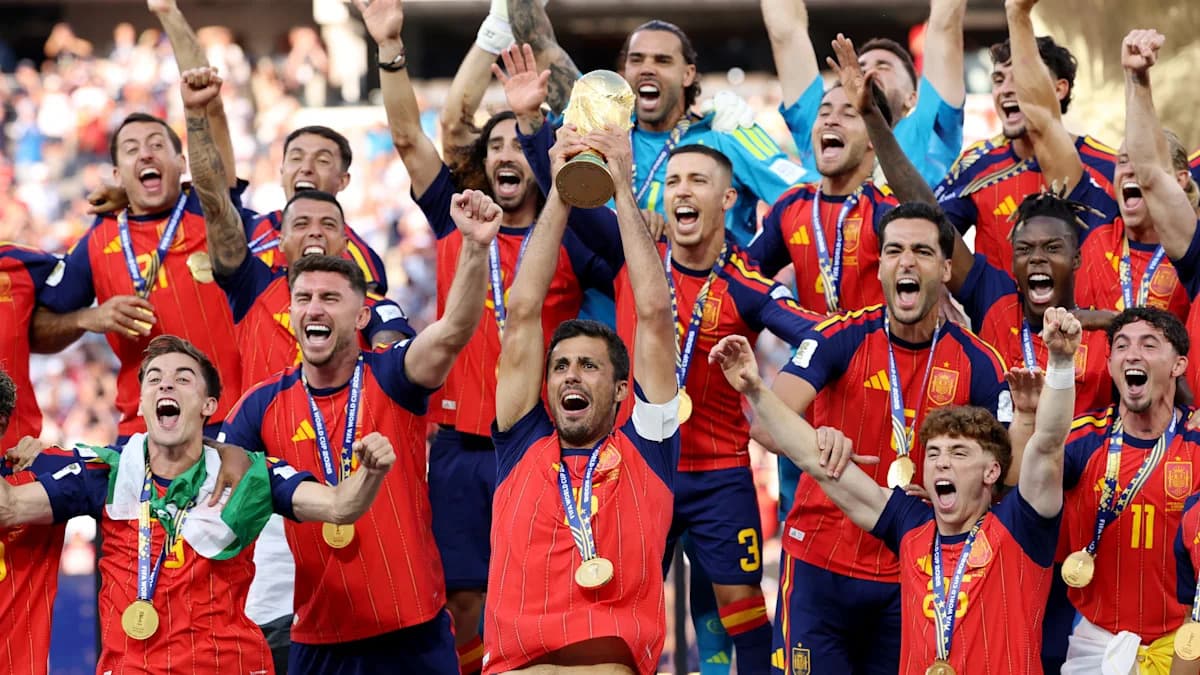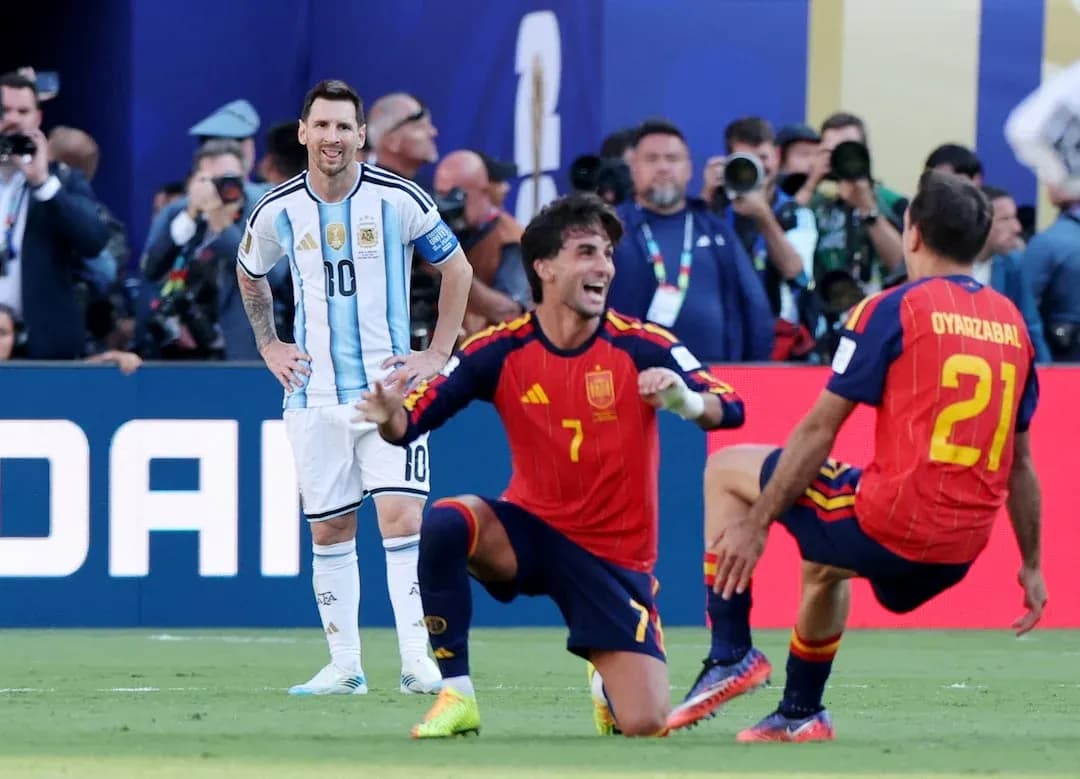
Spain Dominates Argentina in World Cup Final
Spain’s 1-0 extra-time win over Argentina in the World Cup Final at MetLife Stadium was a textbook demonstration of territorial domination, structural control and long-haul game management. Across 120 minutes, Spain turned a 4-2-3-1 into a suffocating positional net, pinning a 4-4-2 Argentina so deep that the South Americans finished without a single shot on target and with ten men. The statistical profile – 65% possession, 20–2 shots, 1.94 vs 0.22 in xG – underlines how completely Spain dictated the game, even if the decisive moment only arrived in extra time through Ferran Torres.
I. Executive Summary
Spain’s plan under Luis de la Fuente was to stretch and fatigue Argentina over time rather than chase an early knockout. The 4-2-3-1 with Rodri and Fabián Ruiz at the base produced long passing sequences (852 total passes, 762 accurate, 89%), constantly shifting Argentina’s 4-4-2 block. Argentina, under Lionel Scaloni, accepted a low-possession, high-suffering scenario (463 passes, 357 accurate, 77%), banking on compactness, duels and transitions via Lionel Messi and Julián Alvarez. In the end, the red card for Enzo Fernández and the relentless Spanish circulation tilted the final decisively.
II. Scoring Sequence & Disciplinary Log
The match’s only goal came in extra time. At 106', Ferran Torres (Spain) finished after service from Nico Williams to make it 1-0, a scoreline that held through 120 minutes and reflected Spain’s cumulative pressure rather than a sudden swing.
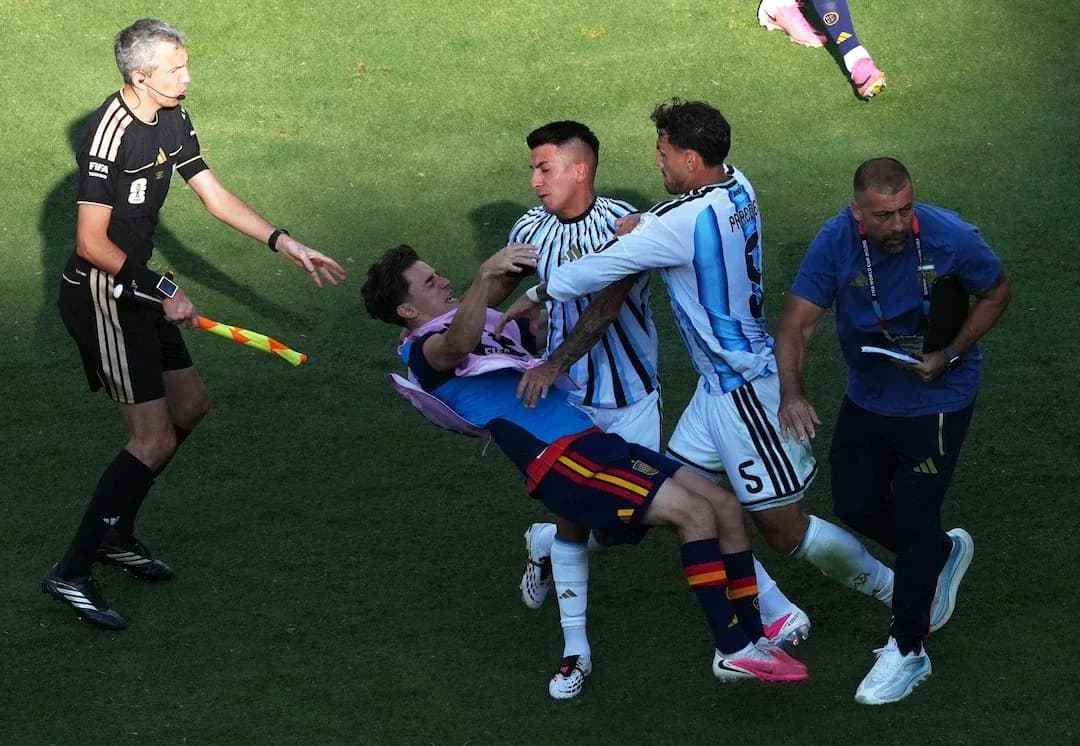
Discipline played heavily into the tactical story, almost entirely on Argentina’s side. Cards, in chronological order by match time:
- -5' Cristian Romero (Argentina) — Argument
- 41' Lisandro Martínez (Argentina) — Foul
- 52' Leandro Paredes (Argentina) — Unsporting behaviour
- 83' Enzo Fernández (Argentina) — Argument
- 90+3' Enzo Fernández (Argentina) — Foul (second yellow)
- 90+3' Enzo Fernández (Argentina) — Foul (Red Card)
- 111' Alexis Mac Allister (Argentina) — Foul
Totals: Spain 0 cards, Argentina 6 yellow cards and 1 red card (all for Argentina), for a combined total of 7 cards. The accumulation of disciplinary incidents reflects Argentina’s increasing reliance on disruptive tactics as Spain’s control deepened.
III. Tactical Breakdown & Personnel
Spain’s 4-2-3-1 was built on structural superiority in the first and second lines. With Rodri and Fabián Ruiz as a double pivot, Spain could always form a 2+2 build-up platform ahead of Unai Simón (Spain). Full-backs Pedro Porro and Marc Cucurella pushed high and wide, turning the shape into something closer to a 2-3-5 in settled possession, with Lamine Yamal and Alex Baena inside the half-spaces and Dani Olmo linking centrally behind Mikel Oyarzabal.
The passing numbers capture that dominance: 852 passes, 762 accurate at 89% completion. Spain were patient rather than vertical for its own sake, prioritizing occupation of all five attacking lanes. The 9 shots inside the box out of 20 total attempts, plus 1.94 xG, show that they eventually converted positional superiority into genuine penalty-area presence, not just sterile possession.
Out of possession, Spain’s counter-press was the primary defensive mechanism. With 21 fouls, they were willing to stop transitions early, but crucially they did so without drawing any cards. Rodri’s substitution at 99' for Martín Zubimendi allowed fresh legs to maintain that screen in front of the centre-backs Pau Cubarsí and Aymeric Laporte (later replaced by Eric García at 99'). The defensive line held high, compressing the pitch and making it difficult for Messi and Alvarez to receive between lines.
Argentina’s 4-4-2 was initially stable but reactive. Rodrigo De Paul and Enzo Fernández had to cover enormous horizontal distances as Spain circulated. The early yellow for Lisandro Martínez at 41' and the pre-kickoff booking for Cristian Romero at -5' (“Argument”) foreshadowed the strain on the back line. Scaloni’s substitutions – Nicolás Otamendi for Lisandro Martínez at 44', Leandro Paredes for Nicolás González at 46', and later Nahuel Molina, Facundo Medina, Giuliano Simeone and Marcos Senesi – were geared towards refreshing the block and adding defensive aggression and running power.
Yet Argentina never solved the core structural problem: they could not contest the middle third with the ball. With only 2 total shots (1 off target, 1 blocked) and 0 shots on goal, their transitions were sporadic and poorly supported. Messi and Alvarez were often isolated, having to drop deep just to secure possession, which in turn emptied the last line and made it easier for Spain’s centre-backs to defend.
The turning point came with Enzo Fernández’s sequence: a yellow for “Argument” at 83', then another yellow and a red for “Foul” at 90+3'. Reduced to ten men just as fatigue peaked, Argentina had to collapse even deeper. The numerical advantage allowed Spain to move the ball with even less pressure on the pivot and half-spaces, and the introduction of Nico Williams and Ferran Torres at 62' gave Spain fresh, direct threats against a tiring and reshuffled Argentine back line.
The winning goal at 106' encapsulated the tactical arc: Spain circulating, stretching a ten-man 4-4-1, then Williams attacking space and delivering for Ferran Torres to finish. It was the logical outcome of cumulative territorial and numerical superiority rather than a random break.
In goal, Unai Simón (Spain) was almost a pure build-up piece; Spain’s statistics show 0 goalkeeper saves, underlining how effectively the outfield structure protected him. Emiliano Martínez (Argentina), by contrast, was under constant pressure, registering 11 saves. That workload, combined with Argentina’s 25 fouls and heavy card count, underlines how much of the final they spent in survival mode.
IV. The Statistical Verdict
The numbers are unequivocal. Spain’s 65% possession and 20–2 shot advantage, combined with 1.94 xG to Argentina’s 0.22, describe a final where the eventual champion controlled both territory and chance quality. Nine corners to four, plus 9 shots inside the box versus Argentina’s single effort from close range, reinforce the territorial imbalance.
Spain’s passing volume and accuracy (852 passes, 762 accurate, 89%) were not sterile: they translated into repeated entries and, crucially, the ability to sustain pressure into extra time. Argentina’s 463 passes at 77% accuracy, 25 fouls, 6 yellow cards and 1 red card reflect a reactive, increasingly desperate defensive approach that never generated a meaningful attacking platform.
Goalkeeper data completes the picture: Emiliano Martínez (Argentina) making 11 saves versus Unai Simón (Spain) facing no shots on target. Spain’s defensive structure and counter-press effectively erased Argentina’s attack, while their own patient, lane-occupying possession finally broke through a worn-down, undermanned Argentina in extra time.