Sunderland's Tactical Masterclass Against Everton: A 3-1 Analysis
Everton’s 1-3 defeat to Sunderland at Hill Dickinson Stadium unfolded as a story of structural control versus transitional ruthlessness. Both sides mirrored each other in a 4-2-3-1, but Regis Le Bris’ Sunderland adapted more intelligently across the 90 minutes, especially after half-time, to overturn a 1-0 deficit and exploit Everton’s increasingly stretched block.
Everton, under Leighton Baines, built from a back four of Jarrad Branthwaite-style profiles in James Tarkowski and Michael Keane, with Vitaliy Mykolenko and Jake O’Brien as full-backs. In possession, the shape morphed into a 2-3-2-3: Tim Iroegbunam and James Garner forming the double pivot, with M. Rohl and Kiernan Dewsbury-Hall operating between the lines, and I. Ndiaye drifting inside off the flank behind Beto. Their 49% possession, 406 passes, 346 accurate (85%), and 10 total shots (4 on target) reflected a side comfortable circulating the ball but lacking incision once Sunderland adjusted.
Early on, Everton’s structure functioned well. The double pivot allowed them to evade Sunderland’s first line, with Beto pinning centre-backs N. Mukiele and O. Alderete and creating room for Rohl and Dewsbury-Hall to receive on the half-turn. The opening goal on 43 minutes was emblematic: M. Rohl (Everton) scored, assisted by M. Keane, capitalising on Everton’s ability to draw Sunderland’s block forward and then find a late-arriving midfielder. Up to half-time, Sunderland’s 4-2-3-1 was relatively passive; G. Xhaka and N. Sadiki sat deep, and B. Brobbey was often isolated, which is consistent with Sunderland’s low shot volume before the break.
The game’s tactical hinge came after the interval. Sunderland, who finished with 51% possession, 430 passes, 365 accurate (85%), and a lean 7 total shots (3 on target), began to press higher and transition faster. The equaliser on 59 minutes — B. Brobbey (Sunderland) finishing from an E. Le Fee assist — showcased this shift. Sunderland won the ball in midfield, with Xhaka and Sadiki stepping more aggressively to disrupt Everton’s build-up, and then attacked Everton’s retreating back line before the hosts could restore their rest defence.
Substitution patterns underline the tactical story. At 23 minutes, O. Alderete (OUT) made way for L. O’Nien (IN), an early defensive reshuffle that hinted at Le Bris’ willingness to tweak his back line. The more decisive wave came around the hour mark and into the final quarter. At 60 minutes, T. Hume (OUT) was replaced by C. Talbi (IN), adding fresh legs and a more direct threat in the advanced midfield line. Then, in a triple move on 77 minutes, Sunderland injected energy and verticality: N. Angulo (OUT) for C. Rigg (IN), N. Sadiki (OUT) for H. Diarra (IN), and B. Brobbey (OUT) for W. Isidor (IN). This reconfigured Sunderland into a more transition-oriented side, with Rigg and Diarra driving forward from midfield and Isidor stretching the last line.
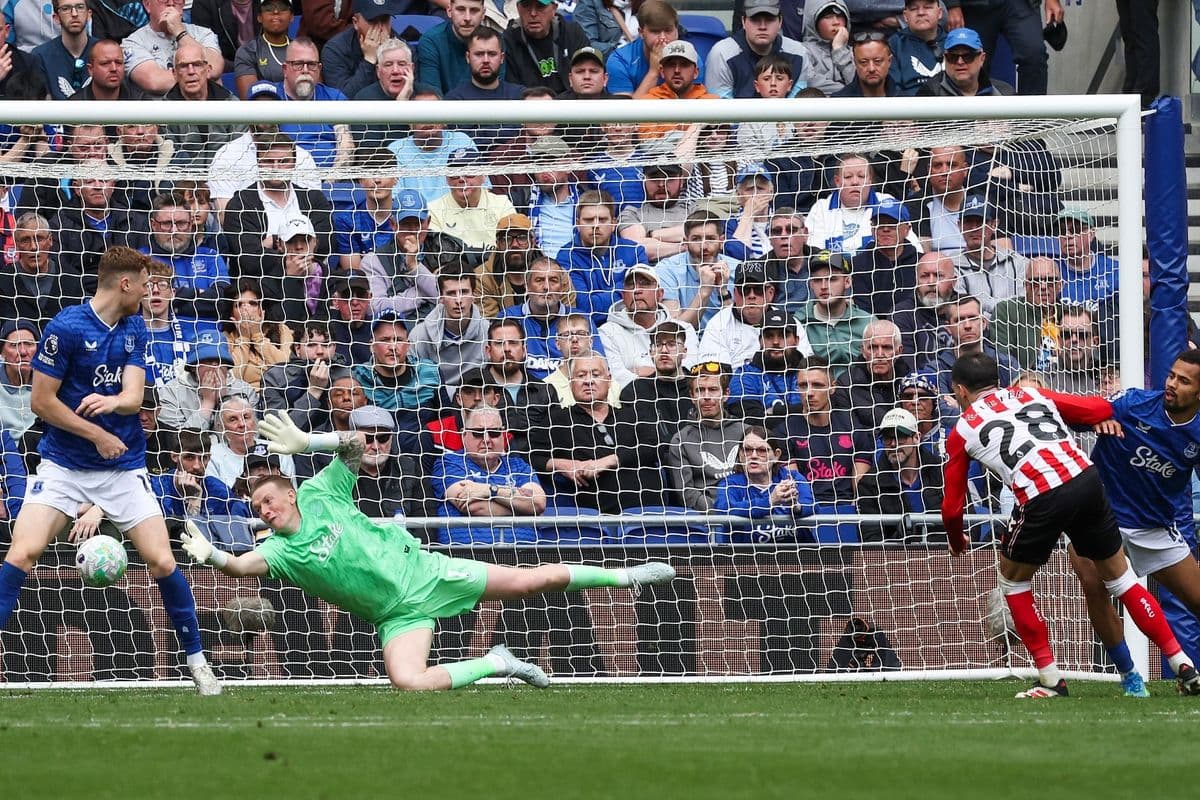
Those changes directly shaped the decisive goals. On 81 minutes, E. Le Fee (Sunderland) scored, assisted by C. Rigg. The move reflected Sunderland’s improved occupation of the half-spaces: Rigg found a pocket between Everton’s lines, drew out a centre-back, and released Le Fee into the channel. Everton’s double pivot, already carrying yellow cards and heavy defensive workloads, struggled to track these late runners. With Everton chasing the game and committing more bodies forward, the structure frayed further. In stoppage time, at 90 minutes, W. Isidor (Sunderland) added the third, assisted by H. Diarra, a classic counter-attack goal that punished Everton’s exposed rest defence and confirmed Sunderland’s superiority in transition management.
Everton’s own substitutions were more reactive and less structurally impactful. At 73 minutes, T. Iroegbunam (OUT) was replaced by T. George (IN), and Beto (OUT) by T. Barry (IN). These changes shifted Everton towards a more attacking posture but at the cost of some midfield stability, particularly with Iroegbunam off. At 88 minutes, J. O’Brien (OUT) made way for S. Coleman (IN), and M. Rohl (OUT) for D. McNeil (IN), late attempts to add crossing threat and experience on the flanks. However, by then Sunderland’s block was compact and well-organised, and Everton’s chance creation had become predictable: 6 of their 10 shots came from inside the box but without the dynamic rotations that had troubled Sunderland before the break.
Defensively, the numbers underline the goalkeeping realities. J. Pickford, despite Everton conceding three times, recorded 0 goalkeeper saves; Sunderland’s 3 shots on target all beat him, aligning with Sunderland’s xG of 0.73 and suggesting that the chances they did create were either high quality or poorly defended. His goals prevented figure of 0.02 indicates he performed roughly to expectation, with the blame lying more in structural and individual defensive lapses than in shot-stopping. At the other end, R. Roefs made 3 saves for Sunderland and posted 0.02 goals prevented, matching Everton’s xG of 1.07 against the single goal conceded. He handled Everton’s limited on-target volume competently, particularly once Sunderland dropped into a more conservative block after going 2-1 up.
Discipline further illustrates Everton’s growing frustration. They received 3 yellow cards, all for “Foul”: at 25 minutes, Tim Iroegbunam (Everton) — Foul; at 47 minutes, Jake O’Brien (Everton) — Foul; and at 90+6 minutes, James Garner (Everton) — Foul. Sunderland, by contrast, finished without a booking, consistent with their more controlled second-half approach and fewer total fouls (9 versus Everton’s 14). The card pattern tracks Everton’s arc: early tactical fouling in midfield to break counters, then increasingly desperate challenges as Sunderland’s transitions became more dangerous.
Statistically, the match was closer than the 1-3 scoreline suggests, but the tactical edge belonged to Sunderland. Everton’s xG of 1.07 to Sunderland’s 0.73 and a near-even possession split point to a relatively balanced contest in volume. However, Sunderland maximised the value of their 7 shots, scoring 3 times from 3 on target, while Everton converted just once from 4 on target. Sunderland’s slightly higher possession and pass count (430 passes to Everton’s 406) reflect their improved control after equalising, but the key difference was the timing and impact of their tactical adjustments: Le Bris’ substitutions directly influenced two of the three goals.
From a broader lens, Everton’s overall form indicators — solid passing accuracy and moderate xG — are undermined by a weaker defensive index in this match: no saves from their goalkeeper, three goals conceded from limited shots, and a late collapse in rest defence. Sunderland, conversely, showed a robust defensive index: disciplined without cards, efficient in duels, and with a goalkeeper who matched xG against. The tactical verdict is clear: Everton’s structure worked for 45 minutes, but Sunderland’s in-game management, particularly around the 60–80 minute window, decisively tilted the match and justified their 3-1 away win.