SV Elversberg's Historic Promotion to Bundesliga
In a town of 13,000, the Bundesliga dream has just come true.
SV Elversberg, once a regional curiosity tucked away in Saarland, will walk out among Germany’s elite next season after a commanding 3-0 win over already relegated Preussen Münster sealed promotion and a second-place finish.
A ruthless start, a historic finish
There was nothing nervous about it. No cautious probing, no feeling-out period. Elversberg tore into Münster from the opening whistle and settled the afternoon inside a quarter of an hour.
Bambase Conte struck first, setting off the party early. David Mokwa quickly followed, doubling the lead and turning what might have been a tense promotion decider into a procession. Münster, already condemned to the drop, had no answer to the surge of white shirts and the sheer force of the occasion.
The pressure had been building all season. This time, Elversberg refused to blink.
Midway through the second half, Mokwa struck again. His second of the day, Elversberg’s third, and the moment the club’s long climb finally hit the summit. From there, it was no longer a contest. It was a countdown.
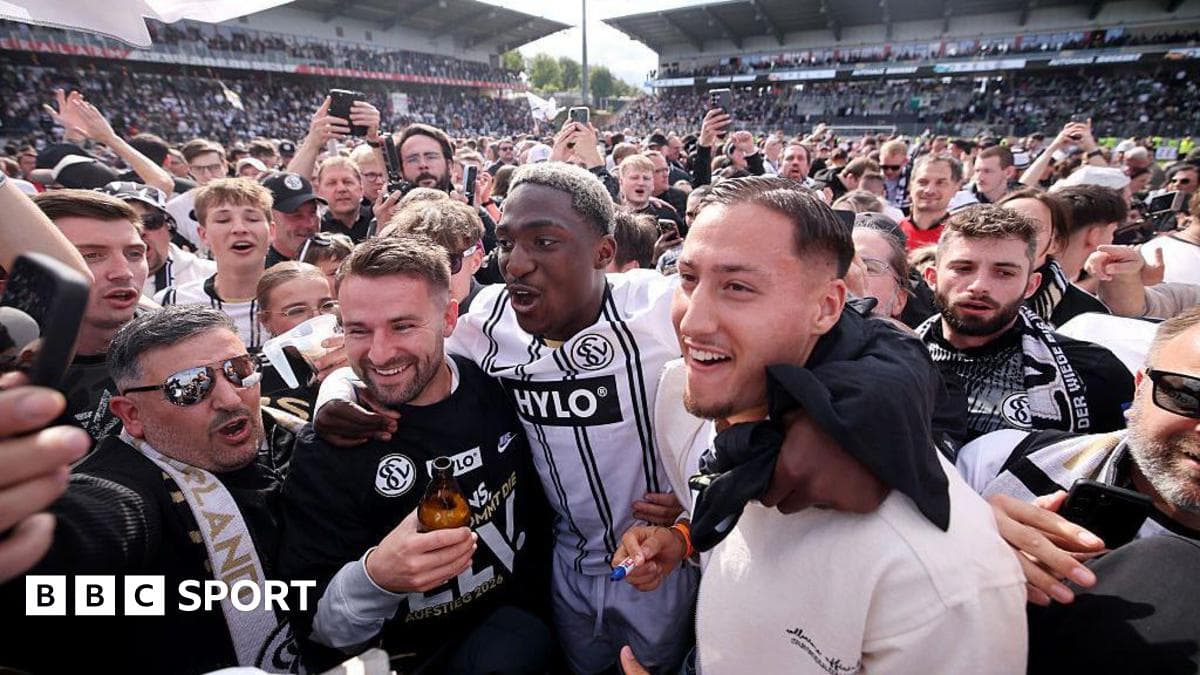
When the whistle went, the stands could no longer hold their people. Supporters poured on to the pitch at the compact Waldstadion an der Kaiserlinde, a 10,000-seat ground that suddenly felt far too small for the scale of what had just happened.
From fourth tier to the top table
The rise has been nothing short of staggering.
As recently as the 2021-22 season, Elversberg were still playing in the regionalised fourth tier. Until the 2023-24 campaign, they had never even set foot in the 2. Bundesliga. Now, three promotions in five years have catapulted them into a league usually reserved for giants of industry and footballing institutions.
Spiesen-Elversberg, with its modest population and quiet streets, will be the smallest town ever represented in the Bundesliga. It is a line that will be repeated all summer, but the numbers only tell part of the story. This is a club that has punched its way up through the divisions and refused to accept its supposed place in the hierarchy.
They almost made it last season. Elversberg pushed all the way to the promotion-relegation play-off, only to fall 4-3 on aggregate to Heidenheim in a breathless tie that underlined how close they already were.
The build-up to that play-off brought one of the more patronising moments of their journey. Rail operator Deutsche Bahn posted an image of a train with a single carriage, a tongue-in-cheek suggestion that Elversberg would not need anything bigger for the away following. The joke went viral. The result did not go their way.
This time, there was no punchline at their expense.
A stadium catching up with the story
The club’s rise has outpaced its infrastructure. The Waldstadion an der Kaiserlinde, atmospheric but modest, is already in the middle of renovation work to meet Bundesliga standards. Capacity is expected to rise to around 15,000 by spring 2027, a necessary expansion for a team now preparing to host some of the biggest names in German football.
For now, the ground remains a symbol of where Elversberg have come from, not where they are supposed to belong. That contrast will define their first months in the top flight: a village-sized club stepping into an arena dominated by major cities and global brands.
Schalke return, play-off drama ahead
Elversberg will not go alone.
Schalke, one of German football’s traditional heavyweights, have secured the 2. Bundesliga title and with it a return to the top flight after three years away. Their promotion restores a familiar name to the Bundesliga, but it is Elversberg’s arrival that reshapes the map.
The final piece of the puzzle will come from the promotion-relegation play-off. Wolfsburg, 16th in the Bundesliga, must fight to keep their place against Paderborn, who finished third in the second tier. One will stay, one will rise, but both will know there is a new and unlikely member of the club waiting for them next season.
In a league of powerhouses and packed arenas, Elversberg’s badge will sit alongside them all. The question now is simple: how long can this smallest of Bundesliga towns keep defying the scale of the stage it has just claimed?