Wolves vs Fulham: Tactical Analysis of the 1-1 Draw
Wolves and Fulham produced a tactically nuanced 1-1 draw at Molineux Stadium, a match defined by contrasting interpretations of the same 4-2-3-1 structure and a clear territorial dominance from Marco Silva’s side. Despite Fulham’s 69% possession and superior passing metrics, Wolves, under Rob Edwards, engineered a more direct, vertical game that generated comparable threat in the box and forced a finely balanced contest in terms of chance quality (1.4 xG for Wolves versus 1.53 xG for Fulham).
Both teams lined up in mirrored 4-2-3-1 systems, but their use of the double pivot diverged sharply. Wolves’ pairing of Joao Gomes and Andre operated as ball-winners and springboards for transition rather than as circulation hubs. With only 250 total passes and 69% accuracy (173 accurate), Wolves accepted long spells without the ball, compressing space centrally and inviting Fulham onto them. The idea was clear: defend compactly, then break quickly through the three behind the striker.
Fulham’s structure was more orthodox and possession-oriented. Sasa Lukic and Sander Berge formed a measured double pivot, recycling the ball and allowing the advanced midfield trio of Oscar Bobb, Emile Smith Rowe and Alex Iwobi (before his substitution) to rotate between the lines. Fulham’s 580 passes, with 501 accurate (86%), underline how comfortably they controlled tempo, shifting Wolves laterally and probing for gaps around the edges of the home side’s block.
Opening Goal
The opening goal on 25 minutes validated Wolves’ transition blueprint. Winning the ball and playing forward early, Wolves exploited the channel runs of Hwang Hee-Chan from the left and the late arrivals of M. Mane from midfield. Hwang’s assist for Mane’s “Normal Goal” was emblematic: a quick vertical phase rather than a long passing sequence, with the front four attacking a temporarily disorganised Fulham back line. Rodrigo Muniz’s isolation as Fulham’s lone forward contrasted with Wolves’ willingness to flood the box with runners from deep, reflected in Wolves’ 7 shots inside the box from just 11 total attempts.
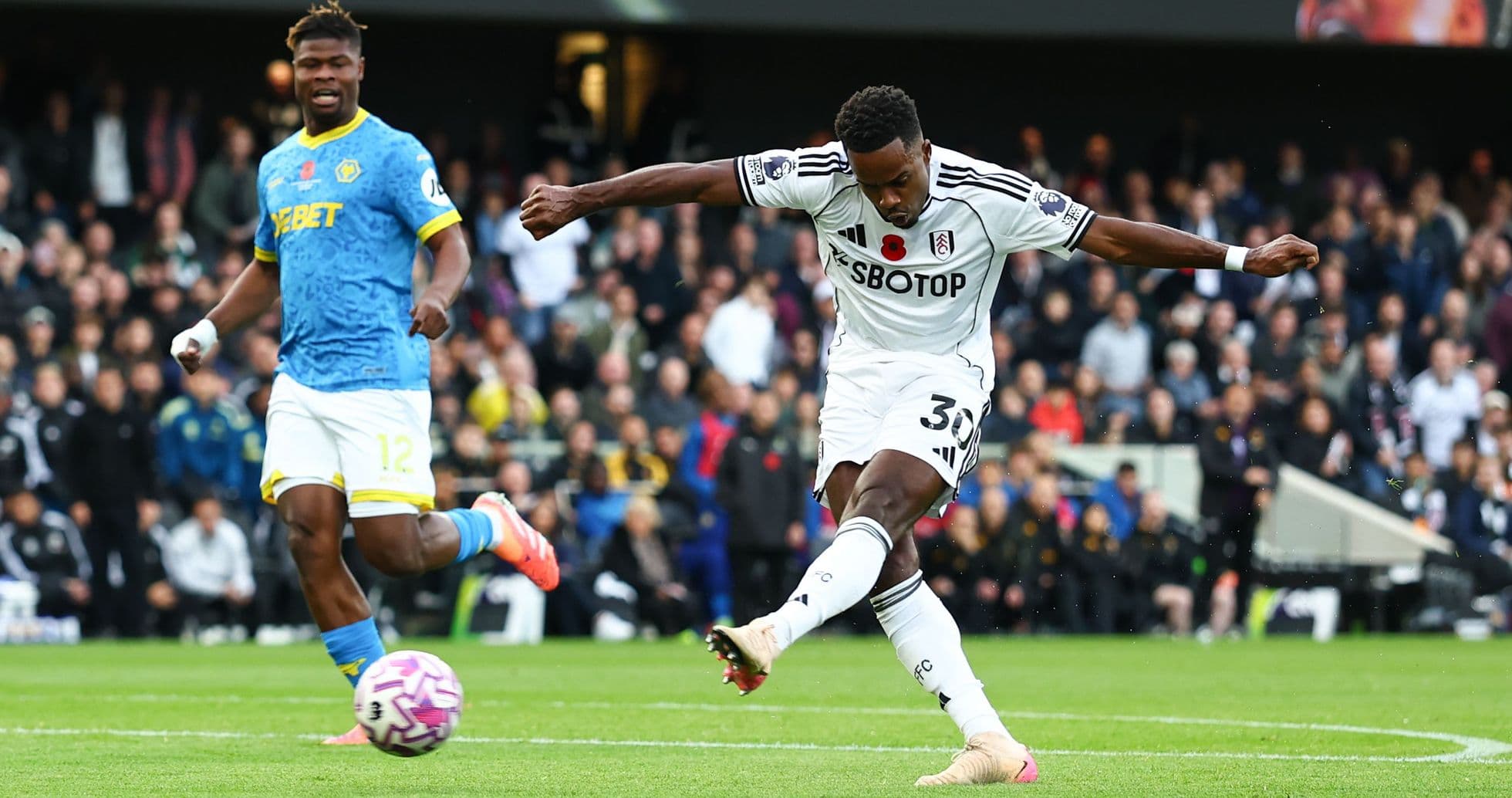
Fulham’s equaliser just before half-time highlighted their different route to threat. The “Penalty confirmed” by VAR for Timothy Castagne at 45+1’ came at the end of sustained pressure and territory. With Wolves pinned back, Fulham’s full-backs, particularly Antonee Robinson, advanced aggressively, creating overloads wide and forcing defensive decisions in the box. Robinson then converted the penalty at 45’, a moment that underlined Fulham’s capacity to turn possession into penalty-box incidents even against a low block.
Defensive Strategies
Defensively, Wolves’ back four of D. M. Wolfe, L. Krejci, S. Bueno and Yerson Mosquera were asked to defend long spells without the ball and a high volume of crosses and combinations around the area. Their compactness limited Fulham to 13 total shots, only two more than Wolves, despite the possession disparity. Jose Sa’s 4 goalkeeper saves, combined with a goals prevented figure of -0.64, suggest he was beaten in line with the quality of chances conceded and did not significantly outperform his xG faced, but he remained structurally important as a final barrier behind a deep block.
At the other end, Bernd Leno faced just 3 shots on goal and made 2 saves, with his own goals prevented also at -0.64. Fulham’s defensive line, marshalled by Issa Diop and Calvin Bassey, generally controlled the spaces in front of them, but their main vulnerability came when Wolves broke quickly and targeted the half-spaces between full-back and centre-back. The fact that Wolves produced 7 shots inside the box from limited possession shows the efficiency of their vertical attacks when they did escape pressure.
Substitution Patterns
The substitution patterns in the second half further revealed tactical intentions. Marco Silva’s early change at 46’, with Kevin (IN) coming on for Sander Berge (OUT), shifted the midfield balance towards more attacking thrust and dribbling from deeper areas, sacrificing some control in the pivot for greater forward momentum. Later, Raul Jimenez (IN) for Rodrigo Muniz (OUT) at 67’ and J. King (IN) for Alex Iwobi (OUT) at 67’ reconfigured the front line, adding different profiles between the lines and in the box to try to unlock a tiring Wolves defence.
Rob Edwards’ changes were about refreshing the transition threat while maintaining the same structural idea. T. Arokodare (IN) for Adam Armstrong (OUT) at 72’ provided a more physical reference up front to hold the ball and contest aerials, useful given Wolves’ low pass volume and reliance on direct play. J. Bellegarde (IN) for Hwang Hee-Chan (OUT) at 79’ preserved the capacity to carry the ball on counters, while H. Bueno (IN) for D. M. Wolfe (OUT) and Pedro Lima (IN) for R. Gomes (OUT) at 85’ were late adjustments to shore up the flanks and maintain defensive intensity in the closing stages.
Discipline and Statistics
Discipline also shaped the closing phase. The only card of the match, at 90+4’, went to Andre (Wolves) — “Foul”. It reflected Wolves’ increasingly reactive defending as Fulham pushed late, with the home midfield forced into riskier challenges to break up play. With Wolves committing 20 Fouls to Fulham’s 8, the pattern was consistent: the home side disrupting rhythm, the away side seeking to sustain it.
Statistically, Fulham’s dominance of territory and possession did not translate into a clear superiority in chance quality. Their 13 shots (5 on goal) and 1.53 xG marginally outstripped Wolves’ 11 shots (3 on goal) and 1.4 xG, but not to the extent their 69% Ball Possession and 580 passes might suggest. Wolves’ more modest 250 passes were used to punch vertically rather than circulate, and their 3 Corner Kicks to Fulham’s 6 again underline the territorial tilt without disproving the effectiveness of Wolves’ counter-attacking plan.
In tactical terms, the 1-1 draw was a fair reflection of two coherent but contrasting game models: Fulham’s structured, possession-heavy 4-2-3-1 against Wolves’ compact, transition-oriented mirror. Both goalkeepers performed in line with expectation, both defensive units were largely well-organised, and the decisive moments came from a well-executed transition and a VAR-confirmed penalty, rather than systemic breakdowns.