Udinese and Como Start Serie A Season with Tactical Draw
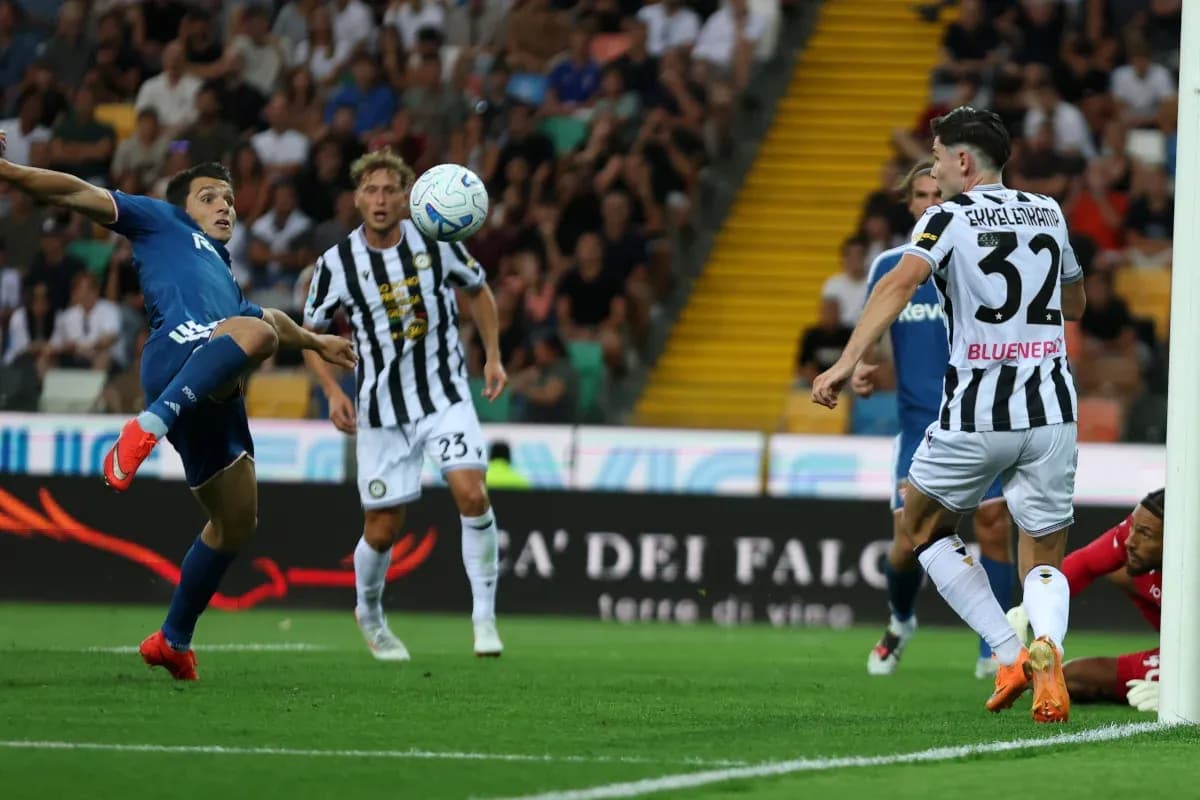
Under the late-summer light of Bluenergy Stadium – Stadio Friuli, Udinese and Como opened their Serie A campaigns with a 1–1 draw that felt less like a settled verdict and more like the first chapter of two evolving tactical projects.
I. The Big Picture – Two New Identities, One Shared Point
Following this result in Regular Season - 1, both sides sit on 1 point with a goal difference of 0, Udinese in 9th and Como in 8th. Each has played 1 match in total, drawn 1, and neither has yet tasted victory or defeat.
Udinese’s early-season DNA is already sharply defined. At home they have played 1, scored 1 and conceded 1, with averages of 1.0 goals for and 1.0 against. Their scoring has come explosively in the 16–30 minute window, where 100.00% of their goals so far have been scored, while their single concession arrived between 46–60 minutes, a warning about their vulnerability just after the restart.
Como’s profile is a mirror image in time. On their travels they have played 1, drawn 1, scored 1 and conceded 1, with away averages of 1.0 goals for and 1.0 against. Their only goal so far has come in that same 46–60 minute band where Udinese are fragile, while Como’s defensive lapse has arrived in the 16–30 window – precisely where Udinese are most dangerous.
The goal maps tell a story of intersecting curves: Udinese’s early surge versus Como’s early weakness, and Como’s post-interval punch against Udinese’s soft underbelly after half-time.
II. Tactical Voids – Absences That Shape the Structure
Both coaches had to build around notable absences.
For Udinese, Kosta Runjaic was without A. Buksa (Inactive), G. Chakvetadze (Foot Injury), C. Kabasele (Red Card) and A. Zanoli (Knee Injury). The missing centre-back presence of Kabasele and the dynamism of Chakvetadze, in particular, pushed Runjaic toward a compact 3-4-2-1, leaning on youth and versatility in the back three and wing-backs rather than a more expansive, risk-heavy shape.
Como, under Cesc Fabregas, were deprived of J. Addai (Achilles Tendon Injury), a loss that trims some of the depth and verticality in the attacking lanes. It nudged Fabregas toward a more controlled, technically oriented 4-2-3-1, trusting the central structure rather than relying on raw pace from the bench.
Disciplinary patterns also framed the tactical risk calculus. Udinese, across their single match so far, have already collected yellow cards in three distinct windows: 16–30 (33.33%), 31–45 (33.33%) and 91–105 (33.33%). On the individual level, Unai Gómez, Jakub Piotrowski and James Abankwah each carry a yellow, making them early-season reference points for both aggression and vulnerability in duels. Como, by contrast, have yet to pick up a yellow or red card this campaign, suggesting a more controlled, perhaps more cautious, defensive posture so far.
III. Key Matchups – Hunter vs Shield, and the Engine Room
Hunter vs Shield
In this early snapshot, the most clinical “hunters” are clear. Hassane Kamara, operating nominally as a midfielder but functionally as an aggressive wide outlet in Udinese’s 3-4-2-1, has 1 goal from 3 shots (2 on target) and a rating of 7.6. His threat is time-stamped: Udinese’s only goal this season has arrived in the 16–30 minute zone, where Como have conceded 100.00% of their goals.
On the other side, Anastasios Douvikas leads Como’s line as the spearhead of Fabregas’ 4-2-3-1. With 1 goal, 3 shots (all on target) and 90 minutes logged, he is both their finisher and their reference point. Como’s goal arriving between 46–60 minutes dovetails perfectly with Udinese’s only concession in that same window. If this pattern holds, Douvikas becomes the hunter most likely to strike when Udinese are mentally and structurally readjusting after the break.
The Shield
Udinese’s back three of M. Palma, O. Solet and Abankwah is still a work in progress, but Abankwah has already shown key defensive traits: 2 tackles, 2 successful blocks and 6 duels contested, with 3 won. His yellow card underlines the edge he brings, yet also the risk if he is isolated 1v1 against Douvikas in wide channels or dragged into late challenges by Como’s rotating attacking midfield line of N. Paz, M. Baturina and J. Rodriguez.
For Como, the defensive shield is more layered. T. Chalobah and J. Ramon anchor the central defence, protected by the double pivot of M. Perrone and L. Milla. Their challenge is to compress the half-spaces where Jurgen Ekkelenkamp and Nicolo Zaniolo operate behind I. Gueye. Ekkelenkamp, already on the top assists list with 1 assist, 30 passes at 70% accuracy and 4 tackles, is Udinese’s connector – the player who can slip Kamara or Gueye into the gaps that Como’s full-backs leave when they advance.
Engine Room – Control vs Disruption
The midfield battle is where the two philosophies collide. Udinese’s central pair of J. Karlstrom and Piotrowski is designed for balance: Karlstrom as the metronome, Piotrowski as the box-to-box disruptor with 30 passes at 96% accuracy and a willingness to step into duels (7 contested, 3 won). Their task is to screen Douvikas’ supply line and prevent N. Paz from receiving on the half-turn between the lines.
For Como, Milla and Perrone must dictate tempo under pressure. With Udinese’s wing-backs Kamara and M. Vojvoda pushing high, Como’s double pivot are constantly asked to play out of tight spaces and find their advanced trio early, before Udinese’s three centre-backs can set the line.
IV. Statistical Prognosis – Margins and Moments
With both sides averaging 1.0 goals scored and 1.0 conceded overall, and neither having taken nor missed a penalty, the numbers point to balance rather than dominance. Udinese have failed to keep a clean sheet at home, and Como have not managed one away; both have also avoided failing to score, hinting at matches where both teams find the net.
The critical intersection is temporal: Udinese’s early 16–30 minute surge against Como’s early defensive frailty, and Como’s 46–60 minute punch against Udinese’s post-interval weakness. Over a larger sample, these windows may flatten out, but right now they define the risk.
From a tactical lens, Udinese’s 3-4-2-1 offers more immediate verticality and wing pressure, while Como’s 4-2-3-1 provides better spacing between the lines and a clearer structure for sustained possession. As the season unfolds, expect Runjaic to lean even more on Kamara’s timing and Ekkelenkamp’s creativity, while Fabregas will continue to build his attack around Douvikas’ movement and the subtle craft of his three attacking midfielders.
Following this result, both teams walk away with a point and a blueprint. The numbers say they are equals for now; the shapes on the pitch suggest that the side who best patches its temporal weaknesses – Udinese after half-time, Como in the early storm – will be the one that eventually breaks from this symmetry.