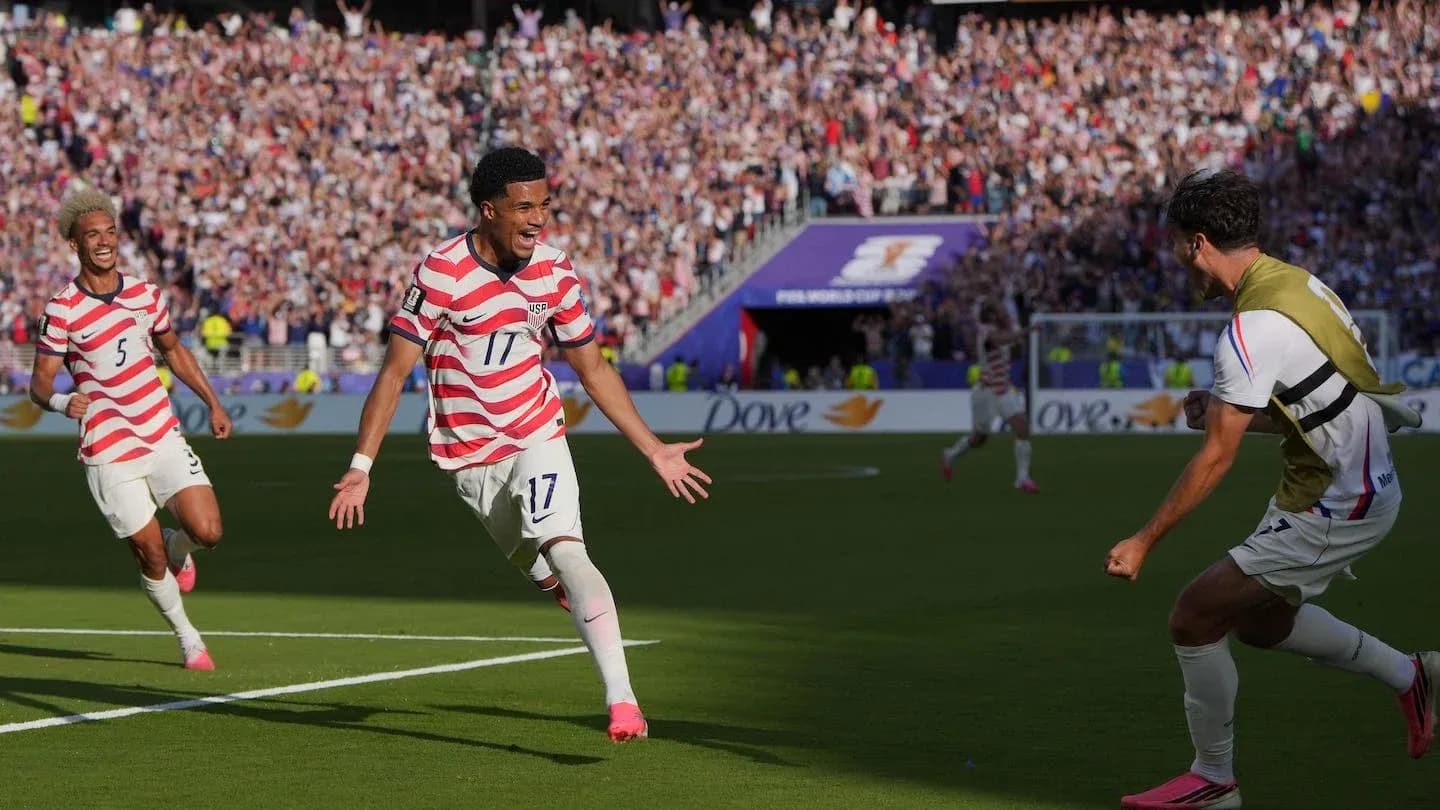
USA Controls Match Against Bosnia & Herzegovina in World Cup Round of 32
USA’s 2-0 win over Bosnia & Herzegovina at Levi's Stadium in this World Cup Round of 32 tie was a textbook example of how to control a knockout match through structure rather than volume. Despite trailing in possession (48%–52%) and taking fewer shots (8–10), USA leveraged a clear 4-3-3 positional blueprint, sharp central pressing, and superior penalty-box efficiency to progress, even after playing the final half-hour with ten men.
Mauricio Pochettino’s 4-3-3 was built on a classic USMNT spine. Tyler Adams anchored the midfield as the single pivot, with Weston McKennie and Malik Tillman as advanced interiors, and Christian Pulišić and Sergiño Dest flanking Folarin Balogun in a narrow front three. The full-backs, Alexander Freeman and Antonee Robinson, pushed high to provide width, allowing the wide forwards to occupy half-spaces and pin Bosnia’s back line.
Against that, Sergej Barbarez set Bosnia & Herzegovina in a 5-3-2 that was initially conservative. The back five of Amar Dedić, Nikola Katić, Tarik Muharemović, Stjepan Radeljić and Sead Kolašinac aimed to compress the central lane and force USA wide, while Ivan Šunjić and Armin Gigović screened in front. Edin Džeko and Ermedin Demirović stayed high as reference points for direct outlets but received limited clean service in the first half.
USA’s attacking pattern was clear: build through Adams, then accelerate via the interiors and wide forwards into the box. Six of their eight shots came from inside the area, reflecting a deliberate refusal to settle for speculative efforts. The first goal at 45' from Folarin Balogun crowned that approach: sustained pressure, occupation of the central corridor, and a final action from inside the box that aligned with an xG of 0.92. Bosnia, by contrast, split their 10 attempts evenly between inside and outside the box (5 and 5), consistent with a more hopeful shot profile and an xG of just 0.25.
Out of possession, USA’s 4-3-3 morphed into a compact 4-1-4-1, with Balogun leading the press and McKennie and Tillman jumping to Bosnia’s pivots. This scheme limited Bosnia’s ability to progress centrally despite their slight possession edge. Bosnia completed 446 passes to USA’s 415, but much of that circulation was in deeper zones; the three centre-backs often recycled the ball laterally under modest pressure, without consistently breaking USA’s midfield line.
The key tactical inflection came at 64', when Balogun received a red card for “Serious foul.” Reduced to ten, USA had to recalibrate. Pochettino’s reaction was pragmatic: the front line became more elastic, with the wide players working deeper and the midfield three tightening distances to protect central spaces. The block flattened into something closer to a 4-4-1 without the ball, with one midfielder stepping situationally to the first pass while Adams stayed as the shield.
Remarkably, the numerical disadvantage did not swing control to Bosnia. Their 5-3-2 struggled to convert the extra man into meaningful overloads. The wing-backs rarely received early switches in stride, and the midfield trio did not consistently push beyond the US line to create between-the-lines options. The triple substitution on 51'—Armin Gigović (OUT) with Esmir Bajraktarević (IN), Ivan Šunjić (OUT) with Benjamin Tahirović (IN), and Edin Džeko (OUT) with Ermin Mahmić (IN)—was aimed at injecting legs and dynamism, but the structure remained largely the same: three central midfielders in a flat line, two forwards trying to pin the US centre-backs.
Bosnia’s discipline issues also blunted their late push. They committed 13 fouls to USA’s 7, and the yellow card to Stjepan Radeljić for “Holding” at 80' underlined how often they were forced to break USA’s transitions cynically. The additional booking for coach Sergej Barbarez at 80' further reflected frustration as the game drifted away from their control.
The second US goal at 82', scored by Malik Tillman, was tactically revealing. Even with ten men, USA continued to attack with clarity, picking their moments to commit numbers forward. The move again originated from a controlled progression rather than a broken play, showing that the red card had not reduced them to pure survival mode. Bosnia’s defensive line, stretched and less coordinated after the 75' changes (Sead Kolašinac and Nikola Katić replaced by Haris Tabaković and Amar Memić), failed to maintain compactness, allowing Tillman to exploit space and finish.
In goal, Matthew Freese (USA) and Nikola Vasilj (Bosnia & Herzegovina) had contrasting statistical profiles. Freese (USA) made 3 saves, aligning with Bosnia’s 3 shots on target, and underpinned a defensive performance that limited high-quality chances; Bosnia’s xG of 0.25 indicates that most of his interventions were from low-probability positions. Vasilj (Bosnia & Herzegovina), by contrast, registered 0 saves despite conceding twice, a reflection of USA’s clinical finishing and the fact that their two shots on target both beat him. The goals prevented metric at -1.73 for both teams suggests that, relative to the quality of chances faced and created, USA over-performed their finishing while Bosnia under-delivered in goal.
USA’s passing was marginally less voluminous but slightly more efficient in context: 415 passes, 346 accurate at 83%, compared with Bosnia’s 446 passes, 364 accurate at 82%. The small edge in accuracy for USA, despite often operating under more direct, vertical pressure, points to a side comfortable playing through tight central zones. Their 4 corner kicks to Bosnia’s 3 also reflect a modest territorial advantage, particularly around the penalty area.
From a broader tactical lens, this match showed a 4-3-3 side with a clear identity outmanoeuvring a 5-3-2 that never fully translated its structural solidity into attacking threat. USA’s ability to generate higher-quality chances with fewer shots, maintain compactness after a red card, and continue to threaten in transition underscores a team whose game model is robust under stress—an asset that travels well in knockout football.