The Old Masters of World Cup 2026: Messi, Ronaldo, and More
The World Cup has always been a young man’s stage. This one belongs to the old masters.
In 2026, North America will host a tournament swollen in size and stretched across searing summer heat, yet its central storylines will be written by players who should, by every conventional rule of the sport, be past their time. They are not. They refuse to be.
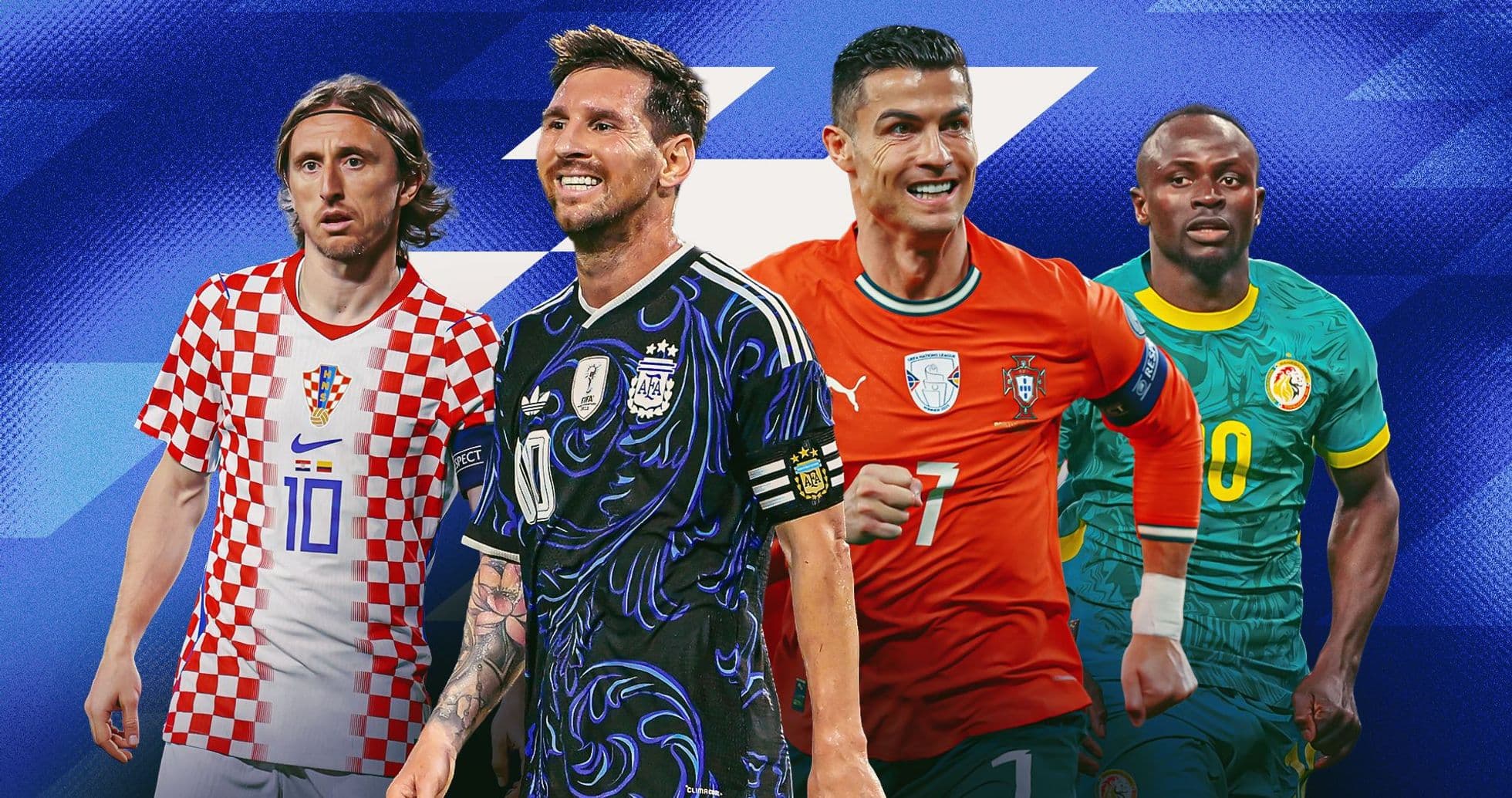
Messi and Ronaldo: The Sixth Act
Lionel Messi turns 39 and walks into a sixth World Cup as if it’s the most natural thing in the world. It isn’t. No one has ever done it at this level with this much expectation, this much history on their back.
He finally climbed the mountain in 2022, dragging Argentina past France in one of the great finals. He could have stopped there, the story complete, the circle closed. Instead, he moved to Inter Miami, traded the Champions League for MLS, and recalibrated his body for one last global push.
The pace of his club game has changed. The genius hasn’t. For Argentina, he still produces angles and passes that younger legs cannot even see, let alone execute. Doubts swirl about whether he can manage the expanded format and the brutal heat across the United States, Mexico and Canada. But this is Messi. He has never done quiet exits.
Cristiano Ronaldo arrives from a different path and with a different burden. At 41, he could become the oldest player ever to lift the World Cup. He has never scored in a knockout round of the tournament. For a five-time Ballon d’Or winner, that gap in his résumé is glaring.
He keeps scoring relentlessly for Al-Nassr in Saudi Arabia, still chiselled, still obsessed, still talking about playing on. Portugal no longer needs to be carried by him. Rafael Leao, Pedro Neto, Goncalo Ramos and a deep, gifted squad surround him. Yet Roberto Martinez continues to build the team with Ronaldo as its axis, its reference point, its lightning rod.
He, like Messi, will also step into a sixth World Cup. For CR7, it feels like the last throw of the dice on the biggest stage of all.
Ochoa and Neuer: Goalkeepers Who Refuse to Fade
Guillermo Ochoa was supposed to be a memory by now, a cult hero from viral highlight reels and past tournaments. Instead, an injury to Angel Malagon cracked the door open, and Mexico’s most recognisable goalkeeper walked straight back through it.
At 40, with more than 150 caps and a career that has wound through Spain, Italy, France, Portugal, Belgium and, most recently, Cyprus with AEL Limassol, Ochoa returns to a World Cup that his country is co-hosting. He has hinted this will be his last dance. For two decades, he has been a World Cup constant. North America feels like a fitting final chapter.
Germany have their own blast from the past. With Marc-Andre ter Stegen battling injuries and doubts over Oliver Baumann’s form, Julian Nagelsmann went back to the man who once redefined the position.
Manuel Neuer had stepped away after Euro 2024 on home soil, part of a generation that chose to close the book. Bayern Munich form, though, forced a rethink. At 40, he comes back for a fifth World Cup, not as a nostalgic mascot but as Nagelsmann’s confirmed No.1.
Germany, bruised by two straight group-stage exits, need stability and authority. Neuer brings both. One last ride, one last attempt to restore order.
Modric and Dzeko: Final Movements for the Orchestrators
Luka Modric turns 40 and still wants more. Croatia’s conductor has already taken his country to a World Cup final in 2018 and a third-place finish in 2022, feats that seemed unthinkable before he arrived.
He left Real Madrid for AC Milan last summer, a move designed to preserve his legs without lowering his standards. This will be his fifth World Cup. By the time it kicks off, he and Messi will be locked in a race to join the tiny club of players with 200 international caps, with the Argentine just ahead on that road.
Edin Dzeko’s route back to the World Cup is even more improbable. Bosnia and Herzegovina had looked destined to drift out of the major-tournament picture after their only appearance in 2014. Yet at 40, Dzeko dragged them through the UEFA play-offs, past Italy, and back into the spotlight.
He is about to pass 150 caps and has already scored over 70 times for his country. A January move to Schalke reignited his club career as he helped fire them back into the Bundesliga. For a striker of his calibre, one World Cup felt too few. Now he gets a second, and likely final, shot at the stage his talent always merited.
Asia and Africa’s Icons at the Crossroads
South Korea’s relationship with Son Heung-min borders on obsession. He is their captain, their talisman, their standard-bearer. He turns 34 in July, younger than many of the veterans in this tournament, but the load he carries is heavy.
Son has already stepped away from European football to join LAFC in MLS, a move that suggests he is managing his body and his future carefully. By the time this World Cup ends, he may look at the miles he has logged for his country and decide that 2026 is a natural full stop.
Mohamed Salah stands in a similar place for Egypt. Just a few days older than Son, he has shouldered his nation’s hopes almost alone for years. This time he does at least have a growing supporting cast, with Manchester City’s Omar Marmoush among those ready to help.
Yet the focus remains Salah. His form for Liverpool over the past year has dipped sharply, his output no longer at its terrifying peak. The hunger, though, will be sharpened by what happened in 2018, when a shoulder injury in the Champions League final compromised his only previous World Cup.
He needs a defining World Cup performance to match his status in the modern game. With a move to Saudi Arabia likely after leaving Anfield, the winding down of his career is already in sight. Expecting him to carry Egypt deep into another cycle beyond this summer feels optimistic. This might be his last big swing at the world stage.
Sadio Mane has already delivered Senegal’s greatest moment, converting the penalty that sealed the 2021 Africa Cup of Nations. He has also been central to their consecutive World Cup qualifications, even though injury cruelly denied him the 2022 tournament itself.
Now 34 and playing for Al-Nassr, Mane is out of the European spotlight but not out of Senegal’s plans. He still captains the side. Around him, Ismaila Sarr and Illiman Ndiaye are blooming into serious threats. Mane’s leadership, his experience of pressure and triumph, could be the difference between a respectable run and something deeper in 2026.
Riyad Mahrez completes a remarkable African trio. At 35, the former Manchester City winger still glides past opponents with that trademark first touch and low-slung dribbling that once lit up the Premier League.
For all his talent, he has only one previous World Cup appearance, back in 2014 with Algeria. His country has failed to qualify ever since. North America offers him a rare, possibly final, chance to show his artistry on the sport’s grandest platform while he winds down his club career in Saudi Arabia with Al-Ahli.
De Bruyne, Van Dijk and James: Golden Generations on the Brink
Kevin De Bruyne’s body has started to argue with him. An injury-hit first season at Napoli after leaving Manchester City has raised uncomfortable questions about how long he can keep operating at the very top.
Yet when he is fit, there is still no one quite like him. He remains a complete playmaker, capable of shredding defensive lines with a single pass or detonating games with long-range strikes. Belgium’s much-discussed “Golden Generation” is fading, but De Bruyne is still its brightest surviving star.
Rudi Garcia’s squad is in transition, younger faces jostling for prominence. De Bruyne, though, is the one who can turn them from a rebuilding project into a genuine threat. If his fitness holds, Belgium will not just be making up the numbers.
Virgil van Dijk, meanwhile, has grown into his role as the Netherlands’ defensive pillar. He will turn 35 during the tournament, and there are whispers at Liverpool that he has lost half a step, that his anticipation is not as flawless as it once was.
Even so, he remains the foundation of the Dutch back line. For years, strikers have tried to avoid him, not test him. This World Cup is likely to be only his second, yet also his last. Dutch supporters will hope the version that turns up in orange is closer to the peak colossus than the slightly dulled version seen at times last season.
James Rodriguez owes his entire career to this competition. In 2014, he exploded in Brazil, scoring one of the World Cup’s great goals and earning a move to Real Madrid on the back of a breathtaking tournament.
Since then, injuries and inconsistency have stalked him. He has hopped from club to club, using short stints — most recently with Minnesota United in MLS — to stay sharp enough for the games that matter most to him: those in yellow for Colombia.
He turns 35 in July. His body may no longer allow him to dominate for months on end, but in a short, intense burst, he can still conjure moments that stop time. For a player whose legend began at a World Cup, ending his international story on the same stage feels almost inevitable.
Neymar’s Last Gamble
Neymar’s relationship with the World Cup has been chaotic, painful, incomplete. Brazil’s all-time leading scorer has not played for his country since tearing his ACL in October 2023. When Carlo Ancelotti took charge of the Selecao in September and consistently left him out, the message seemed clear: the national team was moving on.
Then injuries hit Brazil’s forward line. The door creaked open again. Ancelotti, at the last moment, named Neymar in his 26-man squad. Santos fans celebrated wildly. Across Brazil, hope flickered back to life.
The reality is harsher. Neymar is 34 and has suffered yet another injury just days after his call-up. His body is failing him too often, too brutally. Nobody can realistically expect him to be fit enough for 2030. This World Cup is his last chance to chase the sixth star that Brazil craves and that he has long been expected to deliver.
How big a role Ancelotti gives him will depend on medical reports and training-ground evidence. But just having Neymar in the squad changes the emotional temperature around Brazil. He is still a symbol, for better or worse.
England’s Captain and the Quiet Exit Plan
Amid all the veterans clinging on, Harry Kane stands in a different place. At 32, he might be at his absolute peak. Over 60 goals for Bayern Munich this season underline that his finishing remains as ruthless as ever. He is already England’s all-time leading scorer, the reference point for an entire generation of Three Lions supporters.
There is a plausible path where he plays on to 2030. England would welcome it. The drop-off behind him in the pecking order is steep. Yet the calendar offers a natural staging post: Euro 2028, co-hosted by England.
A major tournament on home soil, with the chance to sign off in front of his own crowd, could tempt Kane to make that his international farewell. If that happens, 2026 becomes his final World Cup.
The same logic may apply to others in Gareth Southgate’s core. Jordan Pickford, John Stones, maybe even Marcus Rashford could eye 2028 as their curtain call. This World Cup, then, carries a different weight: not just a shot at glory, but the beginning of the end for a group that has dragged England back into the latter stages of major tournaments.
From Messi and Ronaldo to Neymar, from Modric and De Bruyne to Salah and Mane, this World Cup will not just crown a champion. It will close chapters. North America is about to become football’s great farewell tour. The question is simple and brutal: which of these giants can still bend one last tournament to their will?