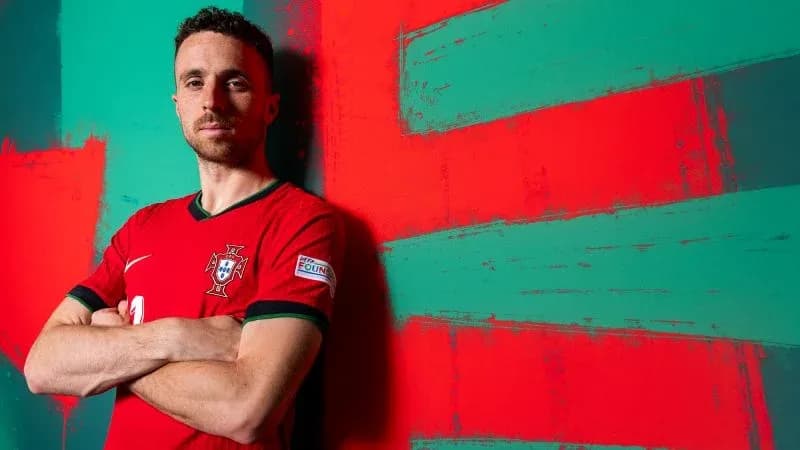
World Cup Emotions: Ronaldo, Jota's Legacy, and Portugal's Journey
Lionel Messi lit the touchpaper. A hat-trick, another record, another night where the World Cup bent to his will. Kylian Mbappé and Erling Haaland added their own flourishes with two goals apiece, the sport’s biggest names turning North America into their personal stage.
Today, the spotlight swings to another enduring giant.
Cristiano Ronaldo, 39 and still raging against the clock, is set for his first appearance of this World Cup. But for Portugal, the opening game in Houston is about far more than their captain, or even three points.
It’s about Diogo Jota.
Portugal’s First Step Without Jota
The news of Diogo Jota’s death, in a car crash that also claimed the life of his brother André Silva, ripped through football last year. It didn’t feel real then. It still doesn’t now.
Jota had just married his long-term partner, Rute Cardoso. Three children. A wedding less than two weeks before the crash. A life seemingly at full speed, suddenly cut short.
At Liverpool, teammates admitted they struggled to focus on football this season. Training sessions, matches, the usual rhythms of a campaign – all of it clouded by grief. Portugal’s players now carry that same weight into the World Cup: the burden of expectation, and the ache of a teammate who should have been standing beside them in the tunnel.
Roberto Martínez made sure Jota would still be part of this journey. The forward was named an honorary member of the squad, a symbolic gesture that means everything to those who knew him. Then came a powerful touch from outside the dressing room: Portugal’s Prime Minister, Luís Montenegro, presented each player with a bracelet bearing their name alongside Jota’s.
They’ll wear them tonight at Houston’s NRG Stadium against DR Congo.
“They made sure that it was a wristband that we could wear on the pitch,” midfielder Vitinha told reporters. “He let us choose if we wanted to use it or not, during the day or during the match. We received it with a lot of affection and we chose to use it.”
The emotion runs deeper than a piece of jewelry. This was Jota’s dream – a World Cup, in his prime, with a squad good enough to win it.
“We feel this and we want to win it, not just because it’s a World Cup and it’s everybody’s dream, but for him as well,” Vitinha told CNN Sports earlier this year.
So when Portugal walk out at 1 p.m. ET, they will do so with a dual purpose: to chase the trophy and to honor a friend who never got his chance.
Ronaldo, the Midfield Maestros and a Dangerous Underdog
On the pitch, the conversation inevitably circles back to Ronaldo.
He is no longer the relentless force of old. The legs don’t go quite as quickly, the leap isn’t quite as violent, the sprint doesn’t last as long. Yet he remains the most magnetic presence in this squad, and he still knows how to find the net.
The dilemma for Martínez is obvious. Portugal’s midfield – Bruno Fernandes, Vitinha, Bernardo Silva, João Neves – might be the best unit in the tournament. It has creativity, control, bite and brains. The question is whether Ronaldo amplifies that brilliance or clogs its rhythm.
He struggled in Qatar in 2022 and was eventually dropped. Few managers would dare repeat that call in a World Cup opener, not with Ronaldo’s aura and history. Messi’s masterclass last night only sharpened the narrative: the old gods are not quite done yet.
Across from them, DR Congo arrive as underdogs but not bystanders. Yoane Wissa, sharp and restless, leads the line and offers a genuine threat. The rest of the side will likely lean on discipline and compactness, hoping to frustrate Portugal and pounce when the game fractures.
For Portugal, it’s a night to manage emotion, not be drowned by it.
England, Croatia and Decades of Scars
Later, at 4 p.m. ET in Arlington’s AT&T Stadium, another familiar World Cup storyline picks up where it left off.
England vs. Croatia. A rivalry built on scars.
England again roll into a major tournament with a suitcase full of expectation and 60 years of failure rattling around inside it. Since 1966, every generation has been told it might be the one to end the drought. None have managed it.
This time, Thomas Tuchel has made a statement before a ball has even been kicked. He has chosen chemistry over celebrity, leaving out big names such as Cole Palmer and Phil Foden to protect the balance of his squad. It’s a ruthless call, and a clear one.
Still, the spine looks formidable. Declan Rice to anchor, Jude Bellingham to drive, Harry Kane to finish. England have the quality to go deep again in North America.
The problem? Croatia.
The Vatreni have long been England’s tournament tormentors. The 2018 World Cup semifinal defeat still stings, a night when Luka Modrić and company dragged the game into their orbit and refused to let go. Remarkably, Modrić is still there at 40, still orchestrating, still dictating tempo like a conductor who refuses to put down the baton.
Croatia will not be overawed by the occasion or the noise. They’ve seen this England before. They’ve beaten this England before. And they’ll believe they can do it again.
Messi’s Relentless March
Elsewhere, Messi quietly tied another World Cup record and shrugged it off with typical understatement.
His hat-trick against Algeria pulled him level with Miroslav Klose for most goals in World Cup history. Another milestone, another number added to a list so long that even he may struggle to keep track.
He has now scored five World Cup goals from outside the box, equaling Brazilian great Rivellino. It’s a small detail in the grand sweep of his career, but it underlines a simple truth: even on the biggest stage, he keeps finding new ways to separate himself from everyone else.
Iran’s Visa Headache Eases
Not every World Cup story is written on the pitch.
Iran have faced more logistical turbulence than any other team this summer, forced by political tensions to base themselves in Mexico and fly into the United States for matches. The complications caught up with winger Mehdi Torabi, who discovered after the first game that his visa had expired.
The issue has now been resolved. A US State Department official confirmed that Torabi has been granted a new multi-entry visa, clearing him to play in every remaining match.
“As soon as we became aware of the issue, we worked to ensure that the player can participate in every game,” the official said.
For Iran, it’s one less distraction in a tournament already heavy with off-field challenges.
Ghana, Panama and a Chance to Reset
At 7 p.m. ET in Toronto’s BMO Field, Ghana and Panama meet in a game that could shape both of their tournaments.
Panama, in only their second men’s World Cup, still carry the bruises of 2018. Three games, three defeats, a 6-1 hammering by England, and not a single point to show for their efforts. Tonight feels like an opportunity to change that narrative.
Ghana once looked like Africa’s best bet for a World Cup winner. The 2010 quarterfinal exit, wrapped in controversy and heartbreak, felt like the start of something. Instead, it became a high-water mark. Since then, the Black Stars have failed to escape the group stage.
This version of Ghana lacks the firepower of those earlier sides, but it does have one outstanding weapon: Antoine Semenyo. The Manchester City forward has been in blistering form and offers the kind of direct, ruthless edge that can tilt tight group games.
They will, however, be without Thomas Partey for the opener. The 33-year-old midfielder had his visa application rejected, a decision upheld by a Canadian federal judge earlier this week, according to the Associated Press. Partey is awaiting trial on rape charges in the United Kingdom, but he is expected to be available for Ghana’s remaining two group matches in the US.
For Ghana, the task is clear: find a way to win without their most experienced midfielder and set a platform for the rest of the group.
Uzbekistan’s Debut and Colombia’s Old Magic
The final act of the day comes at 10 p.m. ET in Mexico City’s iconic Estadio Azteca, where Uzbekistan make their World Cup bow against Colombia.
Uzbekistan are the last of this year’s debutants to step into the spotlight and are desperate to become the only one of the four newcomers to win their opening match. They are led by Fabio Cannavaro, a World Cup-winning captain with Italy in 2006, who has tried to instill the same defensive steel and tactical discipline that defined his playing days.
The standout name is Abdukodir Khusanov. At 22, the defender has already become a regular starter for Manchester City, impressing in both the Premier League and the Champions League. His rise has been rapid; tonight, it reaches another level.
Colombia, though, bring tournament know-how and star power. James Rodríguez, the breakout sensation of 2014, remains the team’s creative heartbeat. Around him, Luis Díaz – one of the most in-form players on the planet this season – offers pace, flair and a constant threat from wide areas.
It’s a classic World Cup matchup: an ambitious newcomer against a seasoned campaigner with memories of deep runs and spectacular goals.
Ebola Shadows DR Congo’s World Cup Moment
Away from the stadiums, a darker storyline is unfolding that touches one of tonight’s teams.
Health officials are closely tracking an Ebola outbreak in the Democratic Republic of Congo, with the head of the Africa Centres for Disease Control and Prevention warning it could become the “worst ever” in the region if not contained. More than 800 cases have been confirmed in the DRC as of Monday.
The outbreak is particularly difficult to control. The affected area is remote yet densely populated, gripped by insecurity and humanitarian crises. The strain involved – the Bundibugyo variant – has no specific treatments or vaccines, complicating the response.
US authorities have already moved. The Centers for Disease Control and Prevention and the Department of Homeland Security have introduced entry restrictions and passenger screening for travelers from DRC, Uganda and South Sudan. No Ebola cases have been identified in the United States, and the World Health Organization rates the global risk as low, even as it describes the risk within DRC as very high.
During the World Cup, US health officials are monitoring a range of viral threats, but Ebola is not at the top of the list. Early in infection, it does not spread easily. Transmission becomes far more likely only when a person is severely ill and has a high viral load – at which point they would be too unwell to travel or attend a match.
Still, the juxtaposition is stark. As DR Congo step onto the field to face Portugal, chasing a famous result, their country fights a far more urgent battle at home.
On days like this, the World Cup shows its full range: joy, grief, politics, health crises, and 90 minutes where a ball, a goal, or a bracelet on a wrist can carry the weight of an entire nation.