2026 World Cup Quarter-Finals: Seven Nations Fight for Glory
Seven nations remain. One World Cup to win. And as the 2026 tournament tightens into its sharpest edges across the United States, a familiar pattern has emerged: Europe everywhere, with one giant from South America refusing to move aside.
Argentina stand alone as the last non-European team left. Around them, six European heavyweights and hopefuls jostle for space in a bracket that feels as much about legacy as it does about form. Records are tumbling, careers are peaking, and a handful of players are dragging entire nations along with them.
This is where the World Cup starts to feel unforgiving. One bad night and you’re gone.
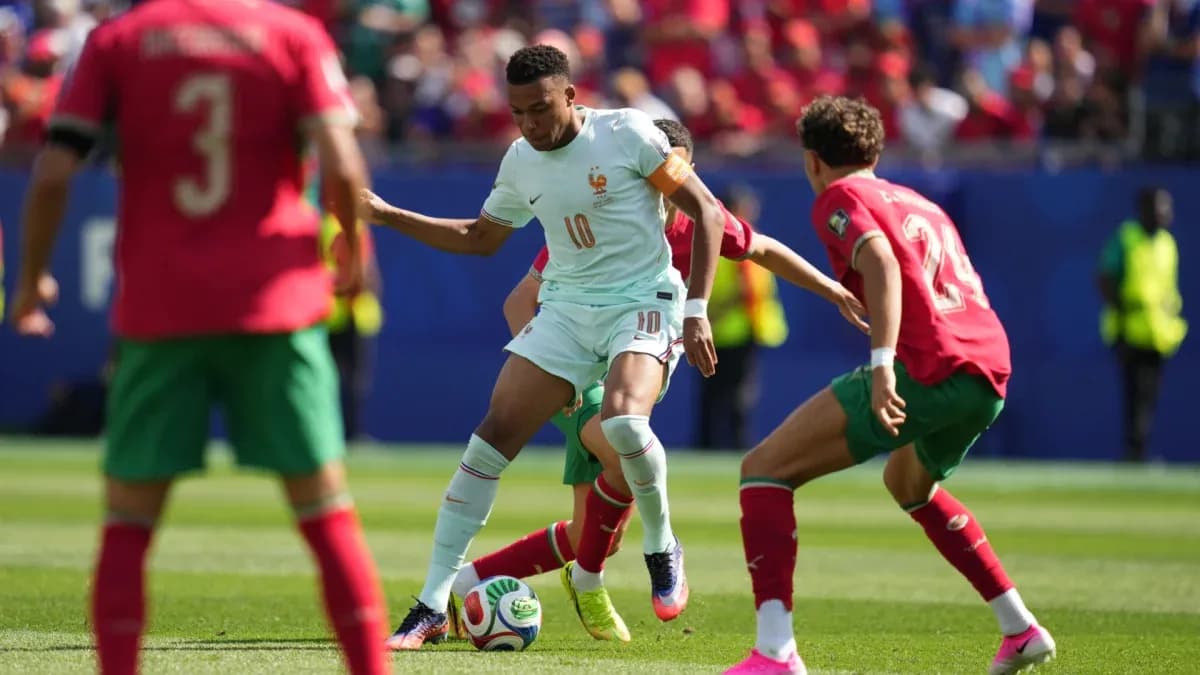
France: Mbappé chasing history
France are already there, waiting. Les Bleus booked their semi-final ticket with a controlled 2-0 win over Morocco on Thursday, the two-time champions now one step from a shot at a historic three-peat.
They have not lost a game in this tournament. They barely looked like drawing one.
From Group I onwards, France have moved with the calm menace of a side that knows exactly who it is. Wins over Senegal (3-1), Iraq (3-0), and Norway (4-1) set the tone. The knockout rounds only hardened it: Sweden brushed aside 3-0, Paraguay edged 1-0, Morocco dismissed.
At the centre of it all, of course, is Kylian Mbappé.
The captain has turned this World Cup into another personal stage. He leads the scoring charts in this tournament and has already climbed to 17 non-penalty World Cup goals across his career, level with Lionel Messi in that specific category. He is also now France’s all-time top scorer, a status that underlines just how quickly he has accelerated into the sport’s elite.
Mbappé still publicly places Messi and Cristiano Ronaldo ahead of him. The numbers say he is closing fast.
An ankle scare against Morocco briefly rattled French nerves, but Mbappé has insisted he is “completely fine.” With a semi-final at AT&T Stadium in Dallas on July 14, and Spain or Belgium waiting, France will trust their captain to carry them again.
The World Cup has rarely seen a team hunt a dynasty with such clarity.
Spain: La Roja’s new conductor
Spain’s last World Cup title came in 2010, a lifetime ago in football terms. This version of La Roja is built differently: less about suffocating possession, more about incision, energy, and a fearless new generation.
Their quarter-final against Belgium at SoFi Stadium in Los Angeles on Friday carries the weight of a nation that believes 2026 might finally be their year again.
Spain came through Group H with a controlled authority. A cagey 0-0 draw with Cabo Verde was followed by a ruthless 4-0 dismantling of Saudi Arabia and a tight 1-0 win over Uruguay. In the knockouts, they swept aside Austria 3-0 and then edged Portugal 1-0, a result that felt like a statement as much as a scoreline.
Hovering over all of this is Lamine Yamal.
The 18-year-old right winger, recently back from a hamstring injury, entered the tournament still building towards full match fitness. It has not stopped him from influencing games or from reminding everyone why he is treated as Spain’s next great attacking reference point. Previous tournaments have already showcased his talent; this World Cup is offering him a bigger canvas.
If Spain reach France in the semi-final, it will likely be because Yamal found yet another level when the stakes rose.
Belgium: Lukaku against the noise
Belgium arrived in the United States as a team many had quietly written off, a golden generation supposedly past its prime. They are still here. And after what they did to the hosts, they are impossible to ignore.
De Rode Duivels ripped through Team USA 4-1 on Monday, knocking the Americans out of their own World Cup in brutal fashion. The subplot around Folarin Balogun’s suspension being lifted by FIFA so he could play — and Donald Trump claiming he had a hand in that decision — only added to the drama. Betting markets tilted towards the U.S. after the intervention.
Belgium ignored all of it.
Their campaign started slowly: a 1-1 draw with Egypt, a 0-0 stalemate with Iran. Then came a 5-1 demolition of New Zealand that suggested the attack had finally clicked. In the knockout stage, they edged Senegal 3-2 and then crushed American hopes 4-1.
Rudi Garcia admitted that “everyone thinks [they] are going home.” His players have treated that as fuel.
Front and centre is Romelu Lukaku. Belgium’s all-time top scorer has turned the role of substitute into a weapon, scoring in each of the team’s last three World Cup matches after coming off the bench. He is now the first player in World Cup history to score as a substitute in four separate games.
He has made an art form out of arriving late and finishing the argument.
Against Spain, Belgium will need him again, perhaps from the start this time, to silence the doubters for good and earn a shot at France in the semi-final.
Norway: Haaland’s breakout on the biggest stage
For Norway, this is already uncharted territory. A first-ever World Cup quarter-final. A date with England at Hard Rock Stadium in Miami on Saturday. And a sense that this might be the beginning of something far bigger than just one run.
Landslaget shared Group I with France and felt the full force of the champions in a 4-1 defeat. They responded the right way. Wins over Iraq (4-1) and Senegal (3-2) pushed them into the knockouts, where they promptly removed Côte d'Ivoire (2-1) and then Brazil (2-1), a result that made the rest of the field sit up.
The axis of their ambition is Erling Haaland.
His numbers are already the stuff of legend: 60 goals in 53 senior international appearances. That 60th came against Côte d'Ivoire in this World Cup. For context, Messi and Ronaldo needed more than twice as many games to reach the same mark for their countries.
Haaland has resisted direct comparisons with those two giants, but the conversation keeps finding him anyway.
Against England, he faces a defence that has not yet looked fully secure. One chance is often enough for him. Norway know this is their best-ever World Cup; Haaland’s presence makes it feel like it might not be their last.
England: Kane and the weight of expectation
England live permanently under the shadow of what they might be, rather than what they are. Yet here they are again, deep into a World Cup, three wins from the trophy and a quarter-final against Norway that feels delicately poised.
The Three Lions came through Group L with a blend of chaos and control: a 4-2 win over Croatia, a frustrating 0-0 draw with Ghana, and a professional 2-0 victory over Panama. In the knockouts, they squeezed past the Democratic Republic of Congo 2-1 and edged Mexico 3-2 in a game that exposed both their attacking quality and their defensive nerves.
Harry Kane remains their compass.
England’s all-time top scorer has six goals at this World Cup, placing him fourth behind Mbappé, Messi, and Haaland. He knows this terrain well, having claimed the Golden Boot in 2018 as the tournament’s top scorer. His current club form is outrageous: 73 goals in the 2025-26 season so far, a tally bettered only by Messi’s iconic 2011-12 campaign.
Kane is not just a finisher for this England side; he is their connector, dropping deep, linking play, and dragging defenders into places they do not want to go. Against Norway, his duel with Haaland — even if they never directly meet on the pitch — will define the narrative.
One of them will leave Miami still chasing a first World Cup title. The other will have to wait for another cycle.
Argentina: Messi against the field
Everything about Argentina at this World Cup feels like a continuation of a story that has run for nearly two decades, with Lionel Messi still writing new chapters.
Ranked No. 1 in the world by FIFA, La Albiceleste have played like it. Group J was a procession: Algeria beaten 3-0, Austria 2-0, Jordan 3-1. The knockout stage brought sterner resistance but the same outcome, with Cabo Verde and Egypt both falling by the same 3-2 scoreline.
They now stand as the only non-European team left in the tournament, a solitary standard-bearer for South America in a field otherwise dominated by UEFA nations. Underdog is not a word that fits them.
Messi, head coach and captain, continues to redefine what longevity at the top looks like. Argentina’s all-time top scorer has already stretched multiple World Cup records during this tournament. He now holds the mark for most goals in World Cup history, with that tally climbing to 21, and he is the first player ever to score in eight consecutive matches at the tournament.
He was also the first to win the Golden Ball twice, as the World Cup’s best player. That alone would be enough for most careers. For Messi, it is just another line on an overflowing résumé.
Saturday’s quarter-final against Switzerland at Arrowhead Stadium in Kansas offers another test, another chance to push the bar higher. Every time he steps onto the pitch, the question is no longer what he can achieve, but where the ceiling actually is.
Switzerland: Xhaka and the belief to punch up
Switzerland know the scale of what stands in front of them. Argentina. Messi. The world’s No. 1 side. On paper, it looks brutal. On the pitch, this Swiss team have shown they are not particularly interested in paper.
Ranked 19th, Nati have pieced together a quietly impressive run. Group B started with a 1-1 draw against Qatar, followed by a 4-1 win over Bosnia and Herzegovina and a 2-1 victory over Canada. In the knockouts, they handled Algeria 2-0, then survived a tense, goalless battle with Colombia before winning 4-3 on penalties.
Now comes their biggest step since 1954.
Granit Xhaka leads them. The captain and defensive midfielder has driven Switzerland to their first World Cup quarter-final in over half a century, not by scoring, but by dictating. His role is about control and disruption, breaking lines with passes, snapping into duels, and setting the tempo for those ahead of him.
His teammates have spoken openly about the thrill of facing Messi. The excitement is real. So is the desire to beat him.
Switzerland will need Xhaka at his sharpest to turn that desire into something more tangible.
Seven teams. Seven stories colliding across Dallas, Los Angeles, Miami, and Kansas. Records are falling, legends are stretching their careers into new territory, and new stars are staking their claim.
When the dust settles, will it be a familiar champion, a long-awaited return, or a first-time dream finally breaking through?