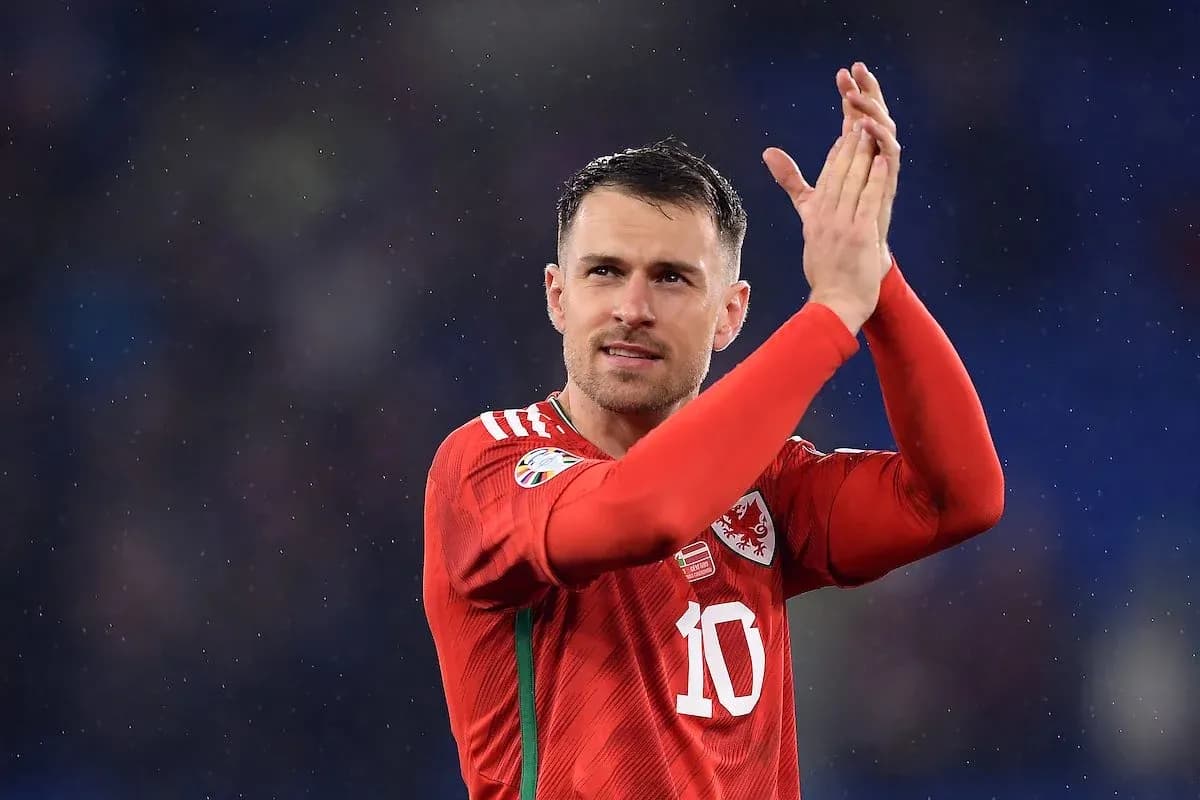
Aaron Ramsey, the elegant heartbeat of Cymru’s golden generation, has called time on his playing career at 35, closing a chapter that dragged Welsh football into a new era and kept it there.
He walks away with 86 caps, 21 goals and a catalogue of moments that reshaped what Wales believed was possible. Sixteen years at senior level. Almost 550 competitive club games. And yet, somehow, a lingering sense that injuries denied him the century of caps his talent richly deserved.
“It has been my privilege to wear the Welsh shirt and experience so many incredible moments in it,” Ramsey said as he confirmed his retirement, paying tribute to the managers and staff who guided him along the way. The privilege, many in Wales would argue, was very much mutual.
From teenage prodigy to captain
John Toshack saw it first. In November 2008, he sent a skinny 17-year-old from Cardiff into a senior international debut and effectively handed Cymru their future.
Ramsey had already raced through the U17, U19 and U21 ranks ahead of schedule. The touch, the vision, the poise under pressure – all of it pointed one way. By 20, his influence was so obvious that Gary Speed placed the captain’s armband on his arm, a statement that this was a player to build around, not merely accommodate.
He grew into that responsibility. A versatile midfielder who glided between deep-lying playmaker and advanced creator, Ramsey’s leadership was never just about volume or theatrics. He led by angles, by tempo, by the pass that split a defence and changed a night. He would wear the armband at various stages of his career and ends his international journey as Craig Bellamy’s captain.
The architect of a new Wales
For more than half a century, major tournaments were something Wales watched, not played in. Then came Chris Coleman’s side, EURO 2016 and a summer that rewrote the script.
Ramsey sat at the heart of it. He was the man between the lines, the one who linked Gareth Bale’s threat with the rest of the team’s endeavour. Cymru ended a 58-year wait to qualify and then stormed to the semi-finals, only to fall to eventual champions Portugal.
He never made that semi-final. Suspended, like Ben Davies, he watched from the stands. Yet his impact on the tournament was undeniable. Alongside Joe Allen, Ramsey earned a place in the UEFA Team of the Tournament, continental recognition of what Wales already knew: this was a world-class midfielder operating at full tilt.
The big moments kept finding him. When EURO 2020 qualification hung in the balance, it was Ramsey who stepped up, scoring both goals in a 2-0 win over Hungary in the final qualifier. Those finishes didn’t just secure a ticket to another European Championship; they underlined his habit of delivering when the stakes spiked.
He would later tick off a personal ambition as Cymru reached the 2022 FIFA World Cup in Qatar, another historic marker for a generation that refused to accept old limitations.
A final bow and lasting influence
His last appearance for Cymru came in September 2024, a Nations League trip to Montenegro. Off the bench, into a 2-1 away win, one more contribution to a team he had helped redefine.
“We’re talking about one of the best players to ever play for Wales,” said head coach Bellamy before that match, summing up a view that stretches from dressing rooms to the Red Wall. Bellamy pointed to Ramsey’s club pedigree – Arsenal, Juventus, Nice – and to the standards he set for younger players watching his every movement, every detail.
That, as much as the goals and assists, is the legacy. The way he trained. The way he carried himself. The way he made top-level football look both demanding and achievable for those coming through behind him.
Cup finals, comebacks and silverware
Ramsey’s club story began at Cardiff City, the boyhood club that nurtured him and gave him a first taste of the big stage in the 2008 FA Cup Final defeat to Portsmouth. From there, Arsenal came calling, and the FA Cup would become his competition.
He lifted it three times with the Gunners, scoring the winning goal in both the 2014 and 2017 finals. Those were not cameos. They were defining strikes on defining days, the kind of contributions that live forever in a club’s highlight reel.
The journey was not smooth. A horrific broken leg in 2010 might have ended lesser careers. Ramsey refused that script. Under Arsène Wenger’s guidance, he rebuilt his game and body to emerge as one of the Premier League’s standout midfielders over the next decade, a late-arriving runner with a knack for timing and a taste for big moments.
In 2019, he took his craft to Italy, following in the footsteps of Cymru great John Charles by joining Juventus. Turin brought trophies: a Serie A title, the Coppa Italia and the Supercoppa Italiana, another layer of medals to an already weighty career.
Scotland followed. At Rangers, he added the Scottish Cup and helped the club reach the UEFA Europa League final in 2022. Later spells at Nice and UNAM in Mexico’s Liga MX closed out his club playing days, before Cardiff City called again – this time for his mind as much as his feet, installing him as interim head coach for the final fixtures of the 2024/25 season.
Goals on the biggest stage
For Cymru supporters, certain Ramsey goals are etched in permanent ink.
The sweeping finish in the 3-0 win over Russia at EURO 2016, a night that felt like Wales were crashing through a glass ceiling. The composed strike in the 2-0 victory over Türkiye at EURO 2020, another major tournament moment delivered with familiar calm.
Those goals were the highlights. The true separation, though, came in the spaces between them: the disguised passes, the subtle body feints, the ability to see a run a second before anyone else. Ramsey didn’t just play the game; he shaped it, often one defence-splitting ball at a time.
Natural leadership. Technical quality. Vision that bent matches to his will. He arrived as a teenager burdened with expectation and left having more than justified every word of it.
One of the finest players Cymru has ever produced has stepped away. The memories remain, carried by a fanbase that watched him turn potential into history and by a new generation of Welsh footballers raised on the idea that nights like his are no longer a fantasy, but a standard.