Alan Jones: A Champion of Formula 1’s Most Dangerous Era
Alan Jones has died at the age of 80, and with him goes one of the last living links to Formula 1’s most brutal, unforgiving era. A world champion. A 12-time grand prix winner. And a man whose career was shaped, scarred and propelled by tragedy.
He raced when drivers climbed into cars knowing they might not climb out. When marshals ran across live circuits with fire extinguishers in their hands. When spectators stood behind flimsy barriers and hoped they held.
Jones did more than survive that world. He conquered it. But the path to his 1980 title was littered with scenes that would be unthinkable in today’s sport.
Baptism of fire in Barcelona
Jones’s first day as a Formula 1 driver came at one of the darkest grands prix the sport has ever staged. Spain, 1975. Montjuïc Park in Barcelona. A street circuit wrapped around a city that did not want to listen to warnings.
From the outset, something felt wrong. Drivers doubted whether the barriers had been bolted in properly. Members of the Grand Prix Drivers Association refused to take part in practice, fearing the consequences if a car went off.
They were persuaded back, amid rumours that the Guardia Civil would impound the cars if the race did not go ahead. The show, as it so often did in that era, went on.
Jones, driving for Hesketh Racing, qualified 21st. His own race barely started; a collision put him out after just three laps. The real horror came later.
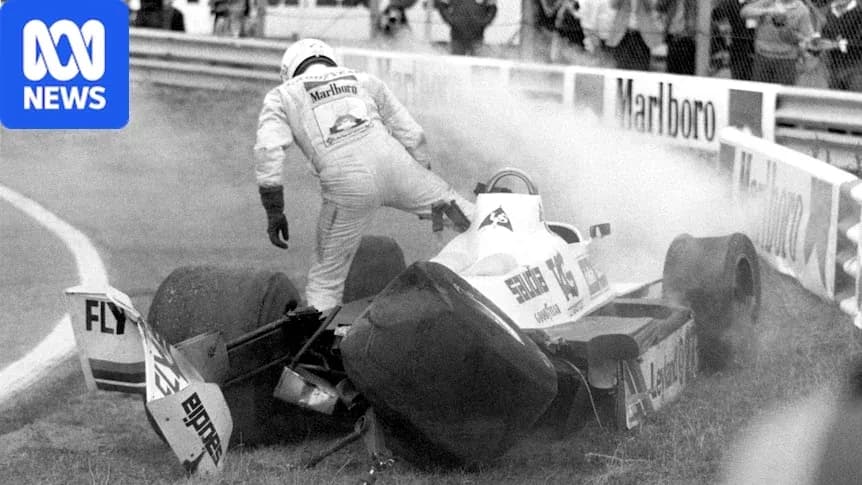
On lap 26, race leader Rolf Stommelen’s rear wing failed. His Hill-Ford speared off the track, tore through the inadequate barriers and ploughed into the crowd. Five spectators were killed. Stommelen suffered serious injuries.
The race staggered on for four more laps before officials finally called it off.
That day is remembered for another piece of history too: Lella Lombardi, finishing sixth, became the first – and still the only – woman to score Formula 1 world championship points. But for Jones, his debut sat under the shadow of a catastrophe that summed up the era he had just stepped into.
A drive born from death
Two years later, tragedy opened the door that would change Jones’s career.
After a falling-out with Team Surtees at the end of 1976, Jones found himself on the sidelines as the 1977 season began. His route back into Formula 1 came through one of the most sickening accidents the sport has ever seen.
At Kyalami in South Africa, Renzo Zorzi pulled his Shadow off to the side of the main straight with a fuel leak. A small fire flickered at the rear of the car. Two young marshals sprinted across the live track with fire extinguishers. One car swerved and somehow missed them.
Tom Pryce did not.
Unsighted, flat-out in his Shadow, Pryce struck 19-year-old marshal Frederik Jansen van Vuuren at full speed. The teenager died instantly. The heavy extinguisher he was carrying smashed into Pryce’s helmet, killing the Welshman on the spot.
Niki Lauda won the race, but his celebration was halted on the podium when a Goodyear representative quietly told him that Pryce was dead. It was a scene that summed up the callous normality of disaster at the time.
In the aftermath, Shadow needed a driver. They turned to Jones for the next race in the United States. Out of the ashes of that weekend, his career reignited.
Later in 1977, Jones delivered a stunning victory in Austria – his first grand prix win and the only one in Shadow’s history. That triumph, carved from the most harrowing of circumstances, set him on course for the front of the grid and, eventually, the world title.
The champion who nearly wore red
By the end of the 1970s, Jones had become one of the hardest, most uncompromising racers in the paddock. From 1979 to 1981, driving for Williams, he was at full power. Eleven grand prix wins in three seasons. The 1980 world championship secured with relentless aggression and consistency.
Yet the story could have unfolded very differently.
Before his golden years with Williams, Jones sat on the fringes of a move that might have rewritten Formula 1 history. Ferrari held talks with him, making it clear he was their second choice if they failed to sign Mario Andretti.
They did miss out on Andretti, who instead joined Lotus and went on to win the 1978 title there. Ferrari turned to a young Canadian, Gilles Villeneuve. Jones chose Williams, and the partnership became one of the defining combinations of the era.
Then, as so often in that period, the narrative swung back to tragedy.
In 1982, a year after Jones’s first retirement from Formula 1, Ferrari was torn apart. Villeneuve died in a violent qualifying crash at Zolder for the Belgian Grand Prix, launched into the air after hitting the back of a much slower car and thrown clear as the wreckage hit the ground.
Later that year at Hockenheim, Didier Pironi slammed into the rear of Alain Prost’s Renault in heavy spray, suffering appalling leg fractures in an accident that ended his Formula 1 career.
Jones would later say Ferrari contacted him that season, asking him to step in for the final rounds of 1982. He hesitated. By the time he responded, the team had moved on and signed another replacement. It was a sliding-door moment in a career already shaped by so many twists of fate.
From lethal era to Halo
Across the span of Jones’s time in Formula 1, five drivers died during grand prix weekends. That number does not include two more who lost their lives in testing, nor Australian Brian McGuire, killed at Brands Hatch in 1977 while driving a Formula 1 car.
It was a horrifying tally, and Jones raced every weekend with that knowledge. The danger was not a concept. It was a constant presence in the paddock, in the mirrors, in the pit lane conversations that fell silent when the medical helicopter took off.
When Jones stepped away for good in 1986, the sport finally began to respond with more than words. Circuits changed. Cars became stronger. Marshals received better training. The culture shifted, slowly, away from fatalism and towards prevention.
For a time, it looked as if the worst days were over. Then came Imola, 1994. Ayrton Senna and Roland Ratzenberger died on the same San Marino Grand Prix weekend, shocking a generation that had started to believe such weekends belonged to the past.
Since then, only one driver has lost his life in a Formula 1 race: Jules Bianchi, who went off at Suzuka in 2014 and struck a recovery crane that had been deployed to move Adrian Sutil’s stranded car. His death forced another reckoning with how and when heavy vehicles should enter a live circuit.
The response has reshaped modern Formula 1. Stronger survival cells. Better barriers. Stricter protocols for marshals and recovery teams. And, towering above the cockpit, the Halo – the curved, wishbone-shaped protection device that has already justified its existence many times over.
It helped save Romain Grosjean as he burst through a barrier in a fireball in Bahrain in 2020. It shielded Lewis Hamilton when Max Verstappen’s Red Bull landed on top of his Mercedes at Monza in 2021. It protected Guanyu Zhou as his car skated upside down and vaulted the barriers at Silverstone in 2022.
The sport that Alan Jones once entered as a rookie at a dangerously prepared street circuit now straps its stars into some of the safest racing machines ever built. The contrast is stark.
His legacy runs through that transformation. Not just in the record books, where his 1980 title and 12 wins stand. But in the hard lessons learned from the era he survived – an era that forced Formula 1 to change, or risk losing far more than it could ever bear.