Amad Diallo's Transformation with Ivory Coast: A Central Threat
Amad Diallo has spent most of the last year living on the margins at club level. With Ivory Coast, he looks anything but a fringe act.
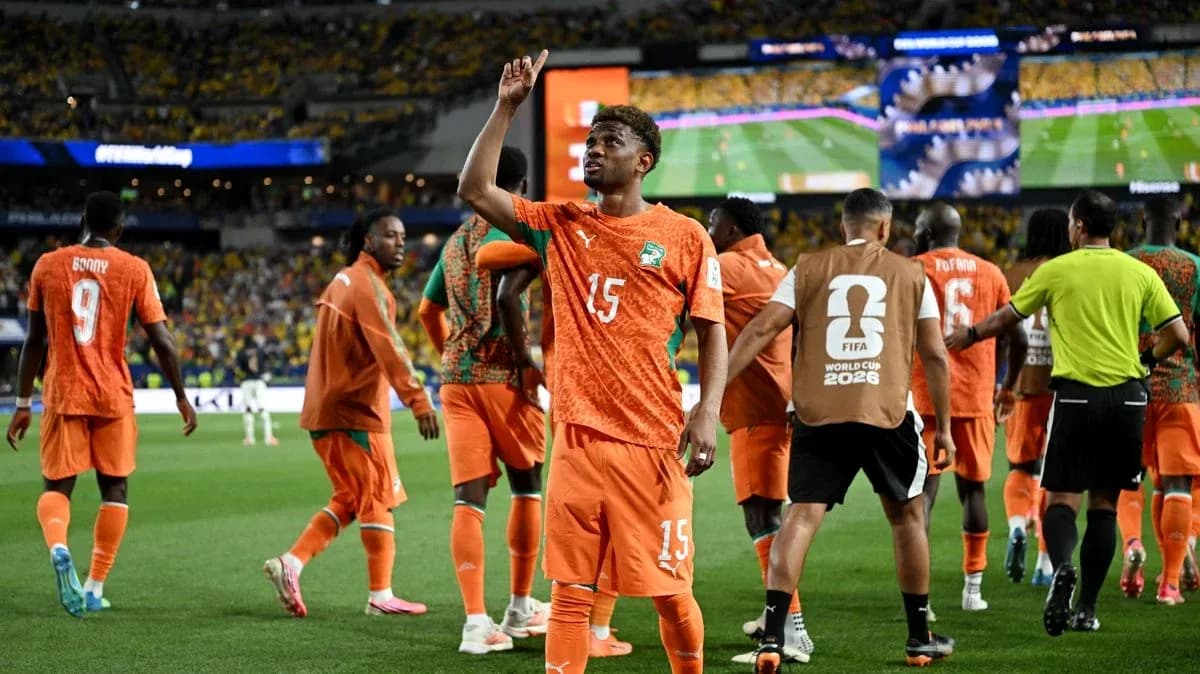
The 23-year-old followed up his winner against France in a World Cup warm-up by coming off the bench to decide another game, this time against Ecuador. Two games, two goals, both struck with the kind of certainty that makes coaches rethink depth charts.
He had every reason to expect a starting place after that late strike against France. Instead, when the real tournament began, he was back among the substitutes. Emerse Fae turned to youth on the flanks, handing the right wing to 19-year-old Yan Diomande and the left to 20-year-old Bazoumana Toure, with Nicolas Pepe operating as a roaming No. 10.
For Amad, it meant 56 minutes of watching.
Diomande justified his selection with a lively World Cup debut, the sort of display that explains why Manchester United tracked him earlier this season before Liverpool moved to close in on the RB Leipzig winger. Toure worked the opposite side, Pepe floated between the lines, and suddenly one of Ivory Coast’s most gifted attackers had no obvious lane into the XI.
That is the luxury – and the headache – Fae now enjoys. Ivory Coast are stacked with wide forwards and creative options. Yet the moment Amad stepped on, he changed the temperature of the game.
Replacing Toure, he often drifted into central pockets rather than hugging the touchline. He linked play, found angles, and then, crucially, finished. His goal to seal the win over Ecuador was superbly taken: a first-time sweep from a low ball from the right, the kind of finish that looks simple only because the technique is so clean.
It was a repeat pattern. Both of his recent goals for the national team have come from those central, penalty-box positions, attacking deliveries from the right and striking without hesitation. They underline a truth United sometimes forget: Amad is not just a neat winger. He is a real finisher.
With Curacao still to come in the group, that strike against Ecuador should be enough to push Ivory Coast towards the World Cup knockouts for the first time in their history. It should also be enough to push Amad back into Fae’s starting plans.
The contrast with his club season is stark. At Old Trafford, he has just emerged from a difficult Premier League campaign: two goals and four assists in 32 appearances is a modest return for an attacking player. The numbers do not leap off the page.
Yet his international record tells a different story. Since the start of the Africa Cup of Nations in December, he has five goals and two assists in nine games for Ivory Coast. When he pulls on the orange shirt, he looks decisive, liberated, and trusted.
The way he operated against Ecuador will not have gone unnoticed in Manchester. With Diomande now a genuine long-term threat to his preferred spot on the right for his country, Amad may see his future more centrally, in the sort of role Pepe is currently filling. Pepe is 31 now. That door will not stay locked forever.
He can also play from the left, as a foil or alternative to someone like Toure. The key point is his flexibility. United know this already. He spent almost all of last season on the right at Old Trafford, but his loan spell at Sunderland told another story: used as a false nine in the Championship, he became a regular goalscorer for the Black Cats, timing his runs and finishing with composure.
That version of Amad – the one who ghosts into central spaces and ends moves, not just starts them – is exactly what Ivory Coast are tapping into.
It is also exactly the profile that could solve a looming problem at United.
Michael Carrick has built a front line rich in variety. Bryan Mbeumo and Matheus Cunha can both play across the front three, rotating positions and dragging defenders into places they do not want to go. There are already plans to add another attacker, either a seasoned centre-forward or a left-sided option to complement what is there.
Yet the real gap sits a little deeper, in the shadow of Bruno Fernandes.
Fernandes has just produced the season of his life, orchestrating United’s attack yet again. But he turns 32 in September and has carried an enormous workload since arriving in January 2020. Every season asks him to go again. Every competition leans on his creativity.
United need someone who can step into that No. 10 role without ripping up the structure of the side.
Cunha can do it. Mason Mount can do it. Both are credible options to give Fernandes a breather in certain games. Amad, though, is now making his own case.
He has shown with Ivory Coast that he can operate through the middle, receive between the lines, and still arrive in the box with the instincts of a forward. He does not just knit play together; he finishes moves. In a fluid, unpredictable front line, that blend is gold.
Carrick recognised his value late last season, publicly defending Amad and urging critics to look beyond goals and assists to see his contribution to the collective. The numbers may yet come if he is trusted closer to goal, in the zones where he is hurting teams for his country.
For Ivory Coast, his emergence as a central threat might be the difference between another honourable campaign and a historic World Cup run.
For United, it poses a sharper question: is the answer to their Bruno problem already in the building, waiting to step inside rather than stay wide?