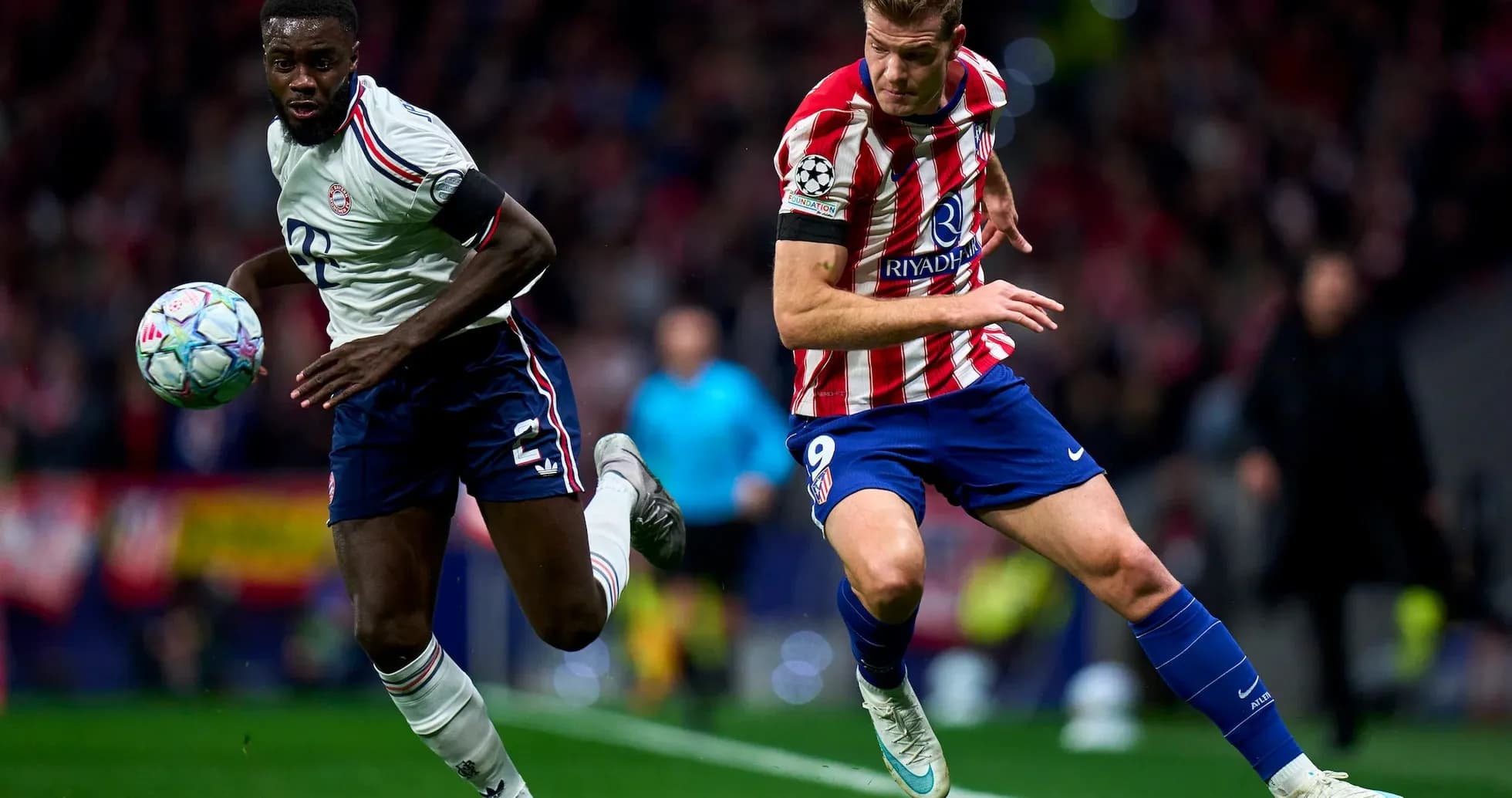
Atletico Madrid vs Bayern München: UEFA Champions League Insights
Under the lights of the Riyadh Air Metropolitano, this League Stage - 4 meeting in the UEFA Champions League brought together two clubs whose seasonal identities are already sharply defined. Atletico Madrid arrived as a side living on the edge of the qualification picture, 23rd in the overall league table with 4 points from 4 matches, their goal difference a tight -1 (4 scored, 5 conceded). Bayern München, by contrast, travelled as one of the early standard-bearers of the competition: 13th in the standings, unbeaten with 8 points from 4 games and a commanding goal difference of +7 (12 scored, 5 conceded).
The 0-2 full-time scoreline in favour of Bayern felt like a crystallisation of those trajectories rather than a surprise twist. Atletico’s campaign has been one of narrow margins: at home they had won 1 and lost 1 from 2, scoring 2 and conceding 2, their overall attacking output steady but modest at 1.0 goals per game both at home and on their travels. Bayern, on the other hand, came in with a ruthless edge in front of goal: 3.5 goals per game at home, 2.5 on their travels, and 3.0 overall, all while conceding only 1.3 per match in total.
Diego Simeone’s selection underlined a desire to retain Atletico’s traditional defensive spine while modernising the edges. The 4-4-2 was familiar, but the personnel told a story of transition. Jan Oblak anchored the side behind a back four of Marc Pubill, Robin Le Normand, Dávid Hancko and Álex Grimaldo. In front of them, G. Simeone, Pablo Barrios, Marcos Llorente and Álex Baena formed a midfield line designed to compress space yet offer ball-carrying from deep. Up front, A. Sørloth and J. Álvarez were tasked with stretching Bayern’s centre-backs and punishing any high line.
The absences for Atletico were significant and coloured their tactical options. J. Cardoso’s thigh injury removed a deeper passing pivot, while C. Romero’s muscle issue deprived Simeone of another defensive piece. Most importantly, M. Hjulmand’s suspension following a red card not only took a combative midfielder off the board but also removed a player who has walked the disciplinary tightrope all campaign; his single red card in just 96 minutes of Champions League action was emblematic of Atletico’s late-game volatility. That volatility is written into their season numbers: in total, 75.00% of their yellow cards have arrived between 76-90 minutes, with a red card shown in the 61-75 window. This is a team that often finishes games emotionally stretched and numerically vulnerable.
On Bayern’s side, Vincent Kompany’s 4-2-3-1 has been the constant heartbeat of their European run, used in all 4 matches. Manuel Neuer started in goal, shielded by a back four of Konrad Laimer, Dayot Upamecano, Jonathan Tah and Josip Stanišić. Joshua Kimmich and T. Bischof formed the double pivot, with Michael Olise, L. Karl and Alphonso Davies operating behind Harry Kane, the competition’s complete forward in this early phase.
Kane’s presence defined the “Hunter vs Shield” narrative of the night. Heading into this game, he had 4 goals and 3 assists from 4 appearances, with 16 shots (7 on target) and a player rating of 7.9. He had also converted 2 penalties from 2, underlining Bayern’s clinical edge from the spot. Against an Atletico side conceding 1.0 goals per game at home and 1.3 overall, the question was not whether Bayern would create, but whether Atletico’s structure could bend without breaking.
The answer lay in the central corridor. Kimmich’s 103 passes in the competition, with 9 key passes and 82% accuracy from Kane himself linking deeper, meant Bayern could progress play both through and around Atletico’s block. With Cardoso absent and Hjulmand suspended, Simeone relied on Barrios and Llorente to patrol the engine room. They brought energy and verticality, but lacked the pure screening instinct that a dedicated destroyer would provide against a side as fluid between the lines as Bayern.
Out wide, the duel between Grimaldo and Olise offered another key subplot. Grimaldo’s attacking instincts from left-back are part of Atletico’s biggest home win so far (2-0), but pushing him high against Bayern’s transitions risked exposing the half-space behind him to Olise’s movement and Kane’s dropping runs. On the opposite flank, Pubill and G. Simeone had to contain Davies’ surges and Karl’s drifting, a demanding double assignment that limited Atletico’s own wing threat.
Defensively, Bayern’s numbers suggested a side comfortable absorbing spells of pressure without losing control. On their travels they had conceded 3 goals in 2 matches, an average of 1.5 away but still balanced by their offensive power. They also arrived with 2 clean sheets in total, one at home and one away, and no defeats in any venue. The central pairing of Upamecano and Tah was built for the aerial and physical challenge posed by Sørloth, while Laimer’s deployment as a right-back added a midfield brain to the back line, useful against Llorente’s inside runs and Álvarez’s drifting.
Discipline was another subtle battleground. Bayern’s yellow cards have been clustered in the 46-75 minute range, with 33.33% shown between 46-60 and 50.00% between 61-75, plus a red card also in that 61-75 window. This suggests a team that occasionally overreaches when trying to reassert control after half-time. Atletico, whose card peak comes even later, often chase games in the final quarter, and that emotional intensity can tilt matches one way or the other. In a tight knockout scenario, this could have been decisive; in this league-stage context, it instead underscored Bayern’s ability to ride out turbulence and re-establish structure.
The benches hinted at different kinds of contingency. Atletico could turn to Koke for control, Lee Kang-In for creativity, and A. Lookman or J. David for directness in transition. Bayern’s depth in defence with Kim Min-Jae, H. Ito and S. Boey, plus midfield reinforcements like A. Pavlović, meant they could either lock the game down or double down on their front-foot identity.
Statistically, the pre-match prognosis tilted towards Bayern. They arrived with 2 wins and 2 draws in total, no defeats, and an attacking output that dwarfed Atletico’s: 12 goals to 4 overall, with their biggest away win a 0-2 result that mirrored the eventual scoreline in Madrid. Atletico’s single clean sheet at home and their tendency to either win 2-0 or lose 0-2 in this competition hinted at a binary outcome: either they would perfectly execute Simeone’s plan, or Bayern’s firepower would eventually crack them.
Following this result, the narrative hardens. Bayern look every inch a side built on a high-functioning 4-2-3-1, with Kane as both finisher and creator, and a defensive unit capable of withstanding the cauldron of away nights. Atletico, still on 4 points from 4 with that -1 goal difference intact in the standings snapshot, remain in the mix but now live even closer to the edge. Their path forward will demand a recalibration of the midfield shield and a more consistent attacking punch, because against sides of Bayern’s calibre, defensive heroics alone are no longer enough.