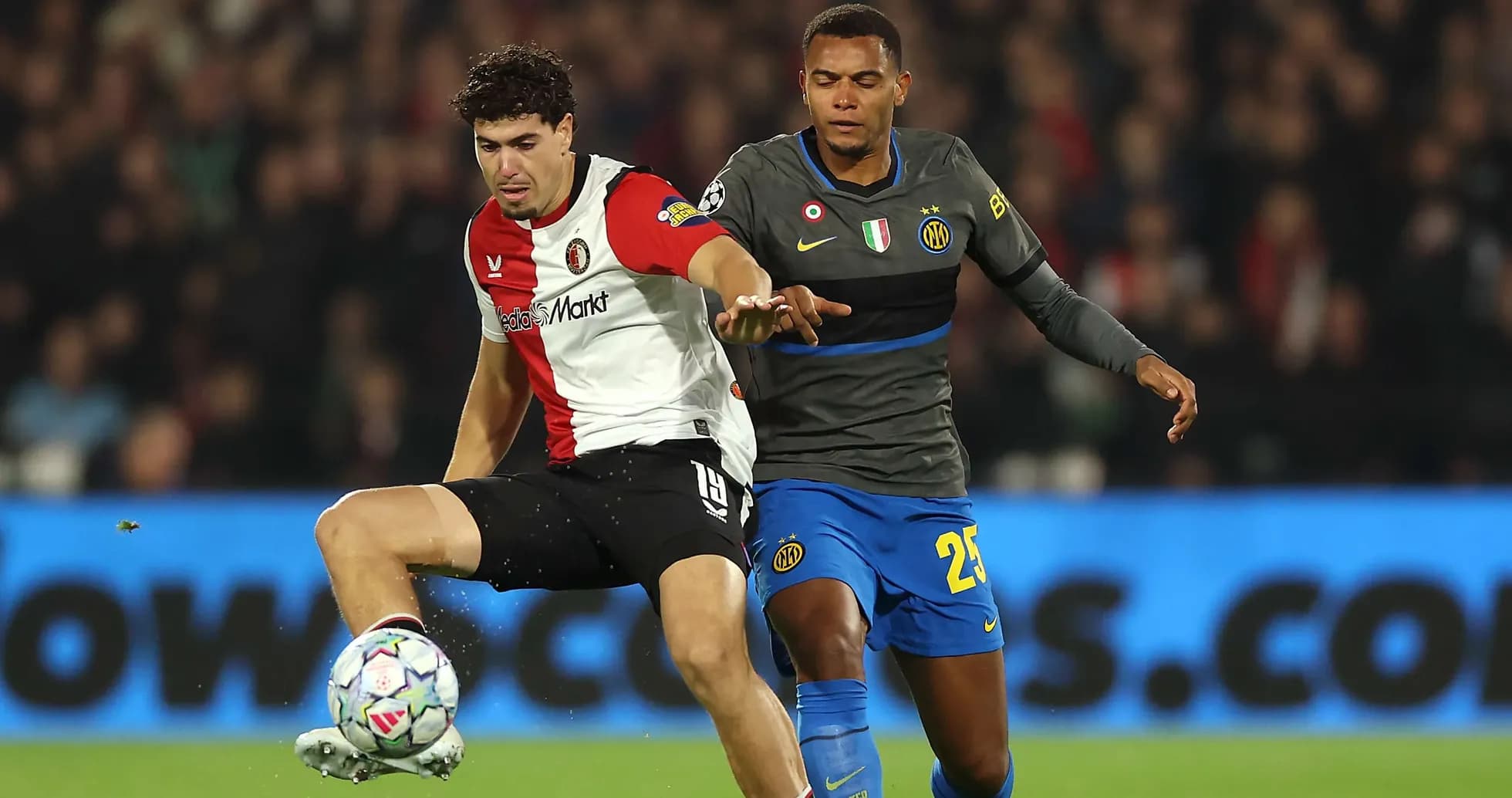
Inter Dominates Feyenoord in UEFA Champions League Clash
Under the Rotterdam floodlights at Stadion Feijenoord, this League Stage - 4 clash in the UEFA Champions League brought together two sides moving in opposite directions. Feyenoord arrived rooted in 32nd place with 3 points from 4 matches, a goal difference of -7 from 4 goals scored and 11 conceded overall. Inter, sitting 15th with 6 points and a goal difference of 2 (8 scored, 6 conceded overall), came to the Netherlands with the air of a side that expects to be in the play-off conversation rather than merely surviving the league stage.
The 3-0 scoreline to Inter, built on a 2-0 half-time lead and closed out without fuss, felt like a faithful reflection of the structural gap between the teams. Feyenoord’s seasonal profile heading into this game already hinted at vulnerability: at home they had scored 3 and conceded 5 in 2 matches, averaging 1.5 goals for and 2.5 against. On their travels Inter had been far more balanced, scoring 4 and conceding just 2 in 2 away fixtures, an away average of 2.0 goals for and 1.0 against. This match simply extended those trends rather than defying them.
I. Tactical Shapes and Seasonal DNA
Giovanni van Bronckhorst stayed loyal to Feyenoord’s European template, rolling out a 4-3-3 that has already been used 3 times in this campaign. T. Ernst started in goal behind a back four of G. Read, T. Kraaijeveld, Mika Màrmol and Javi López. The midfield trio of G. Zechiël, C. Vanhoutte and O. Targhalline was tasked with knitting build-up and offering protection, while the front three of A. Hadj-Moussa, Nacho Ferri and L. Valente were supposed to stretch Inter’s back line.
Across from them, Cristian Chivu deployed the now-familiar 3-5-2 that Inter have used in all 4 Champions League outings. Josep Martínez was shielded by a back three of Y. Bisseck, M. Akanji and Carlos Augusto. The wing-backs, D. Spence on the right and F. Dimarco on the left, flanked a central trio of N. Barella, H. Çalhanoğlu and P. Zieliński. Up front, F. Esposito partnered M. Thuram, a duo built to attack space and punish disorganised transitions.
The contrast in structural stability was stark. Inter arrived with 2 clean sheets in 4 matches overall, and a defensive record on their travels of just 2 goals conceded in 2 away games. Feyenoord, by comparison, had failed to keep a single clean sheet overall and were conceding 2.8 goals per game in total. Inter’s 3-5-2 had an ingrained clarity; Feyenoord’s 4-3-3 looked more like a developmental framework than a finished product.
II. Tactical Voids and Absences
Feyenoord’s defensive absences were brutal. T. Beelen (broken leg), J. Bos and J. Moder (both knee injuries), B. Nieuwkoop (knee), G. Smal (ankle) and J. St. Juste (leg injury) all missed the fixture. That is effectively an entire defensive rotation removed from the equation, forcing van Bronckhorst to lean heavily on a back four that has not yet developed the cohesion required at this level. The knock-on effect was obvious: full-backs Read and Javi López had to be conservative, limiting Feyenoord’s ability to overload wide areas and support the front three.
Inter, too, were not untouched. A. Bastoni was suspended after a red card earlier in the campaign, while C. Jones, Luis Henrique, L. Martinez and J. Stones were all absent with muscle or thigh issues. Yet Chivu could still field a back three of Bisseck, Akanji and Carlos Augusto, underpinned by the positional discipline of Çalhanoğlu at the base of midfield. The depth allowed Inter to absorb Bastoni’s absence without losing their defensive identity.
Disciplinary patterns also shaped the risk profiles. Feyenoord’s yellow-card distribution heading into this game showed a clear spike between 46-60 minutes, with 33.33% of their cautions arriving just after half-time. Inter, by contrast, spread their bookings more evenly, with a notable cluster (30.00%) in the 31-45 minute window and a red-card risk zone between 61-75 minutes, where their only red of the campaign had occurred. It meant Feyenoord were more likely to be walking a disciplinary tightrope just as they typically needed to chase games after the break.
III. Key Matchups – Hunter vs Shield, Engine Room Battles
The “Hunter vs Shield” narrative here was less about an individual scorer and more about collective patterns. Feyenoord’s attack at home had produced 3 goals in 2 matches, but the same side had already failed to score in 2 of their 4 fixtures overall. Against that, Inter’s away defence had allowed only 2 goals in 2 games, and they had kept 2 clean sheets overall. The front trio of Hadj-Moussa, Nacho Ferri and Valente were repeatedly forced to receive with their backs to goal, starved of the kind of quick combinations that unsettle a back three.
In midfield, the “Engine Room” duel was decisive. C. Vanhoutte and O. Targhalline were asked to both press and protect, while G. Zechiël tried to link lines. But Inter’s central square of Barella, Çalhanoğlu, Zieliński and the dropping movements of Thuram simply outnumbered and outmanoeuvred them. Çalhanoğlu dictated tempo, Barella broke lines with his carrying, and Zieliński floated into half-spaces that neither Feyenoord’s midfield nor back line could consistently track.
Out wide, D. Spence and F. Dimarco repeatedly pinned Feyenoord’s full-backs. With Feyenoord already conceding 5 goals at home in 2 matches prior to this, those wide overloads were always likely to open channels for cut-backs and late runs from midfield. Inter’s structural superiority ensured that when the ball was lost, they were better placed to counter-press and prevent Feyenoord from springing transitions.
IV. Statistical Prognosis and Tactical Verdict
Following this result, the numbers and the narrative align. Feyenoord’s overall record of 1 win and 3 defeats from 4 matches, with 4 goals for and 11 against, underlines a side that is conceding too many high-quality chances and lacks the punch to compensate. Their home profile – 1 win, 1 defeat, 3 scored, 5 conceded – suggests they can hurt teams in Rotterdam, but not yet control Champions League games over 90 minutes.
Inter, with 2 wins and 2 defeats, 8 goals scored and 6 conceded overall, are not flawless but are clearly trending upwards. On their travels they now have 2 wins from 3 away-style performances this campaign context, scoring freely while maintaining a compact defensive block. Their 3-5-2 is bedded in, their midfield axis is among the most balanced in the competition, and even without Bastoni they can rotate high-level defenders into the back three.
From an xG and defensive solidity perspective, everything points toward Inter continuing to have the higher ceiling in this matchup. Feyenoord’s rate of 2.8 goals conceded per game overall is simply unsustainable in a league-stage environment where margins are thin. Unless van Bronckhorst can rapidly tighten the central corridor in front of Ernst and restore some of his missing defensive leaders, Feyenoord will remain reliant on chaotic, high-scoring contests that rarely favour the underdog at this level.
Inter, by contrast, look built for the grind. A system that naturally protects the centre, wing-backs who can both defend and attack, and a midfield capable of managing tempo all point to a side whose underlying metrics should continue to improve. In the cold light of this 3-0, the squad analysis reads like a tale of one project already in its Champions League phase, and another still trying to grow into it.