Bafana Bafana vs Canada: First Ever FIFA World Cup Knockout Match
Bafana Bafana and Canada step into the unknown in Los Angeles on Sunday, each carrying the weight of history and the thrill of discovery into their first ever FIFA World Cup knockout match.
For both, the group stage has always been the ceiling. Now it’s a door.
Two teams who refused their old script
South Africa arrived at this World Cup with scars. Three previous appearances — 1998, 2002, 2010 — and three early exits. This one began like the others. A 2-0 defeat to co-hosts Mexico, questions swirling, old doubts creeping back. When they fell behind again in their second match against Czechia, it felt like the same story, just in a different stadium.
Then Teboho Mokoena ripped up the script.
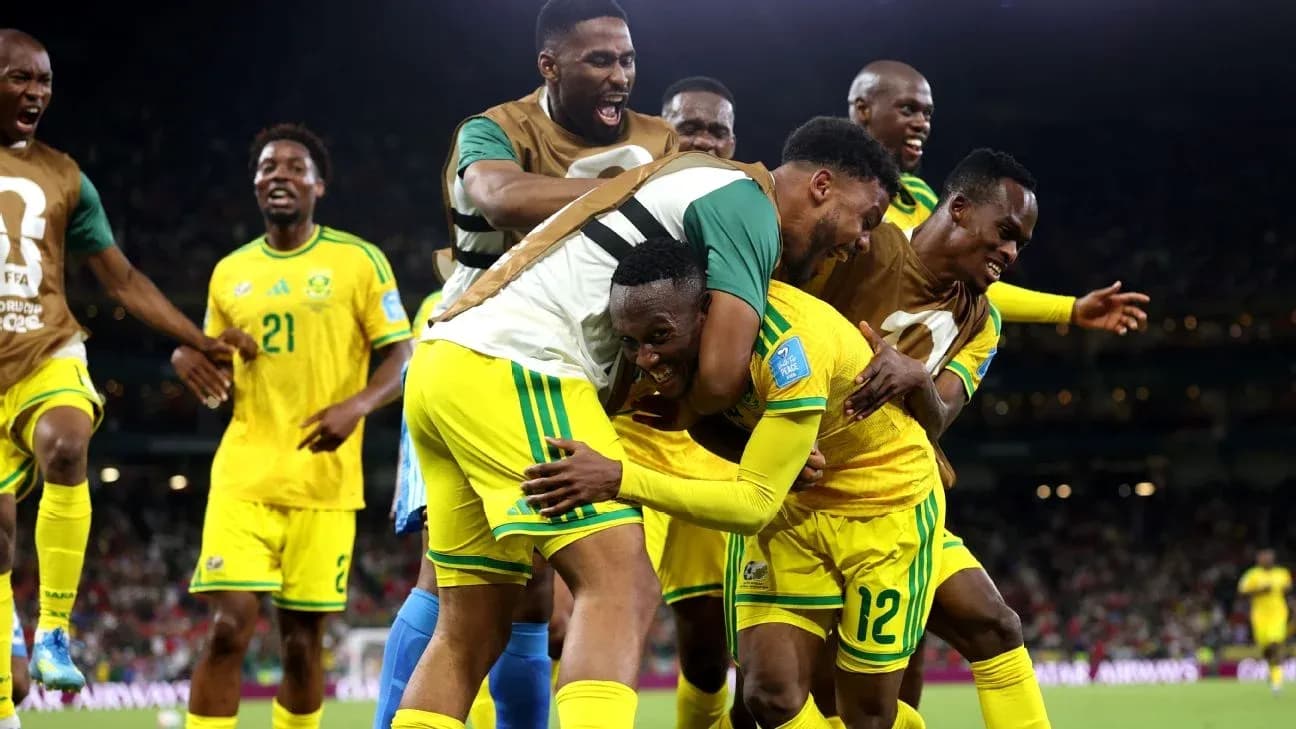
His 83rd-minute equaliser against Czechia didn’t just salvage a point. It jolted Bafana Bafana back to life. From there, belief took over. Thapelo Maseko, with his 63rd-minute winner against South Korea, turned that belief into a statement: a 1-0 victory, a clean sheet, and second place in Group A secured. A “sleeping giant” of African football? In Los Angeles, we find out if it’s finally awake.
Canada have been wrestling with their own history. They came to this tournament as co-hosts alongside Mexico and the USA, under the sharp, demanding eye of Jesse Marsch. Their World Cup story until now? Brief and brutal: group-stage exits in 1986 and 2022.
This time, they opened Group B with a hard-fought 1-1 draw against Bosnia & Herzegovina. Not spectacular, but solid. Then came the statement performance: a 6-0 demolition of Qatar that showcased their attacking edge and their willingness to run over an opponent once they sensed weakness. A 2-1 defeat to Switzerland in their final group game checked their momentum but didn’t derail the mission. Second place in the group, knockout football secured, and a chance to stretch this run deeper than any Canadian side has gone on the world stage.
Two nations, four previous World Cups between them. Not a single knockout tie until now. That changes in Inglewood.
Los Angeles stage, global stakes
On Sunday, June 28, at 12 p.m. local time in Los Angeles (9 p.m. CAT, 8 p.m. BST, 7 p.m. GMT), Los Angeles Stadium in Inglewood becomes the crossroads.
In South Africa, the country will pause for Bafana. SuperSport will carry the game on DSTV channels 201, 202 and 235, SABC will bring it free-to-air, and SportyTV offers another streaming route. In Canada, the coverage reflects the scale of the occasion: TSN, RDS, CTV, and Crave all on board. US viewers have FOX, Telemundo, and Peacock.
On the pitch, Portuguese referee João Pinheiro takes charge. He’s no stranger to high-pressure nights, but his handling of Bayern Munich’s UEFA Champions League semi-final against Paris Saint-Germain drew sharp criticism. Every decision in knockout football carries an extra edge. Sunday will be no different.
Suspensions, injuries and a thin margin for error
Hugo Broos must once again reshuffle. South Africa’s appeal against the extension of Themba Zwane’s suspension failed, meaning the influential attacker remains sidelined for three matches after his red card against Mexico. That robs Bafana of a creative spark and a goal threat between the lines.
There is good news, though. Mokoena returns from his one-match suspension after picking up yellow cards in each of South Africa’s first two games. His presence in midfield is non-negotiable for Broos: he dictates tempo, breaks lines, and, as Czechia discovered, carries a serious threat from distance.
Canada have been forced to navigate their own setbacks. Alphonso Davies, the Bayern Munich star and face of Canadian football, has yet to play a minute at this tournament as he recovers from a hamstring injury. Marsch’s side have adapted without him, but his absence remains a glaring hole on the left flank.
Ismaël Koné’s situation is even more brutal. The Sassuolo midfielder suffered a broken leg against Qatar and is out for the rest of the tournament. For a team that wants to press aggressively and play with energy in midfield, losing such a dynamic presence is a significant blow.
Both managers know this: at this stage, every missing player feels like a risk you can’t fully cover.
Expected lineups and key battles
South Africa are likely to stay close to the formula that brought them here:
- Ronwen Williams in goal, calm and experienced.
- A back four of Aubrey Modiba, Mbekezeli Mbokazi, Ime Okon and Khuliso Mudau — solid, combative, and increasingly confident after that clean sheet against South Korea.
In midfield, Sphephelo Sithole alongside Mokoena provides balance: Sithole to shield, Mokoena to orchestrate and surge. Ahead of them, the craft and movement of Oswin Appollis on the left, Relebohile Mofokeng as the central creator, and Maseko on the right give Bafana width and incision.
Evidence Makgopa leads the line. He will have to occupy Canada’s centre-backs, bring others into play, and be ruthless with any half-chance that falls his way.
Canada, too, are expected to lean on the structure that carried them through Group B:
- Maxime Crepeau in goal.
- A back four of Richie Laryea on the left, Derek Cornelius and Luc de Fougerolles in central defence, and Alistair Johnston at right-back — a unit comfortable pushing high and engaging early.
Across midfield, Ali Ahmed on the left and Tajon Buchanan on the right bring energy and direct running, with Mathieu Choiniere and Nathan Saliba tasked with controlling the middle, linking play, and setting the press.
Up front, a strike partnership of Tani Oluwaseyi and Jonathan David offers contrasting threats: one willing to stretch defences, the other deadly if given a yard in the box.
The game may well be decided in two zones: the space around Mokoena and Choiniere in midfield, and the channels where Maseko and Buchanan like to burst into life.
Mofokeng’s vision, history’s echo
If South Africa are to unlock Canada, Relebohile Mofokeng’s influence will be central. In the 1-0 win over South Korea, he led the game in key passes with four, according to FlashScore. That number tells only part of the story; his willingness to receive the ball under pressure, to thread passes into dangerous areas, and to keep defenders guessing gives Bafana a creative hub they have long craved on this stage.
There’s also a faint echo of history between these sides. The only previous meeting came in Durban in 2007, when South Africa beat Canada 2-0. Teko Modise scored both goals that day, a reminder that Bafana have, on occasion, found clarity and swagger against this opponent.
Nineteen years later, the stakes are incomparably higher. This time, there is no friendly backdrop, no room for experimentation. Lose, and the journey ends. Win, and a new chapter opens for a nation that has waited decades to feel like a genuine player at the World Cup’s sharp end.
Canada stand at a similar threshold. Co-hosts, ambitious, hardened by recent tournaments, and no longer content just to be part of the show.
One of these stories accelerates in Los Angeles. The other stops cold. Which way does the World Cup wind blow for Bafana Bafana and for Canada now?