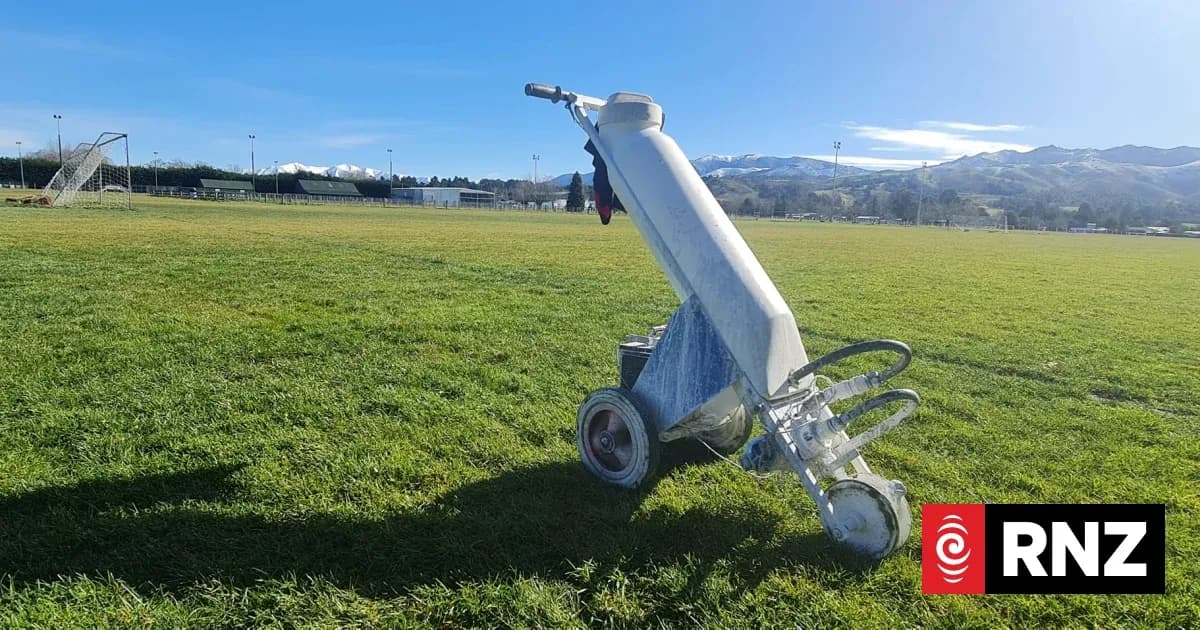
On a quiet patch of North Canterbury grass, a fight over the future of community football is heading to a legal arena.
Oxford Football, a tiny South Island club with just 145 members and a storage container for a clubhouse, has taken the dramatic step of challenging its regional federation, Mainland Football, in the Disputes Tribunal. At the heart of the dispute: $15,000 a year in levies that Oxford says are choking rural clubs.
Seventy-four percent of Oxford’s fixed costs now disappear into what president Keith Gilby calls “upstream fees”. Shirts, balls, nets, goals, pitch maintenance – the club pays for all of it itself. Then it pays again just to be allowed on the pitch.
“We operate out of a container so to spend $15,000 each year to allow 150 players just to play in a competition is an incredible amount of money for a small club like Oxford,” Gilby said.
What began as a polite request for clarity has hardened into formal proceedings. Oxford argues Mainland Football is failing in its obligations to members, providing negligible value in return for fees that, in their view, no longer stack up for a rural outfit with limited financial pull.
Mainland, which oversees nearly 20,000 members across the South Island, rejects any suggestion of price gouging.
Chief executive Martin Field-Dodgson insists the federation is doing its best to keep the game accessible.
“Fees are part of that service delivery from Mainland into clubs. Football is funded through a wide range of sources. What we're trying to do is to keep things as reasonable as possible,” he said.
Mainland’s model is clear on paper: two core charges across all clubs – affiliation and competition fees. Affiliation is per player and funds the “core services that make the football system work”. Competition fees cover the direct costs of running the leagues Oxford and others play in.
Oxford wanted more than a description. It wanted a breakdown, a justification, and, crucially, a sense that rural realities were factored into the numbers. When those answers didn’t come, the club lodged a formal complaint. The dispute is now in mediation, with both sides set to sit down on Friday.
Gilby says Oxford reached a breaking point in September when the latest pricing round landed.
“We felt that Mainland Football are failing in delivering their objectives to us. Unfortunately it got to the stage where Mainland Football refused to talk to us any further, so we lodged a legal complaint with the Disputes Tribunal. We're now in mediation with them to hopefully achieve an outcome outside of a court process.”
Field-Dodgson welcomes the chance to get everyone in the same room.
“Ultimately it's a good opportunity to get in a room and just have a chat about the situation we're in, discuss where they're coming from and then obviously where the federation is coming from,” he said, pointing to regular whole-club meetings and an AGM as proof Mainland values its relationships.
He says “thriving sustainable clubs” sit at the heart of Mainland’s strategy.
A “lone wolf” or a warning siren?
Oxford is not speaking for everyone. In fact, some of its neighbours are pushing back.
At Hurunui Rangers in Amberley, club figure Tim Kelly has little time for the rebellion.
“He's a lone wolf. He's out there trying to nail Mainland because thinks that they're charging too much. Nobody else I know thinks that. The money that we're charged by Mainland is not the principal issue for rural clubs. Relative per head, it's very reasonable,” Kelly said.
Hurunui has around 200 registered players this year and, in Kelly’s eyes, strong backing from the federation.
“Last weekend we had someone from Mainland spend the whole day with us coaching our coaches. They recognise the issues we have as a rural club and they help us out as best they can.”
When Oxford emailed other clubs seeking support, Hurunui replied bluntly: they backed Mainland, not the revolt.
Kelly also points the finger back at Oxford’s own books, suggesting the club’s finances are partly self-inflicted.
“They may have got into trouble by not charging fees for a few years to any kids. If there's now a deficit, that's of their own making.”
Hurunui leans on hardship assistance, including Mainland’s Scorching Goal fund, established after the 2011 earthquake, and NZ Football’s schemes.
“We apply every year for support for certain kids to have their fees paid and we've never been turned down. So we certainly can't see what the issue is in that regard.
“We recognise that these are challenging times financially, but you can't expect to run a club and not have to charge.”
A national model under strain
Field-Dodgson says any serious shift in how football is funded would have to be tackled at national level.
“The funding model is what happens up and down the country. So that's a heck of a conversation to have. If we just say, 'okay, we're going to try reduce or remove player registration fees, where's that funding going to come from?' Otherwise, service delivery would be drastically reduced.”
He bristles at comparisons with rugby.
“Our game's funded differently from rugby which I see getting used as a comparison. We don't have a Silver Lake deal to help keep costs low.
“We'd love a whole lot of funding to come down or a whole lot more commercial partners but ultimately we don't have that. We work with our clubs to keep the financial pressure on families as low as we can, whilst trying to deliver a really wicked experience for those that are involved in the game.
“In this instance, we've got a club potentially with a different viewpoint. We've got our funds that helps those that may have financial pressures and that's eligible for anyone to come and apply for.”
For Oxford, the argument keeps circling back to value. They pay; they say they see little in return.
“We have to pay these fees. If we don't pay these fees, Mainland Football have the obligation to end our membership, which means that we would cease to exist as a club,” Gilby said.
“We actually pay competition entry fees as well as team fees as well as individual fees that the players pay for registration.”
When Oxford warned Mainland the costs were becoming unmanageable, the response, Gilby says, was to cut their own spending. The club insists there’s nothing left to trim without closing the doors.
Free football – with a catch
In a bold, almost desperate move, Oxford decided to stop registering its youngest players with the national body.
The club now runs fee-free football for children up to 10 years old – but those kids sit outside the official system.
“We decided we'd approach Mainland Football, again and again they were unwilling to assist. So we made the decision that we were going to try fee free for kids. But this is an in-house programme and we do not register them into Mainland Football. We've had to make the really hard decision of actually stopping registering kids to be able to afford to allow them to keep playing,” Gilby said.
On paper, it looks backwards: a football club deliberately pulling children out of the formal structure. On the balance sheet, it makes sense to them.
“What we were actually doing was stopping the haemorrhaging of the money, we were stopping the parents having to pay fees, and us having to top up those fees to be able to afford the registrations.”
The move saves about $5000 a year, backed by local sponsorship and community funding.
Rural strain, city power
Gilby believes the funding model has not kept pace with the game’s growth or the realities of rural life.
“Football has always been a bottom up funded model, but it's now getting to the stage where the small clubs like ours can no longer afford to sustain the required payments. We're looking to understand how the pricing is put together. We believe that there is little connection with the rural clubs, little connection between the strategy of and the objectives of the constitution. We have no visibility or transparency over that.”
The extra costs of distance bite hard. To play in Mainland leagues, Oxford’s players routinely travel 100km round trips to Christchurch. Rising fuel prices turn away days into financial stress tests.
Gilby argues that large urban clubs can spread costs across far bigger memberships, use their scale to attract significant sponsorship and then parlay that influence into governance.
“Its principal benefit allows for big clubs to become richer because they get to put all of their costs across a much higher number of players to support the high performance teams, which attract really good sponsorship from mainstream companies.
“Then those clubs are then able to vote their members on as board members into Mainland Football. The opportunity for small clubs and rural clubs to be able to affect meaningful change within the organisation is limited.”
Mainland’s footprint stretches from Ashburton to Golden Bay, covering about 16,000 members across a sprawling, diverse region. Field-Dodgson concedes that delivering a consistent product across such a wide area is demanding, but says it remains non-negotiable.
“Our goal is to ensure every player has a similar experience, wherever they are. If there are concerns, yeah, let's have a chat about it and see where we can improve, we can always try and do better.”
Oxford, though, looks at the booming profile of football in New Zealand and wonders when the benefits reach their corner.
“The the main streamlined competitions are the one that attracts the revenue, people, growth. It's how the game has been developed and that's how this pricing model has been developed,” Gilby said.
“We haven't seen any of that yet, and I don't think it's likely that we will see it.”
For now, everything comes down to mediation on Friday. One small club, one powerful federation, and a funding model under the microscope.
Field-Dodgson remains hopeful.
“It is where it is and we can get opportunity to sit in a room with Oxford next week and hopefully we can find some common ground and move the discussions forward and then we can rip into delivering an awesome season.”
Whether that “awesome season” will still feature Oxford as a fully fledged member of the system is the question hanging over a rural pitch in North Canterbury.