Egypt Triumphs in Shootout Against Australia as Salah Shines
Under the giant roof of the Dallas Cowboys’ home, in air-conditioned tension and with 70,000 voices swirling, Egypt and Australia dragged each other to the edge. It took penalties, and a teenager’s miss, to finally separate them.
Tony Popovic played his last card at the end of extra time, hauling on Mathew Ryan purely for the shootout. A bold, late gamble. It almost worked.
Instead, it opened with a gut punch.
Harry Souttar, usually the picture of composure, strode up first for Australia with the Egypt end whistling and jeering. He leaned back, lost his shape and launched his penalty high over the bar. In an instant, the Socceroos were chasing the contest they had fought so hard to reach.
The next five takers were flawless. Egypt’s players struck cleanly, Australia matched them, and the noise swelled with each successful kick. Then came Mohamed Salah.
He had limped into the tournament with a hamstring strain, laboured through the match, and spent long spells on the periphery. From 12 yards, he was ice. One measured run-up, one unerring finish. The coolest of penalties, buried with the certainty of a man who has lived this moment a thousand times.
Still, Australia clung on.
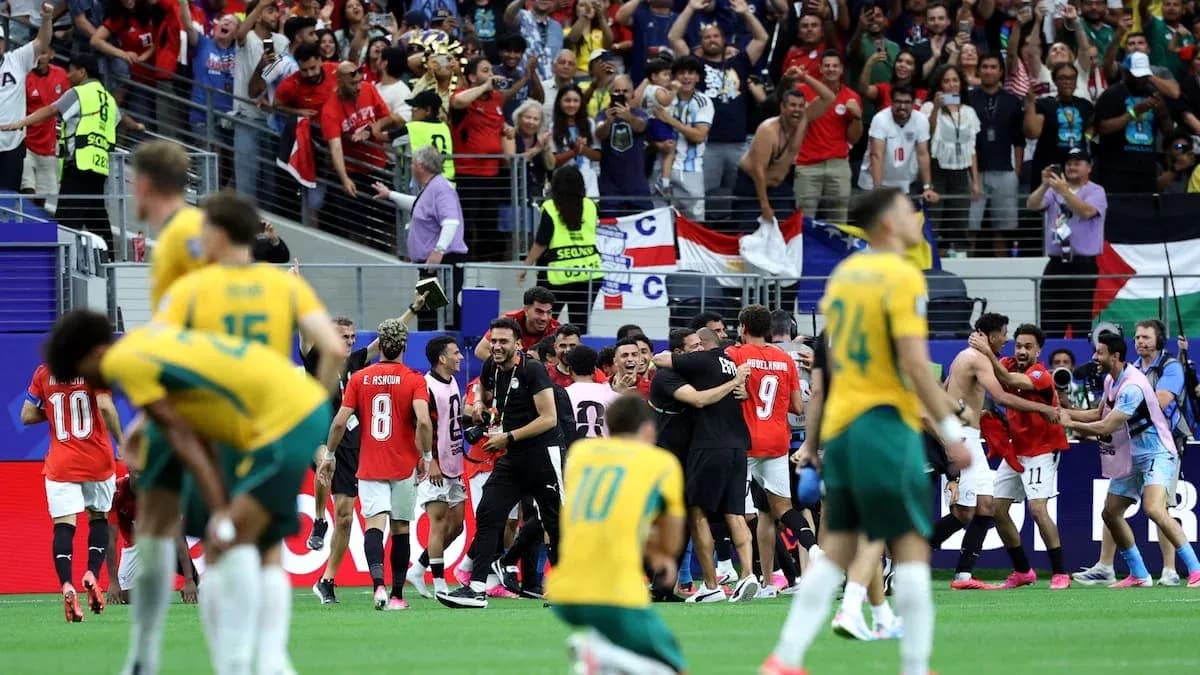
Then 18-year-old defender Lucas Herrington walked forward with the weight of a nation on his shoulders. He went high, too high, his effort cannoning off the bar. Egypt could see the line now. Abdelmaguid stepped up, ignored the chaos around him, and drilled his penalty home to send Egypt through and send Salah to the turf in tears of joy, while Australian players sank to their knees in disbelief.
For all the drama of the shootout, the story had started far earlier.
Egypt strike first, Australia rattled
Emam Ashour lit the fuse after just 13 minutes. Australia switched off at the back post, Nestory Irankunda lost his man, and Ashour ghosted in to meet Karim Hafez’s cross with a firm header. One chance, one ruthless finish. His second goal of the tournament, and a lead that felt enormous against a side that had scored only twice in the group stage.
The goal changed everything. Australia, naturally cautious and short of cutting edge, suddenly had to chase. Egypt, fresh from their first ever World Cup win in the group phase against New Zealand, looked jittery at the back but dangerous when they broke.
Cristian Volpato almost ripped up the script inside the opening five minutes. The playmaker, who chose Australia over Italy on the eve of the World Cup, drifted into space and unleashed a vicious strike that thundered against the top of the crossbar. It was a warning that Australia had more than muscle.
Yet clear chances dried up. Aziz Behich finally forced Mostafa Shoubir into a save 10 minutes before the interval, but his low effort was tame, straight at the goalkeeper whose father, Ahmed, had guarded Egypt’s net at the 1990 World Cup.
The half ended with another blow for Popovic. Jordan Bos, one of the quickest players at the tournament and a constant outlet down the flank, was left in a heap after a fierce, flying challenge from Rabia. He did not re-emerge after the break, replaced by Kai Trewin, and with him went a chunk of Australia’s attacking thrust.
Salah, meanwhile, barely flickered. The 34-year-old talisman, wrapped in cotton wool after his hamstring problem, cut a frustrated figure in an attritional first 45 minutes. Egypt led, but their star man was a shadow.
Australia drag it back, Egypt push again
Seconds after the restart, Egypt should have slammed the door. Omar Marmoush, the Manchester City attacker, slid in at close range and somehow guided his finish off target. It felt like a miss that might haunt them.
It did not take long for Australia to punish that wastefulness.
Egypt’s coach had warned about Australia’s physical edge, and it told from a set-piece. An in-swinging free-kick caused chaos, bodies crashed together, and Mohamed Hany, under heavy pressure, could only glance a header into his own net. His second own goal of the tournament, and Australia were level.
The game changed again. Both sides suddenly saw history in front of them. Neither had ever won a knockout match at a men’s World Cup. One goal, one moment, would rewrite decades of frustration.
Salah stayed on the fringes but finally flickered into life late in normal time. In the dying seconds, he linked neatly in the build-up to a move that ended with Patrick Beach flinging himself across his goal to claw away Ramy’s effort. It was a superb, instinctive save that dragged the contest into extra time.
Egypt finished the 90 minutes in the ascendancy. They carried that momentum into the additional half-hour. Salah, on his weaker right foot, lashed one effort well over early in extra time. The legs grew heavier, the passes looser, and the inevitability of penalties crept in with every tired sprint.
Neither side could find the punch to finish it. So it came down to nerve, to technique, to the cold, lonely walk from the centre circle.
Australia rolled the dice with Ryan. Egypt trusted their rhythm.
In the end, the story belonged to Salah’s calm, Herrington’s crossbar, and Abdelmaguid’s final strike — and to an Egypt side that finally learned how to win when everything is on the line.