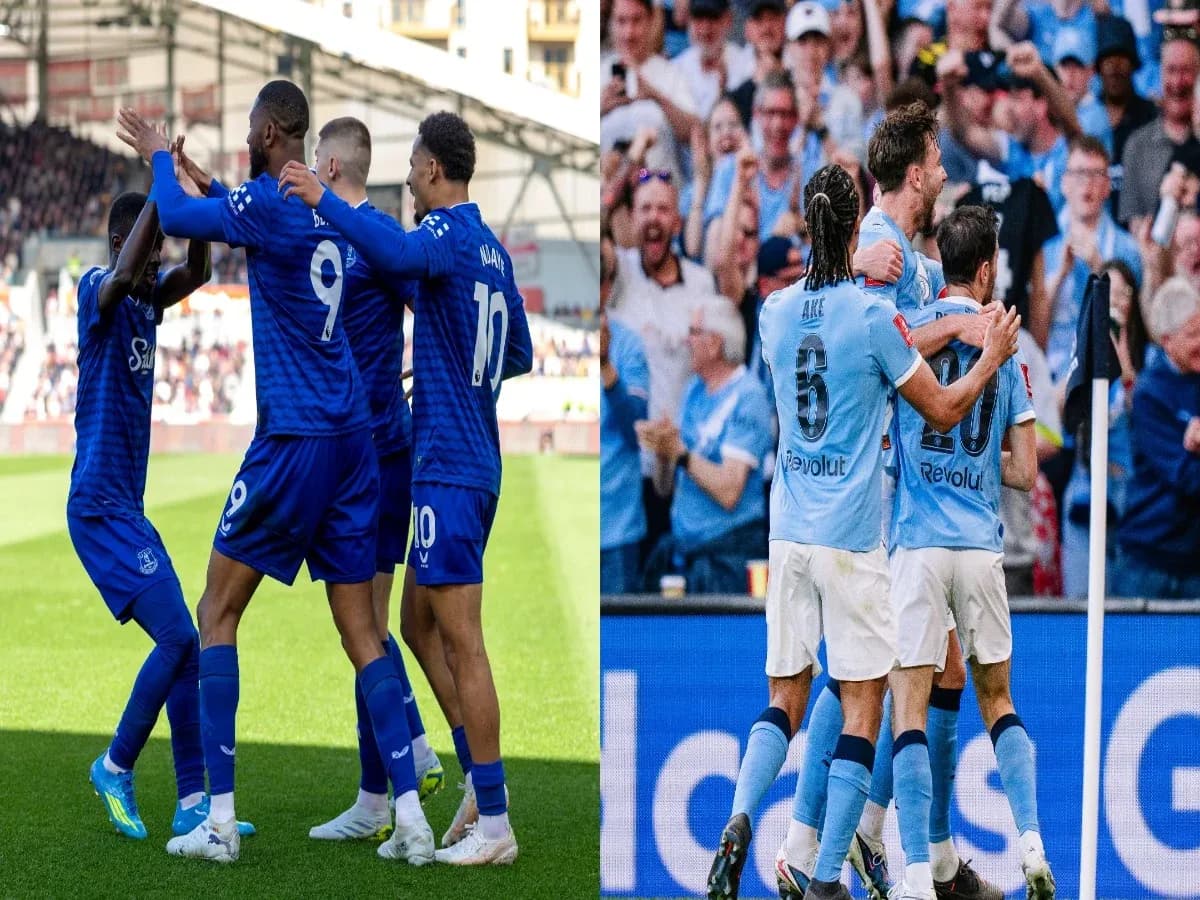
Everton and Manchester City Share Points in Thrilling 3–3 Draw
Everton and Manchester City produced a wild 3–3 draw at Hill Dickinson Stadium in Premier League Round 35, a match that swung violently against the run of possession. City dominated the ball and structure for long stretches, yet Everton’s direct, transitional 4‑2‑3‑1 repeatedly ripped through them in the second half. From 0–1 down at half-time, Leighton Baines’ side surged to 3–1 ahead between 68' and 81', only for Pep Guardiola’s team to salvage a point with late interventions from the bench and a stoppage‑time equaliser. The statistical contrast was stark: City’s control versus Everton’s punch and set‑piece‑style chaos.
The scoring opened on 43' when J. Doku cut through Everton’s right side to finish a move created by R. Cherki, giving Manchester City a 0–1 lead that reflected their territorial dominance. At 45', Michael Keane collected a yellow card for a foul, signalling Everton’s growing desperation as they went into the break trailing 0–1.
After half-time, Everton’s aggression intensified. Beto was booked for a foul on 48', followed by James Tarkowski’s yellow, also for a foul, on 53'. The disciplinary pattern underlined Everton’s willingness to break City’s rhythm physically.
The turning point came with Leighton Baines’ first substitution: on 64', T. Barry (IN) came on for Beto (OUT). Four minutes later, at 68', Barry justified the change by scoring Everton’s equaliser, finishing a direct Everton attack with no credited assist. The momentum flipped fully at 73', when right-back J. O'Brien surged forward and converted from a J. Garner assist to make it 2–1.
Tension spiked at 74'. Gianluigi Donnarumma received a yellow card for argument, reflecting City’s frustration. In the same minute, City adjusted: P. Foden (IN) came on for A. Semenyo (OUT). A minute later, on 75', M. Kovacic (IN) replaced Nico (OUT), reshaping City’s double pivot and adding progression from deep.
Everton’s counter-attacking threat did not subside. On 81', Barry struck again, his second unassisted goal, to push Everton 3–1 up, punishing City’s high line and slow rest defence. City responded immediately: on 83', E. Haaland converted from a Kovacic assist, narrowing it to 3–2 and validating Guardiola’s midfield change.
Everton’s defensive strain showed on 86', when Jake O'Brien was booked for a foul, the fourth Everton yellow. City made a final attacking switch on 87': O. Marmoush (IN) came on for B. Silva (OUT), adding another forward runner.
Baines then moved to lock the game down in stoppage time. At 90+2', N. Patterson (IN) replaced M. Rohl (OUT), and C. Alcaraz (IN) came on for K. Dewsbury-Hall (OUT), signalling a shift toward defensive solidity and fresh legs in midfield. At 90+6', H. Armstrong (IN) entered for T. Iroegbunam (OUT), another late midfield adjustment.
Yet City found a final answer. At 90', J. Doku scored his second, assisted by M. Guehi, to make it 3–3. No VAR interventions were recorded, so the goal stood immediately, closing a breathless scoring sequence. The match finished with Everton on four yellow cards (Keane, Beto, Tarkowski, Jake O'Brien) and City on one (Donnarumma, argument).
Tactically, both sides lined up in 4‑2‑3‑1, but the application was radically different. Everton’s structure was compact and vertical. J. Pickford, with just 1 recorded save, had relatively little traditional shot-stopping to do given City’s 4 shots on goal from 20 total attempts; much of his work was in claiming crosses and organising a deep block. His goals prevented figure of 0.74 suggests he marginally outperformed the xG he faced, but City’s shot profile was often from suboptimal angles despite their volume.
The Everton back four of V. Mykolenko, M. Keane, James Tarkowski and J. O'Brien defended deep, with Tarkowski and Keane accepting aggressive duels that produced two of the yellows. O'Brien was pivotal at both ends: his 73' goal came from a late run from right-back, and his 86' booking showed how stretched he became as City pushed wide and high.
In midfield, T. Iroegbunam and J. Garner formed a double pivot tasked with screening Haaland and contesting second balls. Garner’s assist for O'Brien’s goal highlighted his passing range in transition. Ahead of them, M. Rohl and K. Dewsbury-Hall acted as press triggers, while I. Ndiaye floated to connect with Beto. Everton’s attacking plan revolved around quick vertical passes into Beto and the half-spaces, followed by wide overloads once City’s full-backs were drawn high.
The game’s decisive swing came from the bench. T. Barry’s introduction for Beto shifted Everton’s attack from a target-man reference to a mobile, space-attacking threat. Barry’s brace at 68' and 81' exploited the channels behind City’s advanced full-backs and the gaps between centre-back and full-back, especially as City committed more numbers forward.
For City, G. Donnarumma’s 3 saves and identical 0.74 goals prevented underline that Everton’s 6 shots on target were high quality; the keeper kept the scoreline manageable despite the chaos in front of him. The back four of N. O'Reilly, M. Guehi, A. Khusanov and M. Nunes spent long periods in Everton’s half, compressing play, but were repeatedly exposed in defensive transitions.
The Nico–B. Silva double pivot controlled early possession, but lacked the defensive balance once Everton began breaking lines. The introduction of M. Kovacic for Nico added progressive passing and led directly to Haaland’s 83' goal, while P. Foden’s arrival for A. Semenyo sharpened City’s attacking combinations between the lines. J. Doku, operating from the left, was City’s primary one‑v‑one outlet, and his two goals (43' and 90') framed the match: the opener from structured dominance, the equaliser from late, desperate pressure.
Haaland’s central presence pinned Everton’s centre-backs and created space for Doku and R. Cherki to attack from the flanks and half-spaces. Marmoush’s late introduction for B. Silva further tilted City into a 4‑1‑4‑1/4‑2‑4 hybrid, with Kovacic orchestrating from deep and full-backs pushed very high.
Statistically, the game underlined a clear stylistic clash. Manchester City held 75% possession, completing 551 of 610 passes at 90% accuracy. They generated 20 shots (4 on target), with an xG of 1.37. Everton, by contrast, had just 25% of the ball and 200 passes at 69% accuracy, but produced 14 shots, 6 on target, and a significantly higher xG of 2.77. Everton’s 15 fouls and 4 yellows contrasted with City’s 5 fouls and single yellow for argument, reflecting Everton’s reliance on disruption.
Despite City’s territorial control and superior passing metrics, the xG gap suggests Everton created the clearer chances, largely through transitions and Barry’s incisive runs. The identical goals prevented values (0.74 for each keeper) highlight that both defences allowed more than the raw shot numbers suggest. In the end, City’s Overall Form metrics in possession were superior, but Everton’s Defensive Index and transition efficiency nearly delivered an upset before Doku’s stoppage‑time intervention restored parity.