Fenerbahçe Dominates Gornik Zabrze in Tactical Battle
Fenerbahçe’s 1-0 win over Gornik Zabrze at Chobani Stadium was a tactical siege: a dominant positional performance that produced only a single breakthrough, yet almost completely suppressed any threat at the other end. In the context of a UEFA Champions League 2nd Qualifying Round tie, Ismail Kartal’s side established clear structural superiority with the ball, while Michal Gasparik’s Gornik retreated into a deep, survival-oriented 4-3-3 that often looked like a 4-5-1 without possession.
Fenerbahçe’s 4-2-3-1 was built for total control. The back four of N. Semedo, M. Skriniar, N. Ake and J. Oosterwolde operated on an extremely high line, compressing the pitch and keeping Gornik’s front three pinned back. The double pivot of M. Guendouzi and B. Elmaz acted as the engine of the dominance: Fenerbahçe completed 765 passes with 703 accurate (92%), and that volume flowed primarily through these two, recycling possession and constantly shifting the point of attack.
Ahead of them, the trio of I. Kahveci, Fred and K. Akturkoglu, with Talisca as the nominal striker, created a flexible attacking square between the lines. Fred, listed as a midfielder, frequently drifted into half-spaces to overload whichever side the ball was on, while Talisca dropped off the last line to receive between Gornik’s midfield and defence. This movement forced Gornik’s central trio of L. Sadilek, M. Dietz and K. Urbanski to collapse centrally, opening corridors for full-backs Semedo and Oosterwolde to advance and provide width.
The statistical profile underlines how suffocating this structure was. Fenerbahçe had 79% possession, 15 total shots with 6 on goal and 4 blocked, and 6 efforts from inside the box. That combination speaks to a team that not only circulated the ball but consistently reached the final third and penalty area. The 9 corner kicks reflect repeated territorial gains and sustained pressure, with Gornik defending deep phases for long stretches.
Gornik Zabrze’s 4-3-3, in contrast, functioned almost entirely as a defensive shell. With just 21% possession and only 203 passes (148 accurate, 73%), their primary objective was to deny central progression and protect the penalty area. The front three of Y. Ikia Dimi, E. Prekop and M. Khlan were largely detached from build-up, often forced to drop into the midfield line to help close spaces, which left them with minimal transition outlets. The result was a paltry attacking return: 2 total shots, 1 on goal and 1 blocked, with only a single attempt from inside the box.
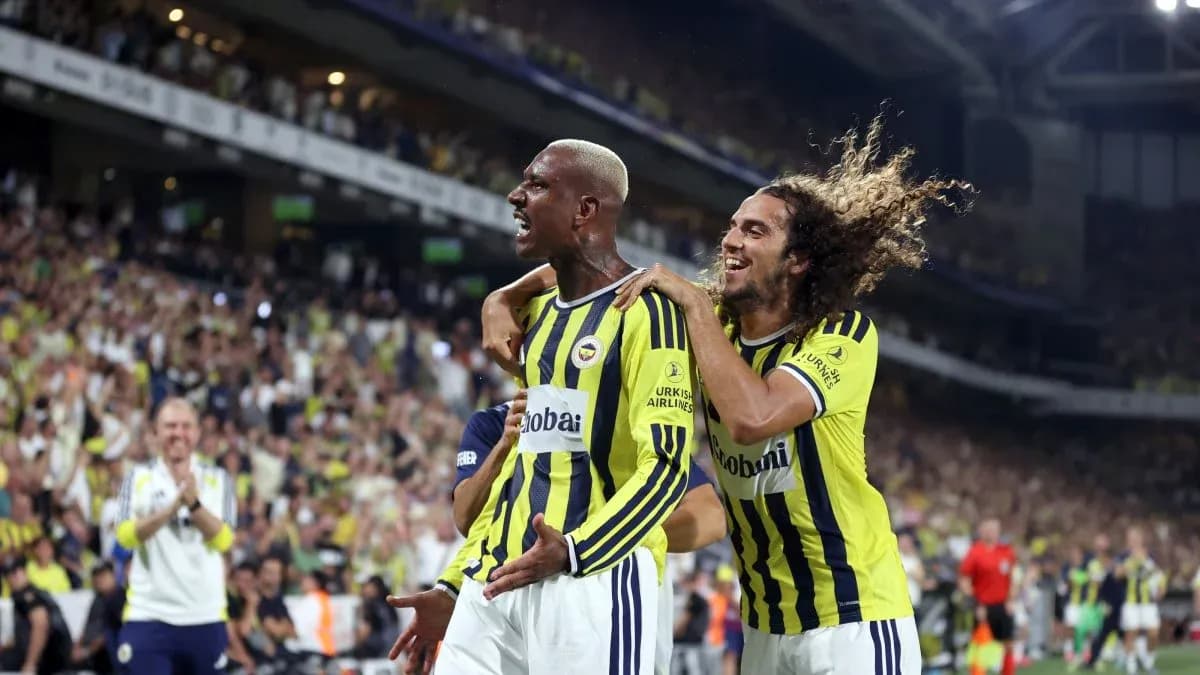
The lone goal, a 37th-minute strike by Talisca, was the logical outcome of Fenerbahçe’s positional superiority. By that point, the home side had already established rhythm and territory; Gornik’s block had been repeatedly stretched horizontally by full-back overlaps and vertically by Talisca’s movement off the front line. When the opening finally came, it was less about a single moment of chaos and more about cumulative structural pressure eventually cracking a compact but overworked defence.
Defensively, Fenerbahçe’s control was as much about rest defence as it was about classic back-line work. With the high line anchored by Skriniar and Ake, and Guendouzi screening in front, they were able to counter-press quickly after losses. Gornik’s 11 fouls compared to Fenerbahçe’s 15 are telling: the home side’s fouls often came from aggressive counter-pressing in advanced zones, while Gornik’s were more about halting combinations and runs near their own box.
The goalkeeping dimension, while statistically light, still matters tactically. M. Gunok (Fenerbahçe) faced just 1 shot on goal and made 1 save, a direct product of the team’s territorial dominance and compact rest defence that prevented Gornik from generating volume or quality in the final third. At the other end, P. Schulze (Gornik Zabrze) made 5 saves, underpinning a performance where he was repeatedly called upon to keep the tie alive despite the imbalance in play. His workload reflects how often Fenerbahçe were able to turn possession into shots on target, even if they could not extend the scoreline.
Substitutions in the second half were primarily about energy management and maintaining the tactical template rather than altering it. At 46', L. Mercan (IN) came on for N. Ake (OUT), a like-for-like defensive adjustment that preserved the back-four structure while refreshing legs in a role that demanded constant high positioning. On 69', M. Asensio (IN) replaced B. Elmaz (OUT), and O. Aydin (IN) came on for K. Akturkoglu (OUT), moves that injected fresh creativity and vertical running into the attacking midfield band without changing the 4-2-3-1 skeleton.
Later, at 83', M. Greenwood (IN) replaced I. Kahveci (OUT), and at 87', S. Cherif (IN) came on for Talisca (OUT). These late changes ensured Fenerbahçe could maintain a front-line press and hold the ball higher up the pitch, protecting the 1-0 lead through possession rather than retreating. The structure remained consistent: a lone striker supported by three advanced midfielders, with full-backs high and a double pivot controlling transitions.
Gornik’s substitutions at 72' and 76' — S. Liseth (IN) for K. Urbanski (OUT), O. Zmrzly (IN) for Y. Ikia Dimi (OUT), and B. Donio (IN) for M. Dietz (OUT) — suggested an attempt to add fresh running and perhaps more direct threat, but the underlying issue remained their inability to progress the ball under Fenerbahçe’s pressure. A final change at 90+2', with P. Warczak (IN) for M. Khlan (OUT), came too late to reshape the attacking pattern.
In the end, this match was defined less by drama and more by control. Fenerbahçe used their 4-2-3-1 to monopolize possession, compress space and repeatedly access the final third, while Gornik Zabrze’s 4-3-3 was forced into a reactive, low-possession stance. The 1-0 scoreline underrepresents the tactical gap, but for a two-legged Champions League qualifier, the key takeaway is clear: Fenerbahçe have a stable, ball-dominant structure that can both create and, crucially, almost entirely deny chances at the other end.