France's Tactical Control in 3-1 Victory Over Senegal
France’s 3-1 win over Senegal at MetLife Stadium was a controlled, structurally coherent performance built off a 4-2-3-1 that steadily wore down Senegal’s own 4-2-3-1. The scoreline reflects France’s territorial and qualitative edge in the final third, but the underlying numbers show a match that was more about efficiency and execution than sheer dominance: 53% possession, an 11–6 shot count and an xG of 1.79 to 0.53.
France’s shape was classic Didier Deschamps pragmatism with a more attacking twist. Aurélien Tchouaméni and Adrien Rabiot formed a double pivot that gave license to the three advanced midfielders — Michael Olise, Ousmane Dembélé and Désiré Doué — to occupy high and narrow pockets around Kylian Mbappé. In practice, this often morphed into a 2-3-5 in sustained possession: Theo Hernández advanced aggressively from left-back, with Jules Koundé more conservative on the right, creating an asymmetry that tilted France’s attack toward the left half-space and central channels.
The numbers back that control. France completed 505 of 575 passes (88%), using that security to patiently probe rather than force vertical balls. Only 11 total shots, but 8 on target, underline how France focused on high-quality shot selection rather than volume. The 7 shots inside the box versus just 4 from outside reflect a deliberate attempt to play through Senegal’s block rather than settle for long-range efforts.
Senegal’s 4-2-3-1, with Idrissa Gana Gueye and Pape Gueye as the initial screen, aimed to compress central spaces and spring transitions through Sadio Mané, Ismaïla Sarr and Nicolas Jackson. In the first hour, this worked reasonably well: France had more of the ball but Senegal limited clear chances and kept the game in a low-event state. Senegal’s 47% possession and 502 passes (430 accurate, 86%) show they were not simply sitting deep; they tried to build, but France’s counter-press, led by the front four, often forced them wide or backwards, capping them at just 6 shots and 0.53 xG.
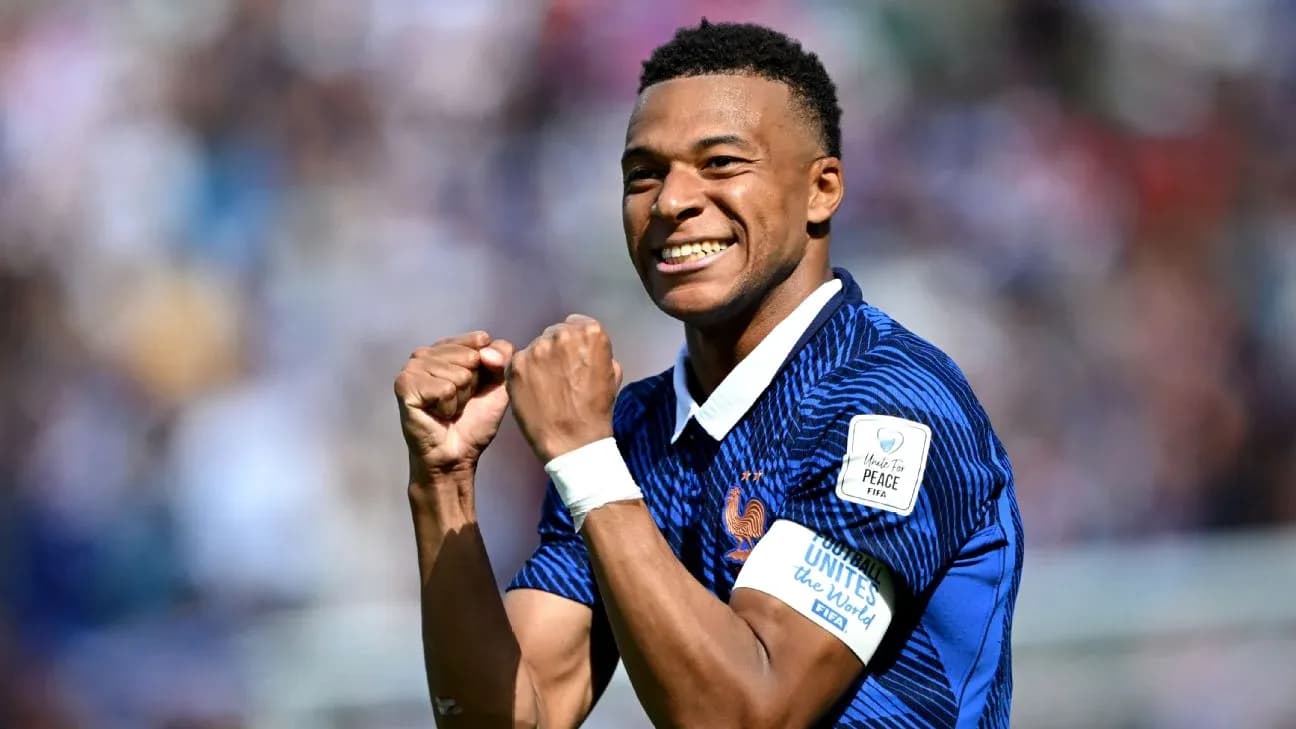
The turning point came around the hour. At 60', a potential France penalty involving Mbappé was cancelled by VAR, but that sequence marked a shift in pressure and territory. France’s attacking midfielders began to receive between the lines more frequently, dragging Senegal’s double pivot out of shape. The 66' opener — Mbappé finishing from an Olise assist — encapsulated the plan: occupation of the half-spaces, quick combination, then a decisive final action from their star forward.
From there, Deschamps’ substitutions sharpened the attacking edge rather than protecting the lead. Bradley Barcola (IN) came on for Ousmane Dembélé (OUT) at 80', giving France a fresh, direct runner on the flank. Within two minutes, France converted that momentum: at 82', Barcola (France) finished a move assisted by Rabiot, making it 2-0. The pattern again highlighted France’s ability to overload central zones, then exploit the wide channels once Senegal’s back line was compressed.
Bouna Thiaw Pape’s response was to inject more attacking profiles. For Senegal, Ibrahim Mbaye (IN) came on for Ismaïla Sarr (OUT) at 75', Habib Diarra (IN) for Lamine Camara (OUT) at 76', Ahmadou Bamba Dieng (IN) for Nicolas Jackson (OUT) at 83', Iliman Ndiaye (IN) for Pape Gueye (OUT) also at 83', and Pathé Ismaël Ciss (IN) for Idrissa Gana Gueye (OUT) at 88'. These changes tilted Senegal towards a more aggressive, risk-taking posture, but they also opened transition lanes that France exploited in added time.
France’s third goal at 90+6', again from Mbappé without an assist, was the logical outcome of that stretched game state: France springing into space against a more disjointed Senegal structure. Senegal’s consolation at 90+5', scored by Ibrahim Mbaye from an Iliman Ndiaye assist, showed that their bench did add some late attacking thrust, but by then the tactical battle was largely decided.
In goal, Mike Maignan (France) made 2 saves. That modest number speaks to the effectiveness of the French defensive block in front of him: 6 total shots conceded, only 2 on target, and just 1 blocked shot required. France’s centre-back pairing of Dayot Upamecano and William Saliba benefited from strong protection from Tchouaméni and Rabiot, who limited clean entries into the central zone where Nicolas Jackson could threaten.
Edouard Mendy (Senegal), by contrast, was far busier, registering 5 saves. France put 8 shots on target from 11 attempts, meaning Mendy was under frequent, high-quality pressure. Senegal’s back four — with Kalidou Koulibaly and Moussa Niakhaté central — often had to defend large spaces, especially once Senegal pushed higher in the second half. The fact that both teams share the same goals prevented value (-0.94) despite very different shot volumes underlines that France’s finishing was clinical relative to the model, while Senegal slightly outperformed their limited xG through Mbaye’s late goal.
Discipline also fed into the tactical rhythm. With France committing just 5 fouls to Senegal’s 9, Deschamps’ side managed to sustain pressure without breaking their structure or conceding many set-piece situations, while Senegal’s higher foul count reflected the strain of containing France’s rotations between the lines and in wide channels.
Statistically, France’s 1.79 xG versus Senegal’s 0.53 confirms that the 3-1 scoreline slightly flatters France in terms of finishing but accurately reflects territorial and chance quality superiority. France’s higher pass volume, better accuracy, and more shots inside the box all point to a side that controlled both the ball and the spaces that mattered. Senegal’s structure kept them competitive for an hour, but once France’s positional play began to consistently access central pockets and Deschamps layered in fresh attacking options, the tactical balance swung decisively toward the eventual 3-1 outcome.