Iran and New Zealand Draw 2-2 in Tactical Stalemate
Iran and New Zealand shared a 2-2 draw at SoFi Stadium in a match that swung repeatedly on wide play, counter-attacks and structural tweaks rather than sheer volume of possession. New Zealand’s 4-2-3-1 had a slight territorial edge with 52% of the ball and higher pass accuracy, but Iran’s 4-4-2 generated more total shots (17 to 14) and more blocked efforts, reflecting sustained pressure phases. Both sides’ goalkeepers were tested – New Zealand more often – and the contest evolved into a tactical arm-wrestle between Iran’s crossing-heavy, front-two approach and New Zealand’s more patient, central progression through a single striker supported by a fluid band of three.
I. Executive Summary
Iran set up in a classic 4-4-2 under Amir Ghalenoei, with Shahriar Moghanlou and Mehdi Taremi leading the line and wide midfielders asked to drive play into the box. New Zealand, in D. Bazeley’s 4-2-3-1, relied on Chris Wood as a reference point, with Elijah Just, Sarpreet Singh and Callum McCowatt rotating behind him. New Zealand struck first through E. Just, Iran replied via Ramin Rezaeian, and the second half mirrored the first: Just again, then Mohammad Mohebi. The 2-2 outcome was a fair reflection of two contrasting attacking models that produced similar quality chances (xG 1.5 vs 1.24) despite different rhythms of possession and passing.
II. Scoring Sequence & Disciplinary Log
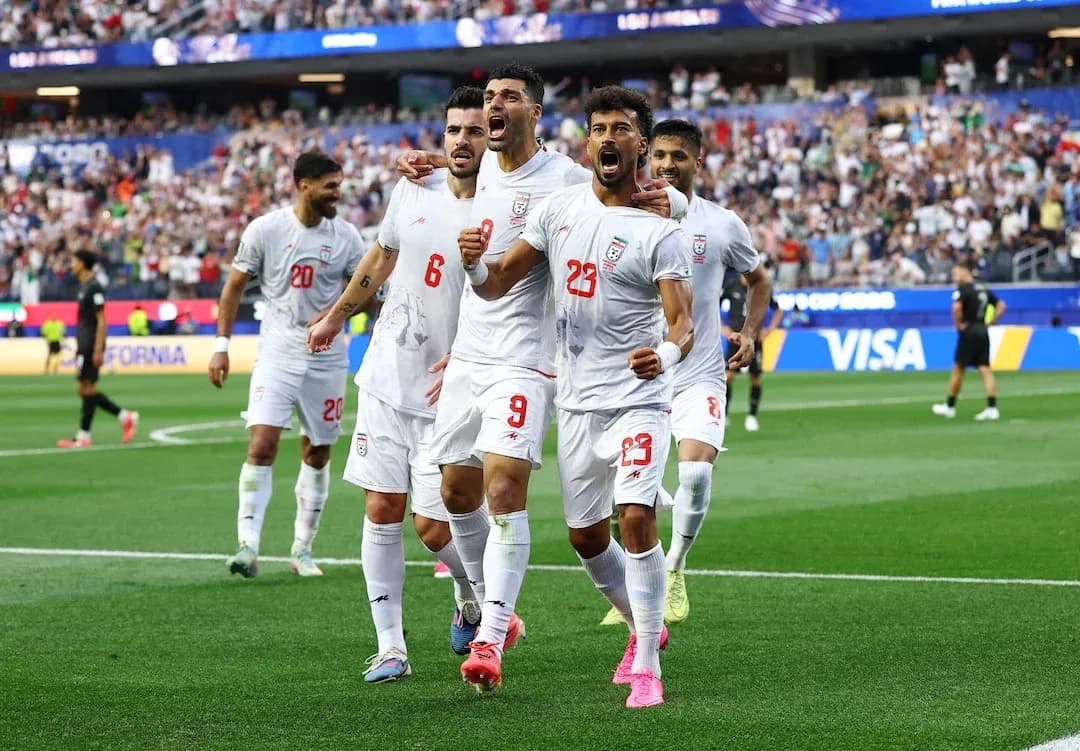
The match opened with New Zealand executing their 4-2-3-1 blueprint perfectly. At 7', Elijah Just (New Zealand) finished a move assisted by Chris Wood, a typical pattern of Wood dropping or pinning defenders while the wide attacking midfielder attacked the space. Iran’s response was methodical rather than frantic: using their 4-4-2, full-backs advanced and the wide midfielders tucked in, gradually forcing New Zealand deeper. The pressure told at 32', when Ramin Rezaeian (Iran) equalised, underlining how aggressively Iran’s right-back was allowed to join attacks.
The second half began with Iran adjusting personnel but keeping structure, and New Zealand once again struck first. At 54', Elijah Just (New Zealand), again assisted by Chris Wood, restored the lead, a near-copy of the first goal in terms of roles: Wood involved as the facilitator, Just arriving from the line of three. Iran’s answer at 64' was a clear example of synergy between full-back and winger: Mohammad Mohebi (Iran) scored with an assist from Ramin Rezaeian, showcasing Iran’s right-sided overloads and crossing threat from deeper wide zones.
Discipline was minimal and almost entirely one-sided. The only card of the match came at 89':
89' Ehsan Hajsafi (Iran) — Tripping
New Zealand finished without a single card, reflecting a controlled defensive approach that relied more on positioning than aggressive duels.
III. Tactical Breakdown & Personnel
Iran’s 4-4-2 was built around width and volume of entries into the box. With 17 total shots, 10 from inside the box and 5 blocked, Iran spent long stretches pinning New Zealand back. The right flank was the primary weapon: Rezaeian, nominally a right-back, effectively functioned as an auxiliary playmaker and finisher, scoring once and assisting Mohebi. The wide midfielders, Mohebi and Aria Yousefi, narrowed in possession, freeing the full-backs to overlap and deliver. Central midfielders Saeid Ezatolahi and Saman Ghoddos provided the platform, recycling possession and stepping into half-spaces when New Zealand’s double pivot was drawn wide.
Out of possession, Iran’s front two sought to screen New Zealand’s first pass into midfield, but the 4-4-2 line occasionally left pockets between midfield and defence where New Zealand’s No. 10 and wide playmakers could receive. This was especially visible on both Just goals, where Iran’s back four were forced to defend facing their own goal after New Zealand bypassed the first line.
New Zealand’s 4-2-3-1 was more patient and technically secure. With 446 total passes to Iran’s 405 and an 85% completion rate (377 accurate) compared to Iran’s 77% (312 accurate), they controlled tempo better, especially through Joe Bell and Marko Stamenic as the double pivot. These two anchored transitions, allowing the attacking trio of McCowatt, Singh and Just to rotate and attack gaps between Iran’s lines. The plan clearly revolved around Chris Wood as the focal point: he was the outlet for direct balls and the lay-off target in structured attacks, assisting both goals by drawing defenders and freeing Just.
Defensively, New Zealand’s back four stayed relatively narrow, conceding some space to Iran’s full-backs but protecting central zones. That trade-off explains Iran’s high shot volume and blocked shots but also New Zealand’s ability to limit truly clear-cut chances to roughly parity in xG. Substitutions – notably Benjamin Old for Liberato Cacace and Ryan Thomas for Callum McCowatt – were like-for-like adjustments to maintain energy and defensive coverage in wide areas rather than structural shifts.
In goal, Alireza Beiranvand (Iran) faced 8 shots on target and made 6 saves, a workload that underlines how dangerous New Zealand were when they broke Iran’s midfield line. His shot-stopping kept Iran in the game after both New Zealand leads. At the other end, Max Crocombe (New Zealand) had 4 saves to make, and while he conceded twice, the underlying metric of goals prevented at -0.2 suggests the finishes Iran found were slightly above what would be expected from the chances conceded.
IV. The Statistical Verdict
The numbers frame this as a balanced, stylistic contrast rather than a mismatch. Iran’s 48% possession with 17 shots indicates an efficient, vertical use of the ball, leaning on quick progression to the front two and aggressive full-back involvement. Their xG of 1.5 aligns closely with the two goals scored, suggesting they converted at roughly expected levels. New Zealand, with 52% possession and 14 shots, were more selective but more accurate in testing the goalkeeper, putting 8 on target. Their xG of 1.24 against two goals points to slightly above-average finishing, especially from Just.
Fouls (Iran 10, New Zealand 8) and the single yellow card for Iran reflect a match that was competitive but not overly physical. Corner counts (4-1 to Iran) further support the picture of Iran applying territorial pressure, especially through wide attacks that forced blocks and clearances. The goals prevented figures of -0.2 for both sides reinforce the notion that finishing quality, rather than goalkeeping heroics, drove the scoreline.
Overall, Iran’s crossing-heavy 4-4-2 and New Zealand’s structured 4-2-3-1 produced a tactical stalemate where each team’s primary attacking mechanism repeatedly found joy but could not deliver a decisive advantage.