Germany's Journey from Villains to Beloved Champions
For generations, Germany were the team the world loved to resent.
They broke hearts in black and white. First Ferenc Puskas’ magical Hungary in 1954, then Johan Cruyff’s breathtaking Netherlands in 1974 – two sides many still call the greatest Europe has produced, both denied at the final hurdle by a German team that refused to bow to romance.
By the 1980s, the image was set in stone. Cynical. Clinical. Ruthless. Spain ’82 brought “The Disgrace of Gijon”, when Germany and Austria contrived a result that froze Algeria out. Then Harald “Toni” Schumacher’s brutal collision with Patrick Battiston in the semi-final against France seared itself into football’s conscience.
Sympathy never followed. Trophies did.
Germany kept winning: Euro 1980, the 1990 World Cup, Euro ’96. Gary Lineker’s famous line captured the mood: “Football is a simple game. 22 men chase a ball for 90 minutes, and in the end, the Germans always win.” They were efficient, admired, but rarely loved.
That started to change with a smile and a song.
From villains to hosts the world embraced
The 2006 World Cup on home soil rewrote the script. Germany staged a festival. A “summer fairy tale” that transformed the country’s image. The team, young and daring, fell in the semi-finals to Italy, but they had opened their doors and their hearts. The world noticed.
Four years later in South Africa, the new Germany went global. Mesut Özil, Thomas Müller, Manuel Neuer and a fearless generation played thrilling football, tearing England and Argentina apart before narrowly losing to eventual champions Spain. They didn’t just compete. They entertained.
By the time the 2014 World Cup loomed, Germany arrived in Brazil with a clear mission: win the trophy, and win over the hosts.
The red-and-black gambit
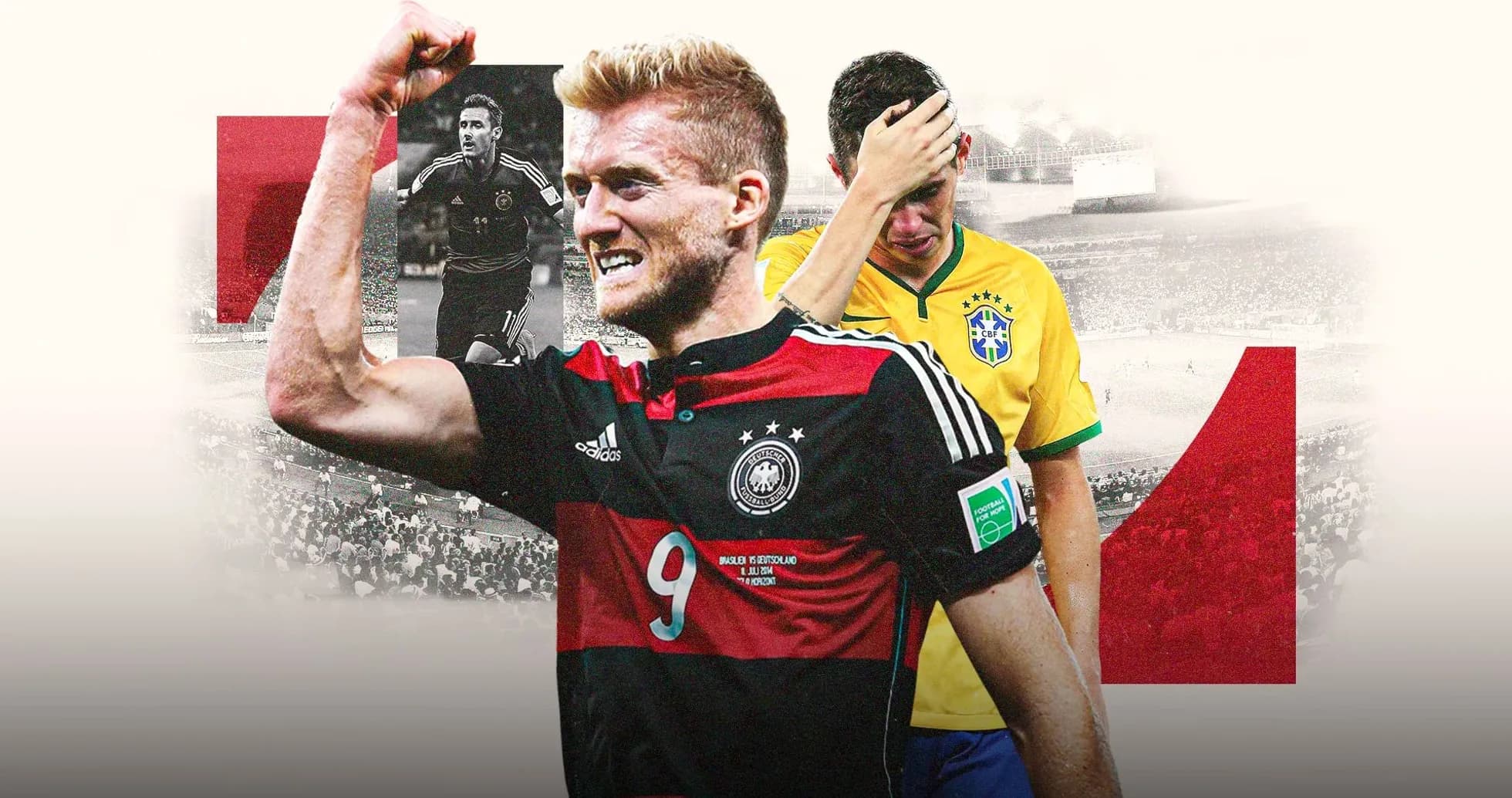
“Your jersey for Rio,” the DFB announced in February 2014. Out came a new away kit: bold red and black hoops, unmistakably echoing Flamengo’s iconic colours. For decades, Germany’s change strip had been mostly green. Sometimes red. Sometimes black. Never this.
“The new jersey looks great and reminds me of the Flamengo Rio de Janeiro kit,” said Mesut Özil. “It’s sure to bring us luck for the World Cup in Brazil.”
It was more than marketing. It was a calculated nod to the country’s most popular club, and to the city that would host the final.
Brazil reacted instantly.
“When the German jersey in the colours of Flamengo was unveiled, I decided to cheer for Germany,” a fan told local daily O Dia. The shirt sparked a frenzy. Within weeks, it was a bestseller. Sports shops in Rio de Janeiro ran out. Counterfeit versions flooded the Copacabana. The red-and-black Germany shirt became part of the local landscape.
Back in Germany, Bastian Schweinsteiger posed at Bayern Munich’s training ground in an original Flamengo jersey, playing up the connection. The message was clear: we’re not just visitors. We’re with you.
One man in Rio took it even further. German expat Bernhard Weber, better known as MC Gringo, turned the new look into a soundtrack. Inspired by the shirt, he released “Deutscher Fussball ist geil, beweg’ dein Hinterteil” (“German football is awesome, move your bum”). In the video, he danced through Rio’s streets, beaches, markets and favelas, singing in Portuguese and German, wearing the red-and-black Germany jersey, a Flamengo cap and accompanied by a scantily clad Brazilian woman.
The song caught on. It played on Brazilian television and in beach bars. Germany, improbably, were becoming part of the local pop culture.
Campo Bahia and the human touch
When the team finally landed in Brazil at the start of June, they didn’t disappear behind hotel gates. They moved into Campo Bahia, a purpose-built base, and made a point of engaging with the community.
Schweinsteiger and Neuer danced with locals to the anthem of a regional club from Bahia. The squad attended social events, mingled, smiled, listened. Brazilian sports journalist Renato Costa told Deutsche Welle: “You can tell that the DFB team has taken an interest in Brazil and is making a lot of effort.”
This was deliberate. Germany wanted to be seen not as aloof contenders, but as respectful guests.
On the pitch, they backed it up.
They opened with a statement: a 4-0 demolition of Portugal, Müller helping himself to a hat-trick. A wild 2-2 draw with Ghana followed, a reminder that nothing comes easy at a World Cup. Then, for the first time, the much-discussed away kit appeared in a tight win over the United States that sealed top spot in the group.
They were through, but far from invincible. Algeria pushed them to the brink in the last 16, forcing extra-time before Germany finally found a way.
Brazil, meanwhile, were living on the edge. They topped their group, then survived a nerve-shredding penalty shootout against Chile in the last 16. The country exploded in relief. So did two Germans.
Videos of Schweinsteiger and Lukas Podolski celebrating with Brazilian flags went viral. They weren’t mocking. They were joining in.
Flamengo, Rio and a bond that grew
Brazil edged past Colombia in the quarter-finals but paid a brutal price: Neymar, their superstar and talisman, suffered a back injury and was ruled out. At the same time, Germany were heading to Rio de Janeiro – Flamengo’s city – for their quarter-final against France at the Maracanã.
Flamengo’s story runs deep in Brazilian football. Founded as a rowing club, it shifted its focus to football and, by the 1930s, had Leonidas – Brazil’s first true football icon and top scorer at the 1938 World Cup – leading the line. In 1981, Zico inspired Flamengo to their first Copa Libertadores and then the Club World Cup, sweeping aside Liverpool in Tokyo. From there, Flamengo grew into the country’s dominant popular force.
Mario Zagallo, Bebeto, Romario, Ronaldinho, Adriano, Vinicius Jr – the list of Brazilian stars who have worn the red and black is a roll call of attacking royalty. Recent years have only cemented their status: Brazilian league titles in 2019 and 2020, Copa Libertadores triumphs in 2019 and 2022, Copa do Brasil wins in 2022 and 2024.
Surveys estimate Flamengo have around 47 million fans – more than a fifth of Brazil’s population. They call themselves “the red and black nation.”
Germany knew exactly what they were tapping into.
Ahead of their first appearance at the Maracanã, Schweinsteiger and Podolski posted a photo from a balcony overlooking the Rio beach, both wearing Flamengo jerseys. It was a simple image, but it hit home.
Podolski in particular leaned into the connection. Throughout the tournament, he tweeted in Portuguese, shared photos with Ronaldo and Ronaldinho, and later kept interacting with Flamengo supporters on social media. Flamengo tried to sign him multiple times in the following decade.
“Everyone knows that I have loved Brazil since the World Cup, and especially the Flamengo club,” he told Globo Esporte.
On the pitch, the romance didn’t soften Germany’s edge. At Flamengo’s home ground, Podolski and company edged France 1-0, Mats Hummels’ powerful header proving decisive. The win set up the semi-final the world had anticipated: Brazil vs Germany.
By then, the red-and-black shirt had become a phenomenon. Local media reported that more than half a million Germany jerseys had been sold in Brazil, most of them in Flamengo colours. Sports daily Lance invited readers to send in photos of themselves wearing the red-and-black Germany kit. Adidas said sales were “exceeding all expectations” – in Brazil and back home.
The stage was set for history. No one imagined what was coming.
The 7-1 and a nation that chose its side
Belo Horizonte. Estadio Mineirão. A semi-final that began tense and quickly turned surreal.
Müller. Klose. Kroos. Kroos again. Khedira. After 29 minutes, the scoreboard read Brazil 0–5 Germany. The hosts were stunned. The world was speechless. Germany were dismantling Brazil in their own backyard.
At half-time, Joachim Löw urged his players to show restraint. They did, to a point. Substitute André Schürrle added two more in the second half before Oscar pulled one back. 7-1. A scoreline that felt like a misprint.
Germany celebrated, but not wildly. They understood the magnitude of the wound.
“Since 2006, we know how painful it is to lose a semi-final in your own country,” the DFB wrote in Portuguese on social media. “We wish you all the best for the future.”
The message was paired with images that would define the night: Schweinsteiger consoling David Luiz, Müller patting Dante on the back, Philipp Lahm comforting Oscar. And, above all, the heartbreaking figure of an elderly Brazilian fan with a moustache, clutching a replica World Cup trophy, tears streaming down his face in the stands.
Later identified as Clovis Acosta Fernandes, a devoted supporter who had followed Brazil around the world, he became the face of the tragedy. After the match, he posted a photo on Facebook of himself with Germany’s then-team manager Franz Beckenbauer at the 1990 World Cup, writing in German: “I hope that on Sunday you will lift the trophy in the sacred temple of football, the Maracana.”
It captured the mood. Despite the humiliation, much of Brazil turned towards Germany, not away from them.
“More Brazilian than Brazil”
As the final against Argentina approached, Brazilian opinion hardened in one direction. Their old rivals from across the River Plate were coming to the Maracanã. The hosts knew exactly where their loyalties lay.
The portal UOL went as far as to say Germany were “more Brazilian than Brazil”, pointing to their fluid style and, yes, those red-and-black jerseys. O Estado de São Paulo praised the “exceptional behaviour” of the Germans, adding that “they have learned to understand the spirit of this region.” Lance, the sports daily, cut to the chase on its front page: “We are all Germany.”
In the end, the World Cup final was tight, tense, and decided by a single moment. Mario Götze, off the bench, chested down André Schürrle’s cross and volleyed past Sergio Romero in extra-time. Germany 1–0 Argentina. A fourth World Cup title, sealed in Rio, in the “sacred temple” Clovis had mentioned.
They lifted the trophy to the roars of their own supporters and the applause of many Brazilians who had adopted them over that month.
Podolski, of course, marked it his way. He posed with the World Cup trophy wearing a Flamengo jersey, red and black gleaming under the stadium lights.
Germany had come to Brazil chasing history. They left with the title – and, improbably, a slice of the red and black nation in their corner.