Saudi Arabia Holds Uruguay to 1-1 Draw: Tactical Analysis
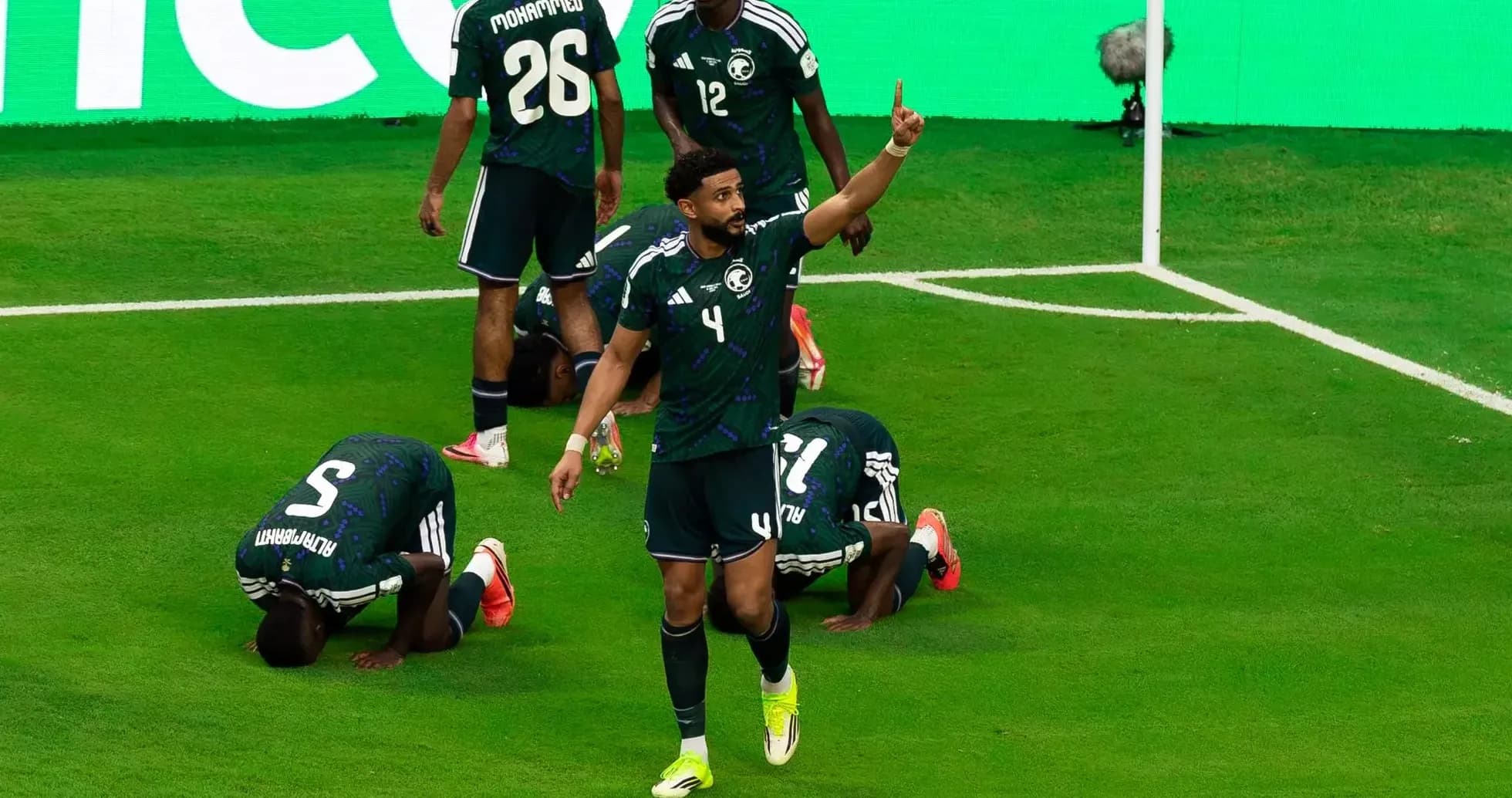
Saudi Arabia’s 1-1 draw with Uruguay at Hard Rock Stadium was a classic clash of control versus compactness. Uruguay, in a 4-2-3-1 under Marcelo Bielsa, dominated territory and tempo, but Saudi Arabia’s 4-4-2 block under Georgios Donis, anchored by a heroic night from Mohammed Al-Owais (Saudi Arabia), bent without breaking.
Uruguay’s structure was clear from the outset: a high-possession, high-volume shooting approach. With 67% of the ball and 612 passes (540 accurate, 88%), they built methodically from the back through Manuel Ugarte and Rodrigo Bentancur as the double pivot, using full-backs Guillermo Varela and Matías Viña to stretch Saudi Arabia’s narrow midfield four. Federico Valverde and Maximiliano Araújo attacked the half-spaces, with Darwin Núñez as the central reference.
Saudi Arabia responded with a disciplined 4-4-2 that often flattened into a 4-5-1 without the ball. The back four of Saud Abdulhamid, Abdulelah Al-Amri, Hassan Altambakti, and Moteb Al-Harbi protected the box aggressively, accepting that they would concede shots from range and crosses rather than central penetrations. The midfield line of Mohammed Abu Al-Shamat, Mohamed Kanno, Abdullah Al-Khaibari, and Salem Al-Dawsari stayed compact horizontally, allowing only 16 of Uruguay’s 27 shots to come from inside the box but crowding those zones with numbers.
Tactical Efficiency
The game’s tactical hinge was the contrast in efficiency. Uruguay generated 27 total shots, 10 on goal, and an xG of 1.72, but needed an 80th-minute strike from Maximiliano Araújo to level. Saudi Arabia, by comparison, produced just 7 shots, 3 on goal, and an xG of 0.66, yet led from the 41st minute through Al-Amri’s set-piece goal. That moment underlined Saudi Arabia’s plan: survive long spells without the ball, then strike from dead balls and direct attacks.
Defensively, Saudi Arabia’s block was built around central protection and penalty-box resilience. They conceded 14 corner kicks and 7 blocked shots for Uruguay, a sign of how deep they were forced, but their line rarely broke completely. Fouls were kept to 11, and only one yellow card was shown, to Al-Amri for “Foul” at 44', which reflects controlled aggression rather than reckless defending. The back line stayed tight to the edge of the box, forcing Uruguay to circulate and recycle rather than slicing through with vertical passes.
The key individual in sustaining that approach was Mohammed Al-Owais (Saudi Arabia). He faced 10 shots on target and made 9 saves, an enormous workload given Saudi Arabia’s 33% possession and 322 total passes (236 accurate, 73%). The negative goals prevented figure (-0.35) suggests that, in pure model terms, he conceded slightly more than expected from the shot quality, but the raw volume and psychological weight of his interventions were central to Saudi Arabia taking a point. Repeated claims from crosses, low stops from Uruguay’s cut-backs, and command of his six-yard box allowed the defensive block to hold its shape instead of collapsing under pressure.
On the other side, Fernando Muslera (Uruguay) had a relatively quiet evening: just 2 saves required, with Saudi Arabia putting 3 shots on target. Uruguay’s defensive structure, with 4-2-3-1 rest-defense and aggressive counter-pressing, limited Saudi Arabia’s ability to transition. Their higher pass completion and territorial control meant most of Muslera’s involvement was in build-up rather than shot-stopping.
In-Game Adjustments
Bielsa’s in-game adjustments reinforced Uruguay’s attacking posture. The double substitution at 46', with Agustín Canobbio (IN) coming on for Darwin Núñez (OUT) and Juan Sanabria (IN) for Matías Viña (OUT), pointed to a desire for more mobility and width rather than a fixed central target. Later, Nicolás de la Cruz (IN) for Manuel Ugarte (OUT) at 72' added a more creative, line-breaking profile in midfield, further tilting the balance toward attack. Brian Rodríguez (IN) for Maximiliano Araújo (OUT) at 81' and Rodrigo Aguirre (IN) for Federico Viñas (OUT) at 90' were late attempts to refresh the front line and maintain pressure.
Donis’s substitutions were almost entirely reactive and defensive in nature, aimed at preserving the structure and energy of the block. Nasser Al-Dawsari (IN) for Musab Al Juwayr (OUT) at 63' gave fresh legs in midfield, while Nawaf Boushal (IN) for Mohammed Abu Al-Shamat (OUT), Ali Lajami (IN) for Saud Abdulhamid (OUT), Ala'a Al-Hejji (IN) for Firas Al-Buraikan (OUT), and Abdullah Al-Hamdan (IN) for Moteb Al-Harbi (OUT) around the 81' and 90' marks were about shoring up flanks and maintaining running power as the defensive workload mounted.
Statistical Overview
Statistically, Uruguay’s dominance is stark. They out-shot Saudi Arabia 27-7, with a 10-3 advantage in shots on goal and 7-1 in blocked shots. Their 67% possession and 612 passes at 88% accuracy contrasted with Saudi Arabia’s 33% and 322 passes at 73%. Uruguay also forced 14 corners to Saudi Arabia’s 4, illustrating how much of the game was played in the Saudi third. The xG gap (1.72 for Uruguay to 0.66 for Saudi Arabia) supports the visual impression of a one-sided attacking contest.
Yet the 1-1 scoreline reflects how effectively Saudi Arabia translated a low-volume, set-piece-focused attack and a deep defensive block into competitive output. Their single yellow card, against zero for Uruguay, and the relatively low foul count (11-6) for such a territorial imbalance show that this was not a chaotic rearguard but a structured, disciplined one.
In tactical terms, Uruguay’s overall form metrics and attacking volume were superior, but Saudi Arabia’s defensive index on the night — compact shape, penalty-area protection, and the performance of Al-Owais (Saudi Arabia) — elevated a statistically inferior side into a result that keeps their group campaign alive.