Ivory Coast Edges Ecuador 1-0 in World Cup Opener
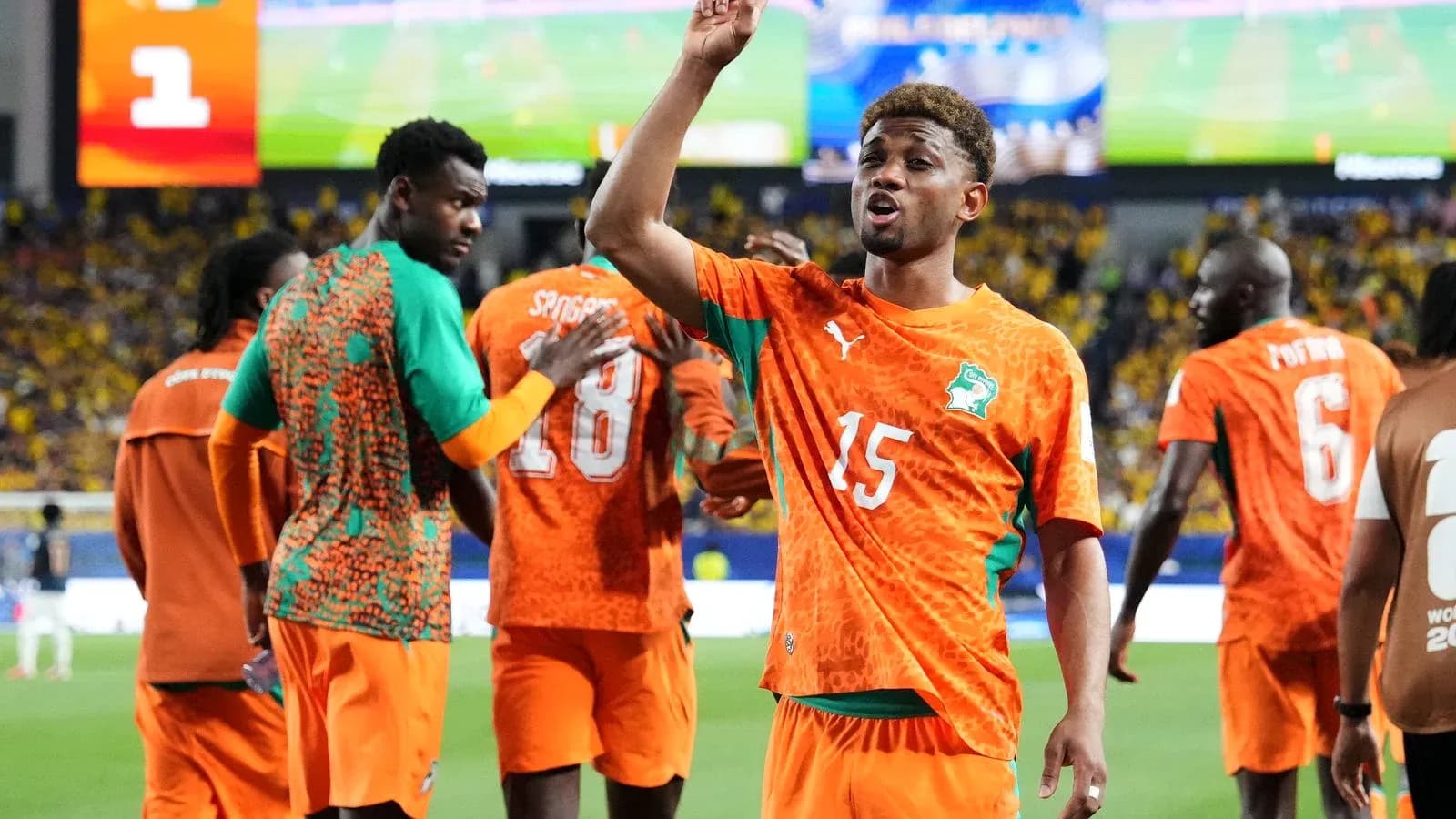
Lincoln Financial Field in Philadelphia hosted a tight, tactical World Cup opener as Ivory Coast edged Ecuador 1–0, a result that instantly reshapes Group E. Following this result, Ivory Coast sit 2nd in the group on 3 points with a goal difference of 1 (1 scored, 0 conceded), while Ecuador are 3rd with 0 points and a goal difference of -1 (0 scored, 1 conceded). It was a match that looked like a mirror on paper — both sides in a 4-4-2, both leaning on athleticism and vertical transitions — but unfolded as a study in control versus chaos.
I. The Big Picture: Two 4-4-2s, one statement win
Emerse Fae doubled down on Ivory Coast’s identity with a classic 4-4-2: Y. Fofana in goal behind a back four of G. Konan, E. Agbadou, W. Singo and G. Doue. The midfield band of four — B. Toure, S. Fofana, F. Kessie and Y. Diomande — was built to compress central spaces and spring the front two, N. Pepe and E. Wahi, into the channels.
Sebastian Beccacece mirrored the shape but not the rhythm. Ecuador’s 4-4-2 had H. Galindez in goal, a back line of P. Hincapie, W. Pacho, J. Ordonez and A. Franco, with A. Minda and J. Yeboah as wide midfielders flanking P. Vite and M. Caicedo. Up front, G. Plata and E. Valencia were tasked with stretching Ivory Coast’s centre-backs and attacking early deliveries.
Across the tournament so far, Ivory Coast’s statistical profile is spartan but sharp: in total this campaign they have played 1 match, winning it 1–0 at home. Their goals-for average at home stands at 1.0, with a goals-against average of 0.0, underlining a clean-sheet, low-margin template. Ecuador, on their travels, have played 1 match and lost 1–0; overall their goals-for average is 0.0, while their goals-against average away is 1.0. The numbers reflect exactly what unfolded in Philadelphia: Ivory Coast were more efficient in the decisive moments, Ecuador more blunt than broken.
II. Tactical Voids and Discipline: Edges in the margins
There were no listed absentees, so both coaches went in with full decks. The real “missing piece” for Ecuador was not personnel but profile: they lacked a true penalty-box predator to convert the half-chances their wide players hinted at.
Disciplinary trends from the early tournament also fed into the narrative. Heading into this game, Ivory Coast’s yellow-card distribution showed a pronounced spike before the interval: 33.33% of their yellows between 16–30 minutes and 66.67% between 31–45 minutes. That early aggression materialised again in the way S. Fofana patrolled midfield, right on the edge. His season data tells the story of his role: 1 yellow card, 1 foul committed, 2 interceptions and 1 blocked shot. He is the fire-starter in Fae’s structure, and his booking risk is a tactical cost Ivory Coast seem willing to pay for front-foot control.
Ecuador, by contrast, tend to flare up later. Their yellow-card map shows 100.00% of their cautions arriving in the 61–75 minute window. It matched the pattern here: as the scoreboard pressure grew, their challenges became more desperate. J. Porozo, already prominent in the disciplinary charts with 1 yellow card and 2 fouls committed in just 28 minutes of action, again symbolised the risk of Ecuador’s reactive defending. Even when he came on from the bench, the defensive line’s composure wavered rather than settled.
III. Key Matchups
Hunter vs Shield: Ivorian attack vs Ecuadorian back line
In the absence of a multi-game scoring sample, the “Hunter vs Shield” battle was embodied less in cumulative numbers and more in individual duels. N. Pepe and E. Wahi continually looked to isolate J. Ordonez and W. Pacho in the inside channels, forcing Ecuador’s centre-backs into uncomfortable foot races rather than aerial battles.
The turning point, though, came from the bench. A. Diallo, already among the competition’s most efficient attackers with 1 goal in 34 minutes, 2 shots on target from 2 attempts, and 5 successful dribbles from 6 attempts, transformed the tempo. His 8.2 rating and 6 duels won out of 8 underline how he functioned as both finisher and ball-carrier. When Diallo [IN] replaced one of the starting forwards, Ivory Coast’s front line shifted from static reference points to a swirling, dribble-heavy threat that Ecuador’s “shield” could not track.
On the other side, Ecuador’s forwards never quite broke Ivory Coast’s defensive shell. E. Agbadou and W. Singo held a compact line, happy to let G. Plata and E. Valencia receive with their backs to goal rather than spinning in behind. With Ecuador’s total goals-for still at 0 this campaign, their “Hunter” unit remains theoretical rather than proven.
Engine Room: Kessie and S. Fofana vs Caicedo and Vite
The central battle was a compelling contrast in styles. For Ivory Coast, F. Kessie and S. Fofana formed a double axis: Kessie as the metronome, F. Fofana as the disruptor. S. Fofana’s 36 passes with 88% accuracy, 1 key pass, 2 interceptions and that single blocked shot highlight a midfielder who both progresses play and snuffs out counters.
For Ecuador, M. Caicedo and P. Vite tried to impose a more possession-oriented rhythm. But without a reliable outlet ahead of them, their passes rarely broke lines with the same conviction. When A. Minda and J. Yeboah did get isolated 1v1s, they were often too far from goal, forced wide by Ivory Coast’s disciplined 4-4-2 block.
The late introduction of creativity from Ecuador’s bench — whether via J. Alcivar, D. Castillo or K. Paez — could not sufficiently tilt the midfield balance. The Ivorian engine room had already set the terms of engagement.
IV. Statistical Prognosis and Tactical Verdict
With xG data absent, the season statistics and match patterns still allow a clear prognosis for both sides as the group unfolds.
Ivory Coast’s blueprint is already visible: at home they have 1 win from 1, scoring exactly 1.0 goal per game and conceding 0.0. Their clean-sheet total stands at 1 in 1 match, and they have yet to fail to score. The combination of a compact 4-4-2, a high-impact bench weapon in A. Diallo, and a physically dominant midfield suggests a team built for knockout football, comfortable in one-goal games.
Ecuador’s numbers are the mirror image: 1 loss on their travels, 0.0 goals-for on average overall, and a goals-against average of 1.0 away. They have failed to score in their only match and have no clean sheets. Yet their defensive structure is not collapsing — a single 1–0 defeat away, with the back four largely intact, hints at a side that is one clinical finisher away from balance.
Following this result, the tactical pressure tilts heavily towards Beccacece. He must either find a way to unlock more from E. Valencia and G. Plata, or turn more quickly to bench options like J. Caicedo, A. Valencia or N. Angulo to add directness and penalty-box presence.
Ivory Coast, meanwhile, can lean into what is already working. Keep S. Fofana’s aggression just below boiling point, continue to unleash A. Diallo as a game-breaking substitute, and preserve the defensive discipline that has delivered a 1–0 home win and a perfect early record. In a World Cup where margins are razor-thin, their ability to turn control into just enough cutting edge may prove decisive as Group E tightens.